
Industrial & Lab pH Meter Buying Guide
Introduction
Looking for a reliable B2B pH meter? Read our industrial and lab pH meter buying guide to pick the right accuracy, electrodes, and PLC outputs without mistakes.
If you need a pH meter for your farm, food workshop, lab, or factory, online specs can be confusing. Prices range from $20 to $2,000. Marketing words like "military grade" are everywhere. It's hard to know what to choose.
This guide is written to save you money and headaches. 60% of this article focuses on practical budget toolkits for small business owners (hydroponics, food workshops, small wastewater).
※ Note: If you need to publish SCI papers, pass FDA audits, or connect to a PLC system, please skip directly to Chapter 3 (Advanced Paths for Research & Engineers).
pH Meter Table of Contents
- Chapter 1: What You Must Know Before Buying a pH Meter
- Chapter 2: Picking a pH Meter for Your Small Business
- Chapter 3: Research & industrial pH meter problems
Before diving into details, use this quick table to find your scenario and the right model. Then read only the chapter you need.
What You Must Know Before Buying a pH Meter
Let’s start with the fastest path to your answer. Answer these 5 yes/no questions – you’ll know exactly which type of pH meter fits your situation.
| Your situation | Recommended model | One‑sentence reason | Approx. price |
| I test clean water, nutrient solution, or tap water on a tight budget, with no audits or papers | Benchtop pH Meter | Under $200, two‑point calibration + automatic temperature compensation – good enough for daily use | $195.88 |
| I need traceable data, pass audits, publish papers – budget is fine | Portable Ion Meter | ±0.002 pH accuracy, GLP storage + USB export – reviewers and auditors accept it | $1,865.79 |
| I need to connect to a PLC, remote monitoring, and auto‑cleaning for industrial use | Digital pH Meter | 4‑20mA + RS485 Modbus, IP66, auto‑cleaning – made for wastewater | $547.89 |
Need a specific configuration or multi-channel integration? Explore our full B2B pH Meter & Controller Catalog to compare all heavy-duty industrial models.
Super simple selection table
Start at Step 1. Answer “Yes” or “No” – then move to the next step as directed.
| Step | Ask yourself this one question | Yes | No |
| 1 | Is my liquid clean water, nutrient solution, or tap water? | Use a regular glass electrode. Go to Step 2 | Go to Step 2 |
| 2 | Is it my liquid yogurt, meat paste, protein solution, or wastewater? | Use a double‑junction electrode. Go to Step 3 | Go to Step 3 |
| 3 | Is my environment humid, splash‑prone, or has acidic fumes? | Choose IP67 or higher. Go to Step 4 | IP65 is enough – go to Step 4 |
| 4 | Do I need to pass an audit, publish a paper, or connect to a PLC? | Go to Chapter 3 (research/industrial part) | Go to Step 5 |
| 5 | Is my budget between $100 and $300? | Buy a portable pH meter (ATC, 2‑point calibration, replaceable electrode) | Adjust the budget or contact us |
Three core specs you must understand about a pH meter
Read these three sections carefully. They will save you from buying the wrong meter.
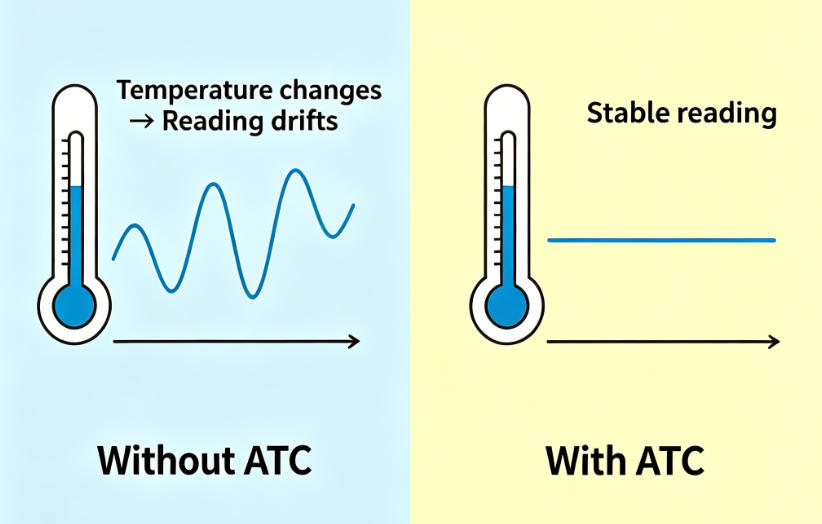
1. Automatic Temperature Compensation (ATC) – the most misunderstood feature
Many people think, "My liquid is at room temperature, so I don't need ATC." Or "Does ATC heat the liquid?"
Truth: pH naturally changes with temperature. The same cup of tap water might read 7.0 at 25°C (room temp) but drift if the temperature changes. ATC does only one thing: it automatically corrects the reading to what it would be at the standard temperature (usually 25°C). It does not heat anything – it just does a math conversion.
If you buy a pH meter without ATC, and your liquid temperature changes by more than 5°C (for example, a greenhouse that goes from morning to evening with a 10°C swing), your readings will drift 0.3 to 0.5 on their own. You'll think your nutrient solution or wastewater is bad, but actually, your meter is lying to you.
Bottom line: If your temperature changes during measurement, you must get a pH meter with ATC. Almost all meters have it now, but double‑check before you buy.
2. At least two‑point calibration – one‑point is almost useless
Many people think, "It was calibrated at the factory, so I can just use it right away." Or "One‑point zeroing is enough."
Truth: Electrodes get "tired" as you use them – their sensitivity slowly drops. One‑point calibration only fixes the zero point, not the slope. Two‑point calibration (usually with pH 4.01 and 7.00 buffer solutions) fixes both the zero and the slope.
If you only do one‑point calibration, your reading for an alkaline solution (like pH 10) might be off by 0.5 or more. You'll think your alkaline solution is too weak. You'll add more and more, but nothing works – the electrode is lying to you.
Bottom line: No matter how cheap the pH meter is, it must have at least two‑point calibration. Ask before you buy.
3. pH Meter Replaceable Electrode – Not a Family Heirloom
Many people think: "I spent good money on this – it should last at least 5 years."
Truth: The electrode contains a reference solution, and the glass membrane ages. With normal use, you'll need to replace it every 6–12 months. In harsh conditions (strong acids, strong bases, high temperature, dirty water), every 3–6 months.
If you buy a one‑piece pen with a non‑replaceable electrode, once the electrode dies, you throw away the whole pen.
Do the math: A $20 pen lasts 6 months, and then it's trash. A $200 portable meter uses $40 replacement electrodes – replace it once and you get another year. Total cost over time is actually lower.
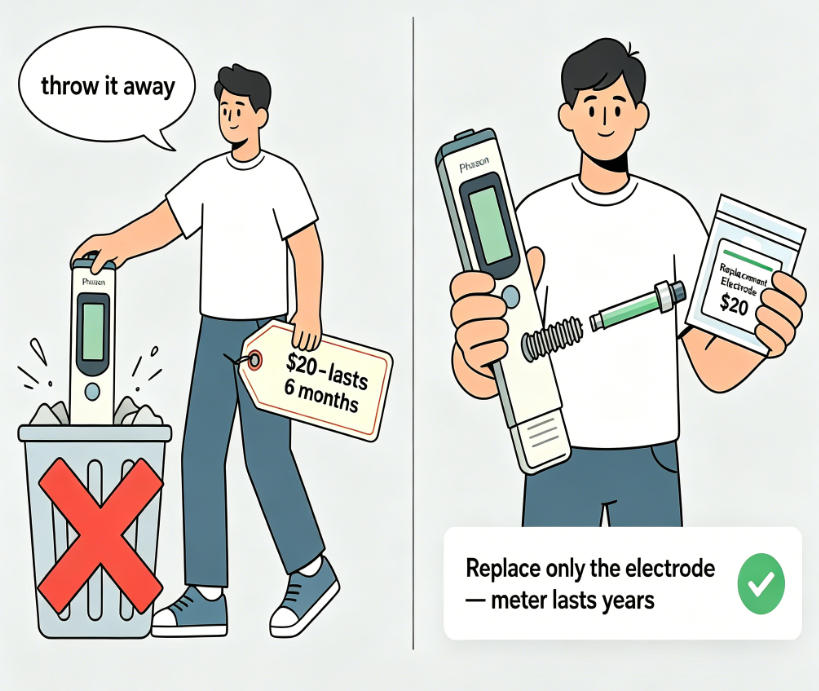
Bottom line: Only buy models with replaceable electrodes. Ask the seller: "Can I buy the electrode separately?"
pH meter electrode types: quick table for your liquid
You don't need to understand all the technical terms. Just find your liquid below.
| Your liquid | Recommended electrode | One‑sentence reason |
| Clean water, nutrient solution, tap water | Regular glass electrode | Cheap and good enough – just calibrate regularly |
| Yogurt, meat paste, protein solution | Double‑junction (or protein‑specific) | Prevents protein from clogging the electrode |
| Wastewater, dirty water, scaling‑prone liquid | Double‑junction + auto‑cleaning (industrial) | Resists fouling, saves maintenance time |
| Semi‑solids (cheese, meat paste, dough) | ISFET solid‑state (no glass) | Won't break, won't clog |
| Very small samples (less than 1 mL) | Micro electrode (tip ≤3 mm) | Measures tiny volumes |
| Organic solvents, oils | Non‑aqueous electrode | Regular glass responds slowly and drifts |
| Strong acids or fluoride‑containing wastewater | Hydrofluoric‑acid‑resistant electrode | Regular glass dissolves in hours |
| High temperature (>80°C) or high pressure (>5 bar) | High‑temp / high‑pressure electrode | Regular electrodes can burst |
Universal rule: No matter which type you use, electrodes are consumables. Replace every 6–12 months (sometimes up to 24 months in ideal lab conditions). Only buy meters with replaceable electrodes – avoid the one‑piece pens.
About calibration certificates – what you really need to know
Some users ask: "Do you include a certificate? If there's a certificate, do I still need to calibrate?" Let's clear this up once and for all.
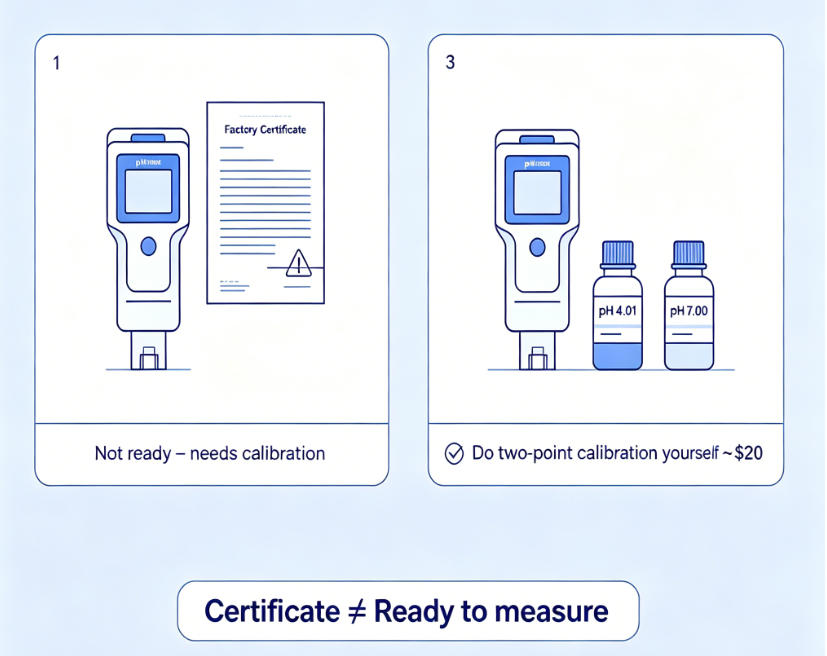
The factory certificate only says that the meter was in spec when it left the factory. It does not replace a field calibration before you use it. Shipping and storage can already cause the electrode to drift.
A third‑party calibration certificate (like CNAS or ISO 17025) is an official report from an independent lab – it has legal value and traceability. Only two types of people really need it: (1) researchers publishing SCI papers, because reviewers will ask for calibration evidence; (2) labs under regulatory audits (pharma, food testing).
If you're a small farm, small food workshop, or small wastewater plant testing pH for daily operations, you don't need a third‑party certificate. Spend $20 on a set of buffer solutions and do a two‑point calibration yourself – that's enough. Don't waste your money.
One‑sentence summary: No matter if you have a certificate or not, the very first thing you do when you get your pH meter is run your own two‑point calibration. A certificate is not a "no‑calibration‑needed" free pass.
How small business owners should pick a pH meter – without wasting money
This chapter is written specifically for small farm owners, small food workshop operators, and people in charge of small wastewater plants. Read it in order – you'll know how much to spend, which type to buy, and the three questions to ask the seller.
Three must‑have pH meter features – confirm before buying
If your meter is missing any of these, skip it and look at the next model.
- Automatic Temperature Compensation (ATC). Without it, if your temperature changes by more than 5°C, the reading will drift on its own, and you'll make wrong decisions.
- Two‑point calibration. One point only? Your alkaline readings could be off by 0.5 or more.
- Replaceable electrode. If the electrode can't be replaced, the whole meter becomes trash after six months – buying a new one costs more in the long run.
Choose an ingress protection (IP) rating based on your environment
Here’s how to choose the right IP rating for your conditions.
Your environment → Recommended IP rating:
- Indoor, clean, dry (e.g., warehouse, occasional testing in an office) → IP65
- Humid, foggy, splash‑prone (e.g., greenhouse, food workshop, outdoor wastewater pond) → IP67 or higher
Why this matters – and a few easy‑to‑miss exceptions.
First, IP ratings do NOT measure resistance to chemical vapors (like acidic fumes). That means an IP67 meter has a good seal, but if it sits for months in an environment with acidic fumes, the circuit board can still corrode. So IP67 handles "water spray" – not "chemical corrosion."
If your workplace has acidic fumes or corrosive gases, don't just look at the IP rating. You also need to check three things: (1) Is the housing made of corrosion‑resistant material (like special PC/ABS or 316 stainless steel)? (2) Are all ports (charging, sensor connection) sealed when in use? (3) Do you need a special protective enclosure for the device?
Second, IP67 gives you a bigger safety margin than IP65. IP65 is for water jets from any direction. IP67 is for temporary immersion up to 1 meter deep. In humid, splash‑prone environments, choose IP67 or higher to be safe – because real‑world spray angles, water quality, and aging seals can make the actual protection lower than the label says.
Third, seals age. Rubber seals and gaskets are consumables. Over time and with repeated plug/unplug cycles, they deform and wear, so the IP rating can drop. Even if you buy an IP67 meter, after one year of use, its real protection might be less. Inspect seals regularly.
Finally, don't ignore the ports. An IP67 meter with its USB charging port or sensor port left open, or with a gap in the BNC connector, will have a system rating as low as IP54 or worse. The seal design of the ports is often more critical than the housing's rating.
Bottom line: In a humid, splash‑prone environment, choose IP67 or higher to be safe. But if acidic fumes are present, IP rating alone is not enough – check the three extra points above. For indoor dry environments, IP65 is fine – don't pay extra for more.
How much should you spend? Which type of pH meter to buy?
Check the table below to compare your options.
| Type | Price range | Recommended? | Explanation |
| Pen‑style | under $20 | No | Most lack ATC, two‑point calibration, and replaceable electrodes. |
| Portable | $100 – $300 | Yes | Has ATC, two‑point calibration, replaceable electrode – good for three years. |
| Online controller | $500+ | Only if needed | Only buy if you need 24/7 automatic monitoring. |
About data logging: Most portable pH meters do not have data export. If you need to keep measurement records (for customer requirements or internal traceability), you have two options. One, increase your budget to $300–800 for a research‑grade meter with USB export. Two, write readings down by hand – many small workshops do this, and it's perfectly legal.
The three‑question method to ask your pH meter seller
Copy these three questions and send them to the seller.
- Can the electrode be replaced separately? If not, don't buy.
- Does it have two‑point calibration? If it only has one point, don't buy.
- Does it have Automatic Temperature Compensation? If not, don't buy.
A real pH meter example model
Take the ATO‑PHM‑AS218 as an example. The price is about $185. It has ATC, IP67 waterproof, and a replaceable electrode. It does not have data export. Accuracy is ±0.05 pH – fine for daily use, but not for research or audits.
| Item | Details |
| Model | ATO-PHM-AS218 (Portable pH Meter) |
| Key Features | ATC, IP67 waterproof, replaceable electrode |
| Accuracy | ±0.05 pH (fine for daily production, but not for research or audits) |
| Approx. Price | Around $185 (excluding shipping and taxes) |
| Main Limitations | No data logging or export; electrode is a consumable (6–12 months in strong acids/bases) |
When should you NOT buy this model? If you need 24/7 automatic monitoring, go look at online controllers. If you need to pass an FDA audit or publish a paper, go look at the research version below.
A few final details to check before you choose
Ask these questions before you buy.
- Connector type: Is it BNC or something more special?
- Cable length: Long enough to reach the bottom of your container?
- Reading: Does it have a HOLD button?
- Auto‑shutdown: Will it turn off in the middle of a measurement?
- Buffer compatibility: Can it use pH 4.01, 7.00, and 10.01?
Small business owner checklist
Print this list and check each box.
Important: If you need to pass an audit or publish a paper, skip the model above and go directly to the research version in Chapter 3.
| □ | Confirmed it has Automatic Temperature Compensation (ATC) |
| □ | Confirmed the electrode is replaceable |
| □ | Confirmed at least two‑point calibration |
| □ | If the environment is humid/splash‑prone, confirmed IP67 or higher |
| □ | If you need data records – confirmed data export, or plan to write by hand |
Answers to uncommon questions
Q: I measure hot water above 80°C. Can I use a regular electrode?
A: No. Regular glass electrodes cannot handle high temperatures. You need a high‑temperature electrode. If you only do it once in a while, you might get away with it, but accuracy will drop.
Q: My liquid is very thick – like sauce or honey. Which electrode should I choose?
A: Choose a double‑junction electrode. Regular single‑junction electrodes clog easily – after a few days, they become inaccurate.
Q: I measure liquids that contain alcohol or oil. Will a regular electrode work?
A: Once in a while, yes – but the reading will drift. If you do it often, you need a non‑aqueous electrode.
Q: Why do some meters say ±0.01 and others say ±0.002? Which one should I believe?
A: ±0.002 can only be achieved under ideal lab conditions: constant temperature, no stirring, a brand new electrode. On a normal bench, assume ±0.01. The ±0.002 number is a lab ideal, not a real‑world.
Q: The seller says, "factory calibrated." Can I use it right away when I get it?
A: No. Shipping and storage cause the electrode to drift. You must do your own two‑point calibration after you receive it.
Research & industrial pH meter problems
This chapter is for graduate students, researchers, people who need to publish SCI papers, as well as field engineers, PLC integrators, and wastewater plant operators. Go to the section that matches your role.
Data or signals not being trusted — the most painful problem
Research pain point: You measured for three months. A reviewer says, "Please provide pH meter calibration records," — and you never exported them. Your paper gets rejected.
Engineering pain point: You connect a 4‑20 mA signal to a PLC on‑site. As soon as a variable frequency drive (VFD) starts, the pH reading jumps wildly. The customer rejects acceptance. You spent two days troubleshooting — the signal was not isolated.
Must‑have specifications:
| Requirement | Research User | Engineering User |
| Accuracy | At least ±0.01 pH. Stability is more important than high accuracy. | At least ±0.01 pH. Stability is more important than high accuracy. |
| Calibration | At least two points (three or more recommended) | At least two points (three or more recommended) |
| Data traceability | GLP storage + USB/RS232 export (timestamps & calibration records) | Not required (PLC/DCS does the logging) |
| Signal reliability | Not required | 4‑20mA isolated output + EMC tested; RS485 Modbus preferred for long distance / multiple probes |
Note for engineers: IEC 61326‑2‑3 is the core EMC standard for industrial pH transmitters.
Two common mistakes:
- Mistake 1: Thinking a factory certificate means no calibration. Wrong — you must calibrate yourself.
- Mistake 2: Thinking non‑isolated is fine. Then a VFD starts, and the reading jumps everywhere.
Handling special or harsh conditions
Research scenario: Yogurt, meat paste, protein solution — regular electrodes clog within days.
Engineering scenario: Wastewater, dirty water, slurry — electrode fouls weekly; acidic fumes corrode the housing.
Must‑have specifications:
| Requirement | Research User | Engineering User | Notes |
| Electrode type | Double‑junction (anti‑clogging for proteins) | Double‑junction (anti‑fouling for wastewater) | Specialized: micro, non‑aqueous, or protein‑resistant / fouling‑resistant, high‑temp, HF‑resistant |
| Environmental protection | Generally not required | IP67 or higher + industrial temp range (-10 to 60°C) | — |
| Auto‑cleaning | Not required | Ultrasonic / scraper / pneumatic — essential for dirty water | — |
In high‑turbidity conditions (e.g., wastewater treatment), suspended particles easily clog the glass membrane and liquid junction — causing drifting or complete failure.
Two common mistakes:
- Mistake 1: Thinking a single‑junction electrode works for everything. For protein or wastewater, it clogs within days.
- Mistake 2: Thinking IP65 is enough. Acidic fumes penetrate more easily than splashing water — IP67 or higher is needed.
Price and maintenance costs — afraid of being told you overpaid
Common principle: Electrodes are consumables. Replace every 6–12 months (up to 24 months in ideal lab conditions). Always include replacement cost in your budget. Don't pay for features you won't use — researchers don't need 4‑20 mA; engineers don't need GLP export.
Budget breakdown by category:
| User Type | Budget Level | What You Get | Extra Notes |
| Research | $300–800 (Entry) | Enough to publish papers and pass basic audits | — |
| Research | $1,800+ (Flagship) | Full GLP features, multi‑channel, ATC | — |
| Research | $200 or less (Teaching) | Student practice only — will not pass any formal audit | — |
| Engineering | $500–2,000 (Complete setup) | Meter + electrode + mounting hardware | — |
| Engineering | (Upgrade) | Auto‑cleaning or ISFET costs more upfront | Saves maintenance labor — if your electrode clogs once a week, pays for itself in six months |
Checklist: whatever you're afraid of — make sure your pH meter has this
Find your worry in the left column, then check that your meter has the feature on the right.
| What you're afraid of | Must‑have feature |
| The reviewer asks for calibration records / auditor wants traceability | GLP storage + USB export + three‑point calibration |
| Reading jumps when VFD starts | 4‑20mA isolated output + EMC tested |
| Protein or wastewater clogs the electrode | Double‑junction reference electrode |
| High humidity on site — equipment fails often | IP67 housing + industrial temperature range |
| Too much maintenance (industrial) | Auto‑cleaning |
| Special sample can't be measured (research) | Specialized electrode (micro, non‑aqueous, or protein‑resistant) |
Quick comparison: flagship pH meter vs. budget pH meter
Short on time? Here's the bottom line.
| Feature | Flagship | Budget |
| Best for | Papers, FDA audits, high accuracy | Teaching demos, general water, tight budget |
| Accuracy | ±0.002 pH | ±0.01 pH |
| Calibration points | Up to 8 (auto‑recognized) | 2‑point manual |
| Data storage | 1000 GLP sets (timestamp & calibration records) | None or very few |
| Data export | USB 2.0 export | Manual copy |
| Reference price | $1,865.79 | $195.88 |
| One sentence | If you have funding and need to pass audits — don't overthink it. | Not suitable for papers or FDA audits. |
One last honest sentence
Whether you're a small farm owner, a graduate student, or a field engineer, the core of a pH meter is never about "expensive vs. cheap." It's about "right vs. wrong."
For small business owners: Don't buy the $20 pen, and don't buy the $2,000 research meter. A $100–300 portable meter with ATC, two‑point calibration, and a replaceable electrode will serve you well for three years.
For research and industrial customers: Match the meter to your audit requirements, sample types, and site environment. Spend your money on the electrode and traceability – not on features you will never use.
Still not sure how to choose? Send us your liquid type, environment, and budget – for example, "measure yogurt, indoors, budget $200" –, and we will recommend specific models.
About us
After reading the above, you should have a good idea what kind of pH meter you need. But if you're still uncertain, or you want us to directly recommend specific models, just tell us three things:
- What is your liquid type? (e.g., clean water, yogurt, wastewater, protein solution)
- What is your environment? (indoor, outdoor, humid, high temperature, etc.)
- What is your approximate budget in USD?
Send us these three pieces of information, and we will recommend one or two models that best fit your needs. Our recommendations are not tied to any brand – we only go by your actual requirements.
If you'd like to see the product categories we supply, visit our website at ato.com. If you find our advice valuable, feel free to contact us. If you don't trust intermediaries, you can take our recommended models and buy them elsewhere – our advice is always free. Have questions? Leave us a message. We reply quickly.