
Conductivity Sensor
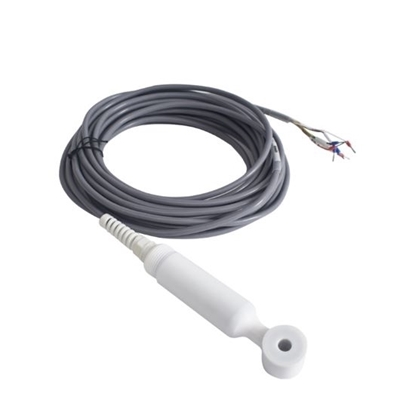
Inductive Conductivity Sensor, 0~2000ms/cm, 4-20mA/RS485
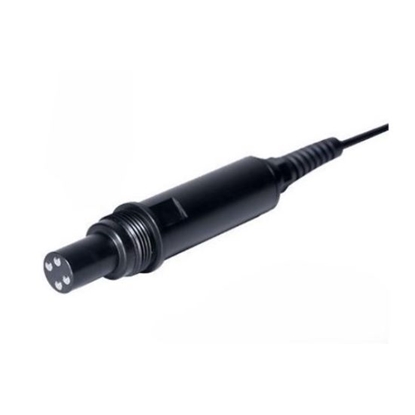
4 Electrode Electrical Conductivity (EC) Sensor, 0.1~500ms/cm
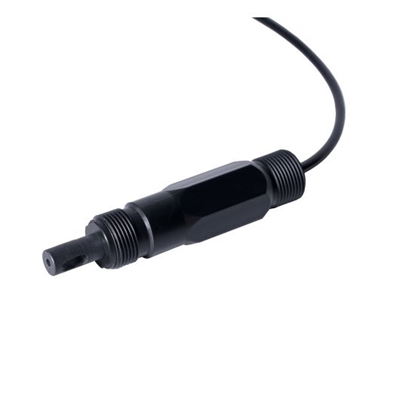
2 Electrode Electrical Conductivity (EC) Sensor, 0-9999μs/cm
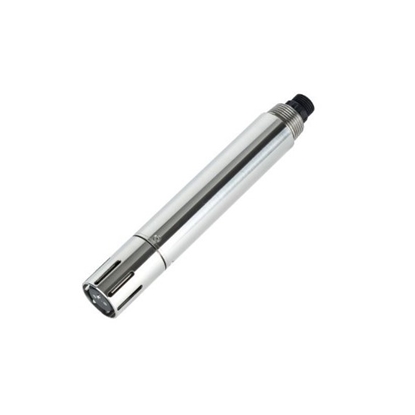
Inline Conductivity Sensor/Probe for Liquid, 0~5000μs/cm
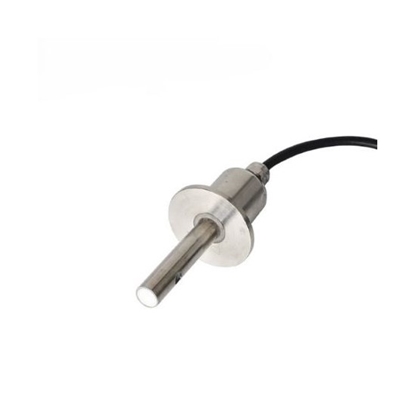
High Temperature Conductivity Sensor, 0~130℃, 0~2000μs/cm
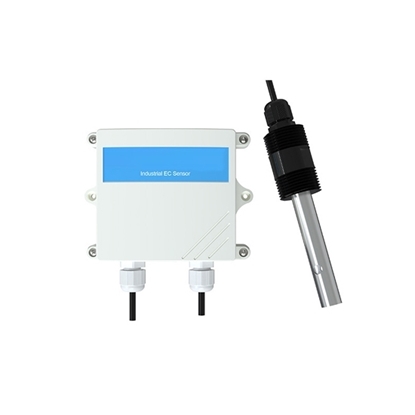
Industrial EC Sensor, RS485/4-20mA/0-5V/0-10V
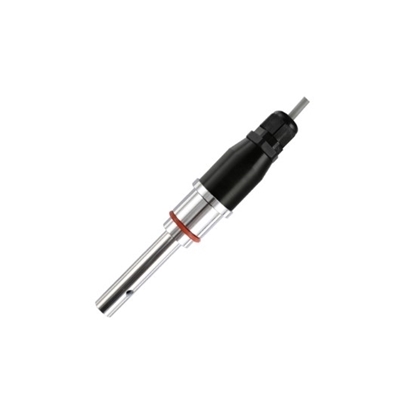
Contacting Conductivity Sensor/Probe for Water, 0~2000μs/cm
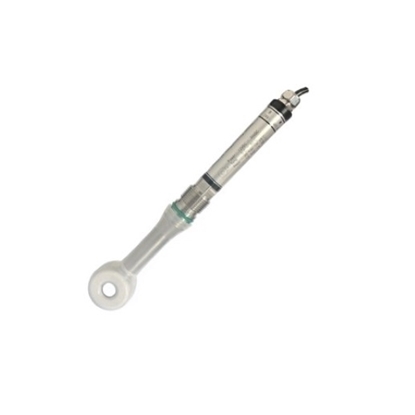
Sanitary Toroidal Conductivity Sensor, 1~2000ms/cm
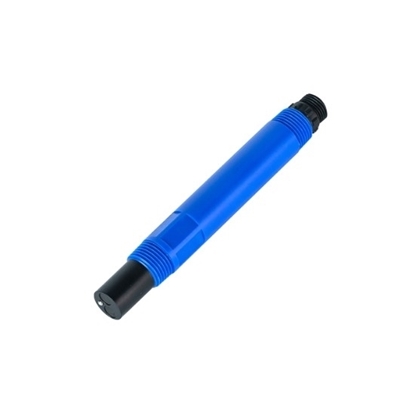
Wireless Conductivity Sensor, 0~5000μs/cm
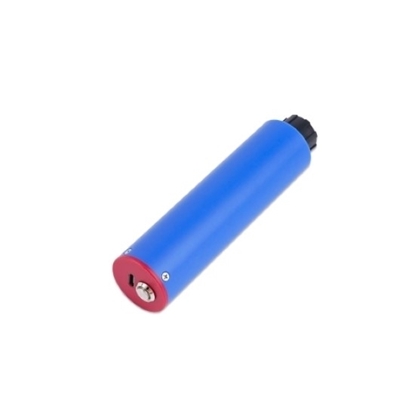
Bluetooth Wireless Transmission Module for Conductivity Sensor
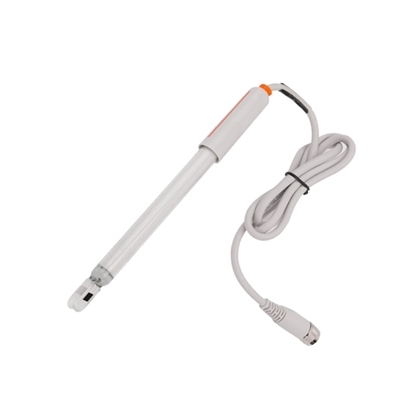
Portable Laboratory Conductivity Sensor, 2~20000μs/cm
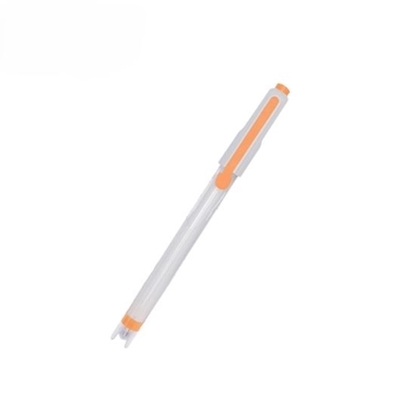
pH and Conductivity Sensor with Composite Electrode, 0-14pH
Conductivity is defined as the ability of a solution to conduct electric current, typically expressed in μS/cm or mS/cm. Accurately monitoring ion concentrations—such as salts, acids, and minerals—is vital for ensuring fluid quality and process safety across modern industrial systems. Designed for high-precision, real-time online monitoring, ATO industrial conductivity sensors deliver reliable performance across water treatment, chemical processing, and diverse industrial process control applications.
How to Choose a Conductivity Sensor
Choosing a conductivity sensor requires matching three factors:
- Liquid conductivity range Ultrapure/RO water needs a low cell constant such as K=0.01. Seawater or wastewater needs a higher K or an inductive design.
- Sensor cell constant (K) See the Selection Guide table below.
- Output communication method 4-20mA for a single-point PLC connection. RS485 Modbus for multi-sensor networks or multi-parameter (EC/TDS/temperature) readouts.
Conductivity Sensor Selection Guide
Price is also a factor: these sensor architectures range from about $195 for a basic low-conductivity probe to nearly $2,926 for a premium inductive model — see exact pricing by type in the table below.
| Sensor Architecture | Cell Constant (K) | Measuring Range | Target Medium | Recommended Model | Typical Price |
| Ultrapure/Pure Water Probe | 0.01 | 0.01 ~ 20 μS/cm | RO Water, Power Plants & Laboratories | ATO-CS-SUS01 | $195.08 |
| General Industrial Probe | 1.0 | 0 ~ 9999 μS/cm (up to 70 mS/cm) | Tap Water & Cooling Towers | ATO-CS-CON625D | $302.62 |
| High Concentration Probe | 10.0 | 0.1 ~ 500 mS/cm | Wastewater & Chemical Processing | ATO-CS-CON630D | $616.46 |
| Inductive Toroidal Probe | N/A | 1 ~ 2000 mS/cm | Seawater, Sludge & Concentrated Acids | ATO-CS-DNFA-5 | $2,925.84 |
Selection Tip (Decision Logic): As a rule of thumb, use a lower cell constant (K) for low-ion liquids (e.g., ultrapure water, K=0.01 or 0.1) to ensure high sensitivity, and a higher cell constant for ion-rich liquids (e.g., seawater or wastewater, K=10.0) to prevent electrode polarization and signal saturation.
Types of Conductivity Sensors
Conductivity sensors are classified into three main types based on measurement method: contacting, 4-electrode, and inductive (toroidal). In short: contacting sensors suit low-to-medium conductivity liquids under about 2,000 μS/cm but foul in dirty media; 4-electrode sensors extend that range while resisting polarization; inductive sensors handle high-conductivity, corrosive, or scaling liquids without any electrode contact.
| Type | Measurement Method | Best For | Limitation |
| Contacting | Two or more metal electrodes in direct contact with the liquid | Pure water, RO systems | Susceptible to polarization and fouling in dirty liquids |
| 4-Electrode | Additional electrode pair reduces polarization and cable resistance errors | Medium-to-high conductivity liquids such as industrial wastewater | More complex construction |
| Inductive (Toroidal) | Non-contact magnetic coil design | High-conductivity, corrosive, or scaling liquids such as seawater and chemical solutions | Higher cost |
Conductivity Sensor vs. Transmitter vs. Meter/Analyzer
A conductivity sensor is the sensing element only — it detects conductivity and outputs a signal (4-20mA or RS485). A conductivity transmitter converts and communicates that signal digitally or as analog output. A conductivity meter is the standalone instrument that displays and analyzes the reading, typically via LCD or controller.
| Device | Function | Output |
| Conductivity Sensor | Detects conductivity | 4-20mA / RS485 |
| Conductivity Transmitter | Converts sensor signal and communicates it | Digital / analog |
| Conductivity Meter | Displays and analyzes conductivity | LCD / controller |
Conductivity Sensor Selection by Application
Matching the sensor architecture to your liquid environment is the final step after checking cell constant and output type. The table below maps common industrial scenarios to the recommended sensor type and a representative ATO model.
| Application Scenario | Key Requirements | Recommended Architecture | Featured ATO Model |
| Pure Water & Semiconductor Rinse | Detect trace ionic leakage below 20 μS/cm | Contacting sensor, K=0.01 | ATO-CS-SUS01 |
| Food, Beverage & Pharmaceutical CIP | Withstand repeated sterilization up to 130°C | Inductive (toroidal) sensor, PEEK/PFA body | ATO-CS-DNFA-5 |
| Agriculture & Hydroponic Nutrient Monitoring | Real-time EC tracking with simple wiring | Wireless or portable probe | ATO-CS-306 |
| Wastewater & Chemical Processing | Resist scaling and electrode fouling in concentrated acids | 4-electrode sensor | ATO-CS-CON630D |
Pure Water & Semiconductor Rinse
Ultrapure and RO water contains very few ions, so a contacting sensor with a low cell constant (K=0.01) is needed to detect conductivity changes as small as 0.01 μS/cm. The ATO-CS-SUS01 covers a 0.01–20 μS/cm range, suited to power plant makeup water and semiconductor rinse lines.
Food, Beverage & Pharmaceutical CIP
Clean-in-place (CIP) cycles expose sensors to repeated high-temperature sterilization. An inductive toroidal sensor with a PEEK or PFA body has no exposed electrodes, so it withstands sterilization cycles up to 130°C without the signal drift that contacting sensors can experience under thermal cycling.
Agriculture & Hydroponic Nutrient Monitoring
Nutrient solution monitoring typically needs a compact, easy-to-install probe rather than a fixed pipeline installation. A wireless or portable EC probe, such as the ATO-CS-306, allows real-time nutrient tracking without running signal cable to a controller.
Wastewater & Chemical Processing
Wastewater and concentrated chemical streams carry a high ion load and particulate content, which causes fouling on standard two-electrode designs. A 4-electrode sensor adds a second electrode pair to correct for polarization and cable resistance error, extending reliable operation into scaling or heavily contaminated media. The ATO-CS-CON630D covers 0.1–500 mS/cm for this range.
Tips for Installing Conductivity Sensor
For reliable data and a longer sensor lifespan, follow these three essential engineering rules:
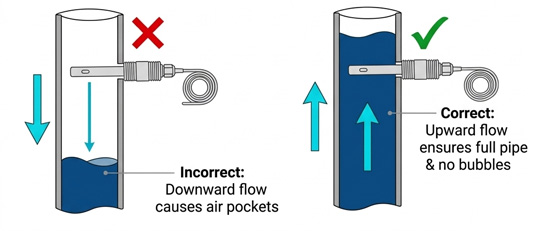
Rule 1: Always Upward Flow
Install the sensor in a vertical pipe section with upward flow. This ensures the pipe is always full and flushes out air bubbles that cause erratic readings.
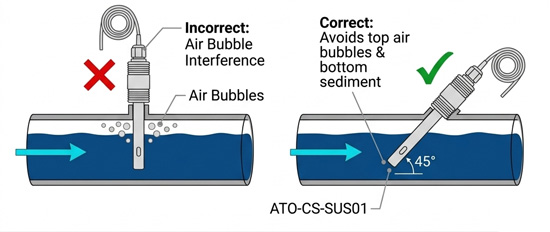
Rule 2: The 45° Mounting Rule.
On horizontal pipes, mount the probe at a 45° angle. This prevents air bubbles from insulating the electrodes at the top and keeps sediment from burying the sensor at the bottom.
Rule 3: Avoid the 'Wall Effect' (2cm Minimum Clearance)
Maintain at least 2cm of clearance between the sensor and the pipe wall to prevent the pipe material from interfering with the electrical field. For Inductive sensors, ensure the probe is centered; proximity to metal walls can distort the magnetic field, leading to a 3-5% measurement error.
Frequently Asked Questions
The following FAQs address common questions about selecting, installing, and maintaining inductive conductivity sensors.
Q: When is an Inductive Conductivity Sensor better than a contacting model?
A: Choose inductive sensors for "dirty," scaling, or highly corrosive liquids. Their non-contact design prevents the electrode "poisoning" and degradation common in harsh chemical processes.
Q: Can ATO Conductivity Sensors measure TDS and Salinity directly?
A: Yes. ATO digital conductivity sensors are designed with built-in conversion algorithms. These conductivity sensors support real-time output of TDS (mg/L) and Salinity (PSU/PPT) via RS485 Modbus-RTU, eliminating the need for manual calculation or external conversion tables.
Q: Can pipe materials interfere with Inductive Sensor accuracy?
A: Yes. Since inductive technology uses magnetic fields, metal pipes can cause interference. Ensure at least 2cm of clearance between the probe and the wall for precise readings.
Q: How often should I calibrate my Inductive Conductivity Sensor?
A: For chemical or wastewater use, we recommend a monthly check. While inductive models resist fouling better than contacting probes, regular verification ensures accuracy in aggressive media.
