
What is a Conductivity Sensor?
A conductivity sensor is a device that measures how well a liquid conducts electricity by detecting dissolved ions. Higher ion concentrations produce higher conductivity readings. These sensors are widely used in water treatment, chemical processing, pharmaceutical manufacturing, and industrial process control.
Contents:
- What Is a Conductivity Sensor?
- How Does a Conductivity Sensor Work?
- What Are the Different Types of Conductivity Sensors?
- What Is a Conductivity Sensor Used For?
- What Affects Conductivity Sensor Accuracy?
- How Do I Choose the Right Conductivity Sensor?
- Conductivity Sensor vs pH Sensor vs TDS Meter: What's the Difference?
- Conductivity Sensor FAQs
What Is a Conductivity Sensor?
A conductivity sensor is a device that measures a liquid's ability to conduct electricity by detecting dissolved ions such as salts, minerals, and acids. It is widely used for water quality monitoring, chemical processing, pharmaceutical manufacturing, and industrial process control.
Conductivity is expressed in μS/cm (microsiemens per centimeter) or mS/cm (millisiemens per centimeter). The more dissolved ions a liquid contains, the higher its conductivity reading.
How Does a Conductivity Sensor Work?
A conductivity sensor works by applying an electrical signal to the liquid and measuring how that signal changes — the exact method depends on whether the sensor uses direct electrode contact or a non-contact magnetic design, both covered below.
Basic Working Principle of Conductivity Measurement
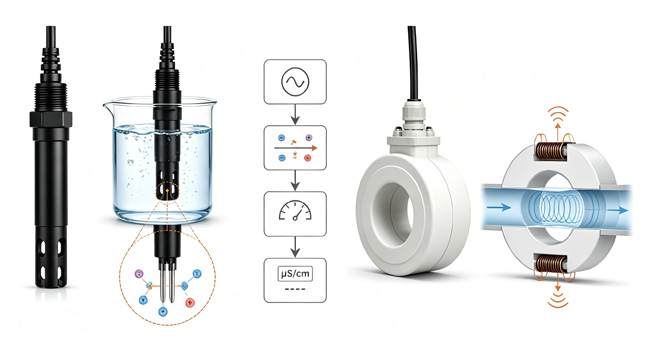
In simple terms, a conductivity sensor applies an electrical signal to a liquid and measures how easily dissolved ions carry current. More ions create higher conductivity.
Technically, this is based on Ohm's Law (I = V/R):
- The sensor applies an alternating voltage (V) to its electrodes
- The resulting current (I) flowing through the ions is measured
- From V and I, the sensor calculates the liquid's resistance (R)
- The reciprocal of resistance is conductance (G)
- Conductance is multiplied by the sensor's Cell Constant (K) to produce the final conductivity value (EC)
The cell constant is a fixed geometric factor of the electrode design. Matching K to the liquid being measured is a key selection decision (see Section 6).
How Does a Contacting (Electrode) Conductivity Sensor Work?
A contacting conductivity sensor uses two or more metal electrodes in direct contact with the liquid. Current passes directly through the liquid between electrodes.
- Best for: low-conductivity liquids such as pure water and RO (reverse osmosis) systems
- Limitation: prone to polarization and electrode fouling in dirty or high-ion liquids
How Does an Inductive Conductivity Sensor Work?
An inductive (toroidal) conductivity sensor uses two magnetic coils instead of electrodes. One coil induces a current in the liquid; the second detects it. There is no direct electrode contact with the liquid.
- Best for: high-conductivity, corrosive, or scaling liquids such as seawater, wastewater, and concentrated chemicals
- Advantage: not affected by electrode fouling or polarization
What Are the Different Types of Conductivity Sensors?
Conductivity sensors fall into two main categories based on measurement method: contacting and inductive (toroidal). Contacting sensors are further divided into 2-electrode and 4-electrode designs.
What Is a 2-Electrode Conductivity Sensor?
A 2-electrode conductivity sensor uses two metal electrodes in direct contact with the liquid to measure conductivity.
- Typical range: low to medium conductivity (e.g., 0–9999 μS/cm)
- Best for: pure water, distilled water, laboratory use
- Limitation: accuracy drops at higher ion concentrations due to polarization
What Is a 4-Electrode Conductivity Sensor?
A 4-electrode conductivity sensor is a contacting sensor with an added electrode pair that reduces polarization and cable resistance errors found in 2-electrode designs. A typical 4-electrode conductivity sensor covers a wide range suitable for demanding industrial fluids.
- Typical range: medium to high conductivity (e.g., 0.1–500 mS/cm)
- Best for: industrial wastewater, chemical fluids, seawater
- Advantage: more stable readings at higher concentrations than 2-electrode designs
What Is an Inductive (Toroidal) Conductivity Sensor?
An inductive conductivity sensor measures conductivity using a non-contact magnetic coil design, with no electrodes touching the liquid.
- Typical range: high conductivity (e.g., 0–2000 mS/cm)
- Best for: sewage, slurry, concentrated acids, sanitary/CIP processes
- Advantage: resistant to fouling, scaling, and corrosion
What Is a Conductivity Sensor Used For?
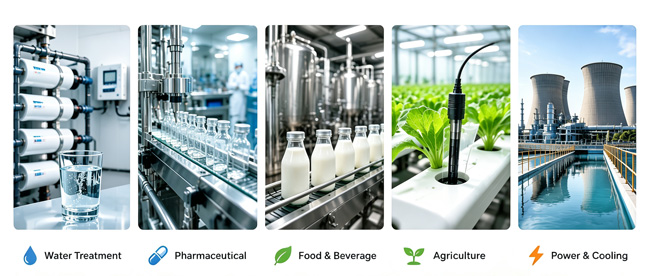
Conductivity sensors are mainly used to monitor water purity, chemical concentration, and process conditions across water treatment, pharmaceutical, food processing, and chemical manufacturing industries.
- Pure water & semiconductor manufacturing — detecting trace ionic leakage in RO/DI systems (requires a low cell constant, e.g., K=0.01, for high sensitivity)
- Food, beverage & pharmaceutical processing — monitoring CIP (clean-in-place) cycles and high-temperature sterilization; a sanitary toroidal conductivity sensor is commonly used here since it withstands repeated sterilization up to 130°C without electrode contact
- Agriculture & hydroponics — real-time nutrient solution monitoring, often via wireless or portable sensors
- Chemical processing & wastewater treatment — measuring concentrated acids and heavy-scaling liquids
- Power plants & cooling towers — monitoring boiler feedwater and cooling water quality, typically using industrial-grade conductivity sensors with 4-20mA or RS485 output for continuous online monitoring
What Affects Conductivity Sensor Accuracy?
Conductivity readings can be affected by several factors, including temperature, calibration, electrode material, and installation conditions — covered in detail below.
Temperature Compensation
Conductivity typically changes by about 2% per °C for many aqueous solutions, though the exact value depends on the solution's chemistry. Automatic Temperature Compensation (ATC) normalizes readings to a 25°C reference point so results stay comparable regardless of the liquid's actual temperature.
Calibration
Conductivity sensors require periodic calibration against a known reference solution. Calibration frequency depends on the application, required accuracy, and the risk of fouling or drift — sensors used in aggressive chemical or wastewater environments typically need more frequent checks than those in cleaner processes.
Electrode Material
Electrode or probe material affects corrosion resistance and long-term stability. Common materials include stainless steel, titanium, platinum, and PTFE/PEEK housings for corrosive or high-temperature environments.
Installation Conditions
Proper installation helps prevent air bubbles, sediment buildup, and wall interference — all of which distort readings:
- Upward flow: install in a vertical pipe section with upward flow to keep the pipe full and flush out air bubbles
- 45° mounting on horizontal pipes: prevents air bubbles from insulating electrodes at the top and sediment from burying the sensor at the bottom
- Minimum wall clearance (around 2cm): prevents the pipe material from interfering with the sensor's electrical or magnetic field; for inductive sensors, proximity to metal walls can distort readings
How Do I Choose the Right Conductivity Sensor?
The most important factor when selecting a conductivity sensor is matching its measuring range and cell constant (K) to the conductivity of the liquid.
Measurement Range
| Cell Constant (K) | Measuring Range | Target Medium |
| 0.01 | 0.05–20 μS/cm | Ultrapure water, power plants |
| 0.1 | 0.5–200 μS/cm | Distilled water, laboratories |
| 1.0 | 1.0–2000 μS/cm | Tap water, cooling towers |
| 10.0 | 10 μS–200 mS/cm | Seawater, chemical fluids |
| N/A (inductive) | 0–1000 mS/cm | Sewage, slurry, concentrated acids |
Rule of thumb: use a lower K for low-ion liquids to maximize sensitivity, and a higher K for ion-rich liquids to prevent electrode polarization and signal saturation.
Sensor Type
- 2-electrode → low-conductivity, clean liquids
- 4-electrode → medium-to-high conductivity, industrial fluids
- Inductive/toroidal → high-conductivity, corrosive, or scaling liquids
Material Compatibility
Check the chemical compatibility and temperature rating of the electrode/housing material against the target liquid — especially for CIP sterilization cycles or corrosive chemical exposure.
Output Signal
Common output options: 4-20mA (direct PLC integration), RS485 Modbus-RTU (digital, long-distance transmission), and 0-5V/0-10V analog. RS485 typically carries EC, TDS, and temperature data over a single signal line.
Conductivity Sensor vs pH Sensor vs TDS Meter: What's the Difference?
These three devices are often confused because they're all used for liquid quality monitoring, but each measures a different property, as shown below.
| Device | What It Measures | Typical Unit |
| Conductivity sensor | Ionic conductivity of a solution | μS/cm, mS/cm |
| pH sensor | Acidity or alkalinity of a solution | pH (0–14) |
| TDS meter | Estimated total dissolved solids, calculated from conductivity | mg/L, ppm |
A TDS meter does not measure a separate physical property — it converts a conductivity reading into an estimated dissolved-solids value using a conversion factor. A conductivity sensor and a conductivity meter refer to the same underlying measurement principle; "sensor" typically refers to the probe/electrode, while "meter" refers to the full instrument with a display.
Conductivity Sensor FAQs
Q1: What does a conductivity sensor measure?
A: It measures a liquid's ability to conduct electrical current, which corresponds to the concentration of dissolved ions such as salts, acids, and minerals.
Q2:What is the difference between 2-electrode and 4-electrode sensors?
A: 2-electrode sensors suit low-conductivity liquids like pure water; 4-electrode sensors add a second electrode pair to reduce polarization errors, making them suitable for medium-to-high conductivity liquids like wastewater.
Q3: Is a conductivity sensor the same as a conductivity meter?
A: They share the same measurement principle. A sensor typically refers to the probe/electrode, while a meter refers to the complete instrument with a display and calibration controls.
Q4: Can a conductivity sensor be used in seawater or high-salinity liquids?
A: Yes. High-concentration liquids like seawater require a higher cell constant (K=10.0) or an inductive/toroidal sensor to avoid electrode polarization and signal saturation.
Q5: Can a conductivity sensor measure TDS?
A: Yes. Many digital conductivity sensors include built-in conversion algorithms that output TDS (mg/L) and salinity (PSU/PPT) directly, alongside the conductivity reading.
If you're ready to select a sensor for your application, browse the full range at the ATO automation store.
