
Water Turbine Selection Guide
Selection of water turbine is an important task in the design of hydropower plant, and whether this problem is solved correctly or not has an important influence on the investment, construction speed, power generation and the amount of expected output of the hydropower plant, as well as on the degree of utilization of water energy resources during the whole period of operation, and the economy and flexibility of the operation of the hydropower plant and its generator.
According to the scale of the hydroelectric power plant and its role and status in the power system, the selection of methods and procedures vary in the degree of simplicity, ATO industrial automation have concluded several ways for you to choose a water turbine correctly, usually in accordance with the following procedures.
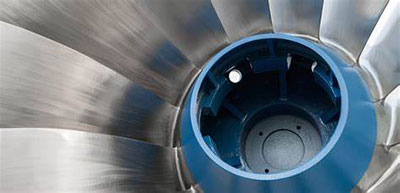
Procedures for Water Turbine Selection
Analysis and approval of the original information
Selection of the original information is based on the selection of the basic basis for calculation and known conditions. Should be assembled or the original information provided by the relevant departments for the necessary analysis and verification. Selection experience shows that often found in the calibration of information data have a bias towards large or small two tendencies, which will produce unrealistic results on the selection, resulting in water resources can not be fully utilized or can not meet the selection requirements.
Development of alternatives
Develop multiple feasible solutions based on head, flow, power demand, and operational conditions. Compare different water turbine types, unit sizes, and arrangement modes. Consider water turbine performance, adaptability, and maintenance requirements for each option.
Estimated economic indicators
Estimates of the program estimates the corresponding economic indicators (mainly refers to the investment and operating costs) and kinetic energy indicators (mainly the maximum output of the hydropower plant, the highest efficiency and average annual power generation).
Kinetic energy economic analysis and comparison
Evaluate and compare alternatives in terms of water turbine energy output and economy. Calculate key indicators such as annual power generation, water turbine efficiency, initial investment, and operational costs. Incorporate both quantitative metrics and qualitative factors like water turbine reliability and environmental impact.
Optimal program detailed calculation and review
Perform detailed validation for the preferred water turbine alternative, including hydraulic design, strength analysis, and anti-cavitation checks. Simulate various operating conditions to ensure water turbine safety and stability. Organize results into a professional water turbine selection report and submit for expert review and approval.
Methods of Water Turbine Selection
- Selection of water turbine by applying statistical data
This method is based on the statistical data of constructed hydropower stations, through collecting and counting the basic parameters of water turbines of domestic and foreign constructed hydropower stations, and then analyzing and categorizing them according to the parameters of turbine type, applied head, and capacity of a single machine. On this basis, the relationship curves between specific rotational speed of water turbine, unit parameter and applied head, and the relationship curve between cavitation coefficient and specific rotational speed of the power station are made by mathematical statistics, or the empirical formulas of these parameters are made by numerical approximation method. - Selection of water turbine according to the series of turbine type spectrums
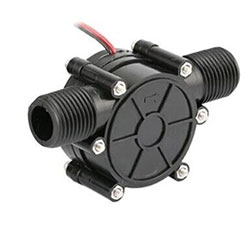
In some countries, the water turbine equipment has been serialized, generalized and standardized, and a water turbine type spectrum has been formulated to configure one or several kinds of water turbine runners for each head section, and the basic parameters of each type of water turbine and the comprehensive characteristic curve of the model have been obtained through the model test. In this way, the model selector can choose the model and parameters of water turbine according to the water turbine type spectrum and model comprehensive characteristic curve. - Selection of water turbine by application method
This method is to directly apply the water turbine type and parameters of the built power station which are similar to the basic parameters (head and installed capacity) of the proposed power station. This method is mostly used in the selection of small hydropower stations, which can make the selection work greatly simplified. However, it should be noted that it must be applied reasonably, and the parameters of the proposed power station and the built power station should be analyzed and compared in detail, and the differences in the selection and manufacturing level of water turbines in different years should also be considered. - Selection of water turbine by rotational speed ratio method
In the preliminary selection, it is also a common method to select the main parameters of water turbine by specific rotational speed. Since the specific rotational speed includes the three basic working parameters of rotational speed, output and head of the water turbine, it comprehensively reflects the characteristics of the water turbine. Although the specific speed is not a dimensionless parameter in the form of expression, it has the characteristic of dimensionless number. The advantage of selecting the turbine according to the specific speed is that it is not limited by the runner corresponding to the head section in the turbine model spectrum.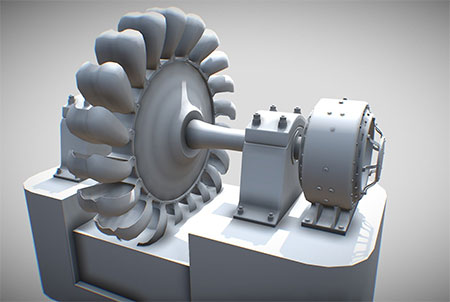
Basic Requirements for Water Turbine Selection
- Operational Stability and Reliability: The selected water turbine should be stable and reliable in operation, offer good maneuverability, possess excellent anti-cavitation performance, and operate without excessive vibration or noise.
- Short Construction Period: The construction period should be as short as possible. The selected equipment must account for the possibility of low-head operation during the initial water storage period of the reservoir, which is especially critical for hydropower stations with large reservoirs.
- Realistic Supply and Technical Compatibility: The selected unit should be realistically supplied, and the proposed technical requirements must align with the manufacturing plant’s capabilities in selection, testing, and production.
- Adaptability to Special Natural Conditions: The unit should be capable of adapting to special natural conditions. For example, water turbines operating in sandy rivers should feature abrasion and wear-resistant structures, while overflow components should offer corrosion resistance in corrosive rivers or marine environments.
- Compatibility with Computerized Monitoring: Equipment selection should support the requirements of computerized monitoring and unmanned operation in hydropower plants.
In addition to the above requirements, there is another crucial point: The technical characteristics of the water turbine shall be suitable for the hydrogeology and water resources of the power station, and meet the requirements of the power system composition and hub layout for the water turbine, so as to ensure sufficient rated output and high operating efficiency.
The maximum efficiency of recent large water turbine selection should be more than 94%, the average efficiency of expected operation should be more than 88%, and the maximum output guaranteed should be more than 115% of the rated capacity of the synchronous generator, so as to have a large reserve of output.
The above general principles in specific issues may be in conflict, at this time you should be based on the specific circumstances to seize the main contradictions reasonable selection.
