
What is a Foam Cutter?
A foam cutter is a specialized tool designed to cut and shape foam materials using heat, mechanical blades, or laser technology. Unlike standard utility knives, foam cutters deliver clean, precise edges without crushing or tearing the material.
They are used across industries including construction, packaging, automotive manufacturing, advertising, and model making.
This guide explains how foam cutters work, the different machine types available, compatible foam materials, common applications, selection criteria, safety considerations, and maintenance requirements.
Contents:
- How Do Foam Cutters Work?
- Technical Specifications and Material Compatibility
- What Types of Foam Cutters Are There?
- Foam Cutter Applications
- How to Choose a Foam Cutter?
- Safety Precautions for Operating a Foam Cutter
- How to Maintain a Foam Cutter
- Frequently Asked Questions
How Do Foam Cutters Work?
A foam cutter works by applying either thermal energy to melt through foam or high-speed mechanical force to slice through it. The method used depends on the foam material's density and the required cutting accuracy.
1. Hot Wire Cutting
Uses a nichrome wire heated to approximately 500–550°C (depending on wire resistance and machine configuration) to melt through foam without generating dust or debris. Best suited for EPS and XPS foams used in insulation panels and architectural models.
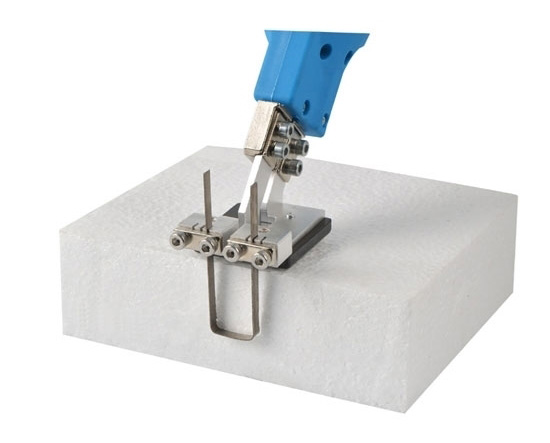
For manual shaping work, an electric foam cutter with a 150mm blade and 16-step temperature control can cut materials up to 15 cm thick with minimal effort.
2. Mechanical Blade Cutting
Uses high-speed blades at up to 3,200 RPM to cut dense foams without heat or fumes. Preferred for PU and PE foams, and the go-to choice when ventilation conditions are limited.
3. Laser Foam Cutting
Directs a focused beam along a digitally programmed path, achieving tolerances as low as ±0.1 mm under controlled industrial conditions. Top choice for aerospace parts, precision prototypes, and complex industrial components.
Technical Specifications and Material Compatibility
Matching the cutting method to the foam type is critical. A mismatch can result in rough edges, excessive melting, or equipment damage.
| Cutting Method | Best For | Precision Tolerance | Ventilation Required |
| Hot Wire | EPS, XPS, insulation panels, general fabrication | ±0.5 mm | Yes |
| Blade | Dense foam, PU foam, contour cushion cutting | ±1 mm | No |
| Laser | Complex geometries, prototypes, high-tolerance parts | ±0.1 mm | Yes |
Foam Material Guide
- EPS (Expanded Polystyrene) — Density: 10–50 kg/m³. Best processed with hot wire cutters. Common uses: packaging inserts, display props, architectural models.
- XPS (Extruded Polystyrene) — Density: 25–50 kg/m³. Highly compatible with hot wire cutting. Primary use: building insulation panels.
- PU (Polyurethane) Foam — Density: 20–100 kg/m³. Requires mechanical blades or oscillating cutters. Common uses: upholstery, automotive seating.
- PE (Polyethylene) Foam — Density: 15–60 kg/m³. Best cut with mechanical blades. Primary use: shock-absorbing protective packaging.
- PVC (Polyvinyl Chloride) Foam — Density: 40–200 kg/m³. Requires a laser cutter or rigid carbide blade. Common uses: marine and aerospace components.
Materials You Must Not Cut
Chlorinated foams and phenolic foams must never be processed with thermal tools because they release toxic gases when heated.
Hard materials such as metal, wood, rigid plastic, glass, or stone will damage or destroy the cutting elements.
What Types of Foam Cutters Are There?
Foam cutting machines are categorized into three main types based on production volume, required precision, and budget.
| Machine Type | Max Thickness | Precision | Best For | Price (USD) |
| Manual Foam Cutter | Up to 300 mm | ±0.5–1 mm | Small crafts, cosplay props, RC models | $50–$500 |
| Semi-Automatic Cutter | Up to 1,000 mm | ±0.3–0.8 mm | Batch production, packaging, signage | $500–$3,000 |
| CNC Foam Cutter | Up to 2,000 mm | ±0.1–0.5 mm | D shapes, industrial parts | $3,000–$20,000+ |
Specialized Cutting Systems
- Ring Wire Cutters — Use a continuous loop wire to produce clean circular and curved profiles.
- Contour Cutters — Equipped with a rotating cutting head to carve irregular shapes and complex block profiles.
- Oscillating Blade Cutters — Use a high-frequency vibrating knife to slice through soft, flexible PU and PE foams without compressing the material.
- Multi-Wire Cutters — Deploy multiple hot wires simultaneously to increase production output by 3x to 10x compared to single-wire systems.
Foam Cutter Applications
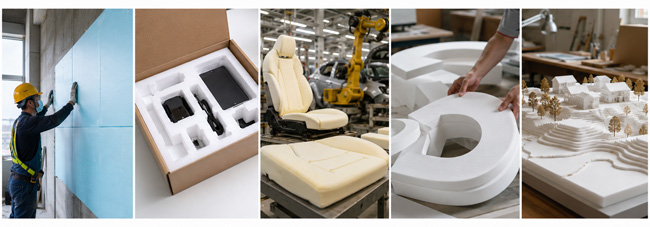
Foam cutters are used across five major industries, with the choice of cutting method varying by material type, production volume, and environmental conditions.
Construction and Architectural Fabrication
Used to cut XPS and EPS insulation panels for walls, roofs, and foundations, as well as decorative moldings and concrete formwork molds.
Hot wire cutters are preferred for EPS panels in high-volume projects because they produce smooth, post-processing-free edges — eliminating finishing time and reducing labor cost.
Protective and Cold-Chain Packaging
Used to cut custom PE and PU foam inserts that protect electronics, medical devices, and artwork during shipping, as well as thermal liners for transporting perishable food and pharmaceuticals.
Industrial Manufacturing and Engineering
Used to shape automotive foam cores, dashboard cushioning, and vehicle seating. In aerospace and marine sectors, these machines fabricate buoyancy structures, hull cores, and aerodynamic test models.
In workshop environments, blade-based systems are sometimes chosen over hot wire alternatives when ventilation is limited, since mechanical cutting produces no fumes.
Advertising and Display Signage
Used to produce lightweight 3D lettering, company logos, exhibition stands, and large-scale event backdrops.
Model Making and Creative Industries
Used by architects to build scale models and topographical maps, and by film and theater productions to create props, scenic backdrops, and cosplay armor.
How to Choose a Foam Cutter?
Selecting the right foam cutter depends on five factors: foam material type, required cutting thickness, precision tolerance, production volume, and available budget.
For Hobbyists and DIY Users ($50–$500)
Choose a manual hot wire foam cutter. These compact tools are ideal for personal crafting, cosplay props, and low-volume model building.
Look for adjustable temperature control and a comfortable grip for extended use.
For Workshops and Small Businesses ($500–$3,000)
Choose a semi-automatic foam cutting machine. This configuration offers higher throughput for standard packaging inserts and insulation panels without requiring CNC programming.
For businesses that regularly cut thick upholstery or custom cushions, a heavy-duty electric foam rubber cutter saw with variable speed control and low vibration is recommended.
For Industrial Factories and Mass Production ($3,000–$20,000+)
Choose an automated CNC foam cutter. This system supports high-volume production runs, complex 3D shapes, and tight engineering tolerances for automotive and aerospace components.
Note that CNC foam cutters require operator training and are not recommended for unskilled users due to the programming complexity involved in setup and calibration.
Safety Precautions for Operating a Foam Cutter
Foam cutting safety practices generally follow industrial ventilation and material handling guidelines used in manufacturing environments, particularly when processing thermoplastic foams that may release hazardous fumes under heat.
Ensure Adequate Ventilation
Thermal cutting of PVC and PU foam releases hazardous gases, including hydrogen chloride and isocyanates. Always operate thermal cutters in a well-ventilated space and wear a respirator rated for chemical fumes.
Hot wire cutting is not suitable for PVC foam in enclosed environments. In those cases, blade-based or laser cutting is a safer alternative.
Wear Appropriate Personal Protective Equipment (PPE)
Operators must wear safety glasses to guard against flying debris and heat-resistant gloves to prevent burns from hot wires or blades.
Implement Fire Safety Protocols
Keep an ABC-rated fire extinguisher and a working smoke detector near the machine workspace. Store all flammable materials at least 1 meter from the equipment.
Maintain Constant Supervision
Never leave a running foam cutter unattended. If a fire starts or the machine behaves abnormally, immediately cut the main electrical power supply.
How to Maintain a Foam Cutter
- Clean After Every Use
Remove all loose foam debris and dust from the cutting surface and guide rails after each session. Accumulated material creates fire hazards and can cause mechanical binding. - Perform Weekly Wire Checks
Inspect the hot wire for correct tension and physical condition. Replace stretched or nicked wires immediately — loose wires reduce cutting accuracy, and over-tightened wires are prone to breaking. - Apply Monthly Lubrication
Lubricate the mechanical guide rails and lead screws with appropriate machine oil. Clear accumulated dust from electric motors and control panels at the same interval. - Conduct Quarterly Electrical Inspections
Check all wiring insulation, power cables, safety limit switches, and emergency stop buttons to confirm correct functionality and identify wear before it becomes a hazard. - Schedule Annual Recalibration
Perform a comprehensive mechanical inspection, execute precision calibration, and replace worn drive components. Regular annual servicing can extend the equipment's working life by 3 to 5 years
Frequently Asked Questions
Below are the most common questions about foam cutters and how they work, use, and safety considerations.
Q1: Can a foam cutter cut wood?
A: No, a foam cutter cannot cut wood. These machines are engineered exclusively for low-density foam materials; attempting to cut wood, metal, or rigid plastic will break the blades or burn out the hot wires.
Q2: How hot does a hot wire foam cutter get?
A: A hot wire foam cutter typically operates between approximately 500°C and 550°C (932°F to 1,022°F), depending on wire resistance and machine configuration. The nichrome wire reaches this temperature within seconds of receiving power.
Q3: Is cutting foam with a hot wire toxic?
A: Yes, cutting certain foams with a hot wire can release toxic fumes. Heated PVC foam generates hydrogen chloride gas, and PU foam can release harmful isocyanates, making proper room ventilation and respiratory protection mandatory.
Q4: What is the best foam cutter for EPS and XPS?
A: The best tool for cutting EPS and XPS is a hot wire foam cutter. Because these materials melt at precise temperatures, a hot wire delivers a perfectly smooth edge with zero dust, crumbs, or structural debris.
Q5: Can I cut thick foam with a regular knife?
A: You can cut thin foam with a regular knife, but cutting thick foam results in jagged, uneven edges and static-filled debris. A dedicated foam cutter uses heat or specialized blades to maintain a clean, uniform edge across any thickness.
Foam cutters provide precise, rapid, and low-waste material processing across commercial and creative applications. Selecting the ideal foam cutting system depends on your specific material type, required dimensional tolerances, production volume, and machinery budget. Following the safety and maintenance guidelines outlined in this guide ensures that your foam cutting machine from ATO Industrial Automation delivers reliable performance for years.
