
What is a Force Gauge Used for?
In many industrial and R&D scenarios, we not only need to know how heavy an object is, but also care more about how much force it is subjected to. At this time, the force gauge has become an indispensable measuring tool. This article will guide you through what a force gauge is, its working principle, common applications, and key points for selection.
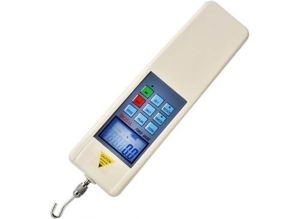
What is a Force gauge?
A force gauge, also known as a push-pull force gauge, is an instrument used to measure the force acting on an object. It can measure tension, pressure/compression force, and even peel force etc. The force in motion or at rest can be read by converting it into an electrical signal or mechanical indication.
ATO's force gauge product line covers digital and mechanical models ranging from a few newtons (N) to thousands of kilonewtons (kN), meeting a wide range of requirements from precise detection to heavy-load testing.
Working Principle of Force Gauge
The principles of different types of force gauges vary slightly, but the common ones include the following categories:
- Strain gauge type: The most common digital force gauge. When a force acts on structural components, it causes them to deform. Strain gauges detect the deformation changes and convert the strain into resistance changes. The bridge circuit outputs a voltage signal, which is then processed, amplified, and digitized by electronic circuits. Finally, the reading is displayed.
- Mechanical spring/pointer force gauge: It uses the deformation of the spring under force to drive the mechanical pointer to indicate the force value. It has a simple structure and does not require a power supply, but its functions are relatively limited.
- Hydraulic/Pneumatic force gauge: It converts the force into pressure through the principle of pressure transmission by liquid or gas, and then reads it from the pressure gauge. Suitable for occasions where the maximum force value is measured.
Regardless of the type, when installing, it is necessary to ensure that the force direction is aligned with the gauge's measurement axis to avoid errors introduced by lateral forces or eccentric loads.
Common Applications of Force Gauge
Force gauges have a wide range of applications and play an important role in various industries.
- Industrial manufacturing and quality inspection: In industrial manufacturing and quality inspection processes, force gauges are used to test the insertion and extraction forces of buttons and plugs, the pressing pressure of buttons, and the lifespan of keys. These measurements ensure the consistency and reliability of the product's hand feel, providing a quality basis for mass production.
- Material testing field: Force gauges can perform tensile, compressive, peeling, bending, and other experiments, helping researchers obtain key mechanical parameters such as the ultimate strength, elastic modulus, and ductility of materials. This is of vital importance in the research and development of new materials and structural analysis.
- Electronics and precision manufacturing industry: In the fields of electronics and precision manufacturing, force gauges are used to detect PCB insertion force, spring compression force, and battery insertion and extraction force. With micro-Newton-level high resolution, consistency, and quality control during the high-precision assembly process are ensured.
- The automotive and aviation industries: In high-stress environments, force gauges are used for tensile testing of seat belts, force detection of components, and fatigue monitoring of structures. By real-time monitoring of the force state, the structural safety and operational reliability of vehicles and aviation components are ensured.
- Medical devices and rehabilitation equipment: Force gauges are widely used in pressure detection of medical equipment, operation force monitoring of surgical instruments, and measurement of joint or hand strength in rehabilitation training, ensuring the safety and durability of the equipment in medical scenarios.
In all the above-mentioned fields, force gauges help engineers precisely quantify the magnitude, direction, and time-varying waveform of force, providing crucial data support for product design optimization, structural reliability analysis, and quality control.
How to Choose a Force Gauge: 6 Key Points
To obtain stable and accurate measurement results, the following key points should be noted when purchasing and using:
- Select the appropriate range: It is generally recommended to use the gauge within the range of 20% to 80% of its rated range to achieve the best accuracy and avoid overload damage. (GR Metrology)
- Pay attention to the range resolution and accuracy: The higher the resolution, the finer the reading; the higher the precision, the smaller the measurement error. For micro-force measurement, it is recommended to choose a high-resolution model.
- Force direction/axial alignment: When measuring, the force must be along the measurement axis of the gauge to avoid eccentric loading or lateral force, as this will significantly affect the accuracy. (GR Metrology)
- Data interface and storage capacity: If it is necessary to record and analyze the fluctuations of force over time for a long period, the model with a communication interface (USB, RS-232) and an internal storage function should be selected.
- Calibration and verification: Regular calibration is the key to ensuring long-term accuracy. It is generally recommended to calibrate once a year or immediately after the equipment is impacted or overloaded. (blog.dmsystemsgroup.co.uk)
- Environmental adaptability: Choose dust-proof, water-proof, temperature-resistant, and anti-interference designs according to the usage environment. Gauges that are sensitive to humidity, vibration, and shock should be specially protected.
Summary
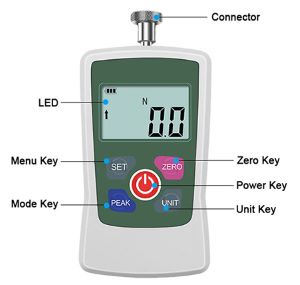
Whether you are engaged in product design, material testing, quality inspection, or process calibration, force gauges are powerful tools for measuring "force". ATO's force gauge product line is renowned for its multi-range, high precision, ease of use, and rich interfaces, capable of meeting various measurement requirements from light loads to heavy loads, and from laboratories to production lines.
When selecting a model, the key points are range matching, accuracy requirements, environmental adaptability, and whether it has storage and communication functions. Mastering the correct usage habits and calibration methods can make your measurement data more reliable, stable, and traceable.
We look forward to your application of this force gauge in future testing projects, providing strong data support for your products and research.
