
What is Battery Indicator?
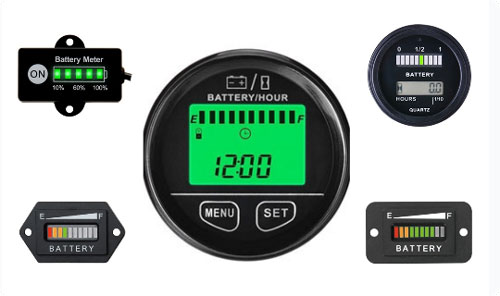
In battery-powered equipment, knowing the battery status is essential for maintaining continuous and reliable operation. A battery indicator serves as a visual monitoring component that gives users a convenient way to check battery conditions during everyday use. It is widely incorporated into electric vehicles, golf carts, forklifts, RVs, portable equipment, and industrial systems where battery status needs to be monitored regularly.
Contents:
- Introduction
- Working Principle
- Types of Battery Indicators
- LED vs. LCD Battery Indicator: Which One Should You Choose
- Key Benefits
- Conclusion
Introduction
A battery indicator is a device designed to monitor and display the remaining power in a battery, power supply, or other energy systems. By detecting changes in voltage, current, or capacity, it translates the operating condition of the power source into clear and intuitive information, such as numerical values, percentage levels, or LED status lights. This allows users to quickly determine whether sufficient power is available for continued operation.
By providing real-time feedback, battery level indicator help prevent unexpected shutdowns caused by low charge levels, support proper charging management, and facilitate routine battery maintenance. Consequently, they contribute to improved system reliability, operational efficiency, and overall safety.
Working Principle
Although designs may vary, most battery gauge operate through a sequence of detection, processing, and display. The basic steps are as follows:
- Power Activation: Upon connection, the battery charge indicator draws a small amount of power from the battery to activate its internal circuit.
- Voltage Detection: The device continuously monitors the battery’s terminal voltage in real time.
- Signal Processing: The voltage signal is filtered for stability and converted from analog to digital using an internal microcontroller.
- Data Comparison:The digital voltage value is compared against preset reference ranges corresponding to different charge levels.
- Capacity Estimation: Based on this comparison, the system calculates the battery’s remaining charge.
- Visual Display Output: The remaining battery level is presented via LED bars, indicator lights, or an LCD screen, updating continuously during operation.
Types of Battery Indicators
Battery indicators can be categorized according to their display type, which determines how battery status is presented to the user. Different display technologies offer distinct advantages depending on the application, accuracy requirements, and ease of use. The two most common display types are LCD display and LED display.
1.LCD Display Battery Indicator
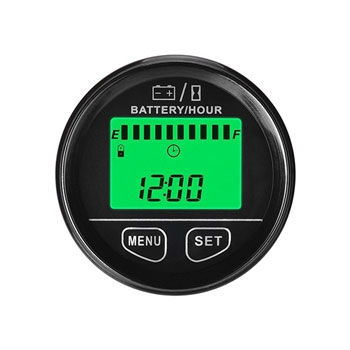
LCD battery indicators provide precise readings of battery voltage, remaining charge, and sometimes operational time. Many feature backlighting for easy visibility in low-light conditions.
Example: The ATO LCD display battery indicator stands out for its LCD display, which is one of its most useful features: it uses a green-backlit liquid crystal screen to show real-time battery level percentages, actual voltage readings, and a built-in clock, all in clear numeric form instead of simple LEDs. This makes it much easier to see detailed battery information at a glance, even in low-light conditions, and also supports visual alerts for high/low voltage, a cumulative hour meter, and configurable maintenance reminders, all presented on the LCD for precise and intuitive monitoring during use.
2.LED Display Battery Indicator
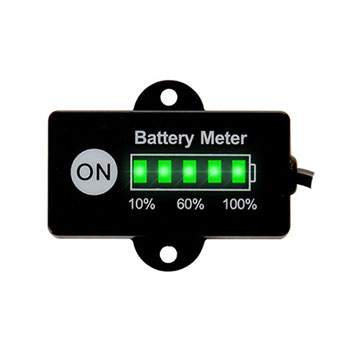
LED indicators are simple and cost-effective, using a series of lights to represent battery levels. Color coding (green, yellow, red) or bar-style LEDs provides an intuitive visual cue. While less precise than LCDs, they are easy to read at a glance.
Example: The ATO LED display battery indicator features a clear and intuitive LED-based display that shows your battery’s remaining charge by illuminating five LED lights, each representing a portion of the battery’s capacity; when you power it on, the indicator automatically detects the system voltage and instantly lights up the LEDs to reflect the current charge level, making it easy to visually monitor battery status at a glance without needing any complex setup, ideal for golf carts, RVs, forklifts, and other vehicles powered by Lead Acid, LiFePO₄, or LiCoO₂ batteries.
LED vs. LCD Battery Indicator: Which One Should You Choose?
LED and LCD battery indicators are both designed to provide a quick view of battery status. The main difference is the display technology and how the information is presented. Comparing their basic features can help you choose a suitable battery indicator for your application.
| Feature | LED Battery Indicator | LCD Battery Indicator |
| Display Type | LED display | LCD display |
| Readability | Easy to read at a glance | Clear and easy to read |
| Power Consumption | Low | Low |
| Size | Compact | Compact to medium |
| Best For | Quick battery status checks | Clear battery status monitoring |
| Typical Applications | Golf carts, forklifts, RVs, electric vehicles | Golf carts, forklifts, RVs, electric vehicles |
Quick Selection Guide:
Choose an LED battery indicator if you need a simple and easy-to-read display for checking battery status at a glance;
Choose an LCD battery indicator if you prefer a clear display for battery status monitoring.
Both LED and LCD battery indicators can provide a convenient way to monitor battery status. The right choice depends mainly on the display type, available installation space, and the specific requirements of your application.
Key Benefits
Using a battery indicator provides more than just a visual display of charge level, it also plays a critical role in improving battery management, system reliability, and long-term operational efficiency. The key benefits include:
- Enhanced Monitoring: Users can track remaining power and plan usage effectively.
- Battery Protection: The small battery indicator prevents over-discharge and reduces battery stress, extending lifespan.
- Simplified Maintenance: Quick checks for charging or replacement reduce operational interruptions.
- Operational Consistency: The battery level indicator helps different operators follow the same battery management standards.
- Cost Savings: Timely maintenance and early detection of issues reduce premature battery failure.
Conclusion
In summary, a battery indicator is an essential tool for monitoring battery status. By converting voltage and other electrical signals into intuitive displays, it enables users to track remaining power, protect battery health, and maintain reliable system operation. Providing real-time feedback, supporting timely maintenance, and reducing the risk of unexpected shutdowns, battery indicators enhance efficiency and extend battery lifespan across applications such as electric vehicles, solar energy systems, and industrial equipment. They are, therefore, a critical component of effective battery management. For reliable battery monitoring solutions, ATO One-stop Automation Shop offers a wide range of high-quality battery indicators and automation products.
