
What is the Fiber Optic Sensor?
A fiber optic sensor is a type of sensing device that uses light transmitted through optical fibers to measure physical changes such as displacement, pressure, temperature, or the presence of objects. It works by detecting variations in light intensity, phase, or wavelength caused by external environmental changes. Fiber optic sensors are widely used in industrial automation, electronics manufacturing, packaging machinery, robotics, and precision detection systems, where high accuracy and resistance to electromagnetic interference are required.
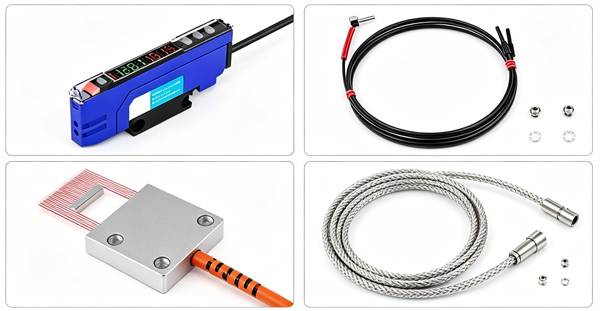
Table of Contents
- Components of a Fiber Optic Sensor
- How Does a Fiber Optic Sensor Work
- Types of Fiber Optic Sensors
- Advantages of Fiber Optic Sensors
- Limitations of Fiber Optic Sensors
- Fiber Optic Sensor vs Photoelectric Sensor
- How to Choose the Right Fiber Optic Sensor
- Conclusion
- FAQ
Components of a Fiber Optic Sensor
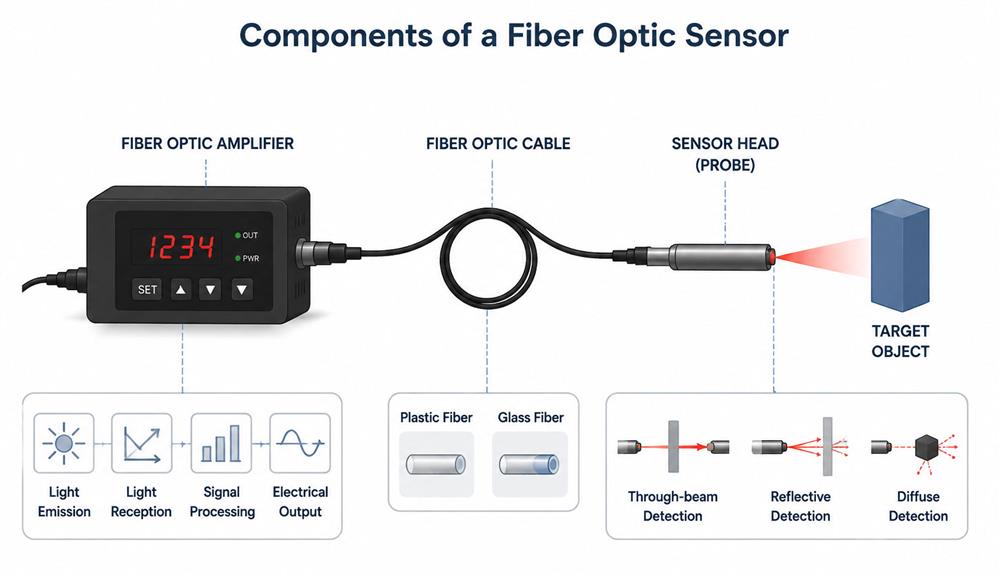
A fiber optic sensor system consists of three core components: fiber optic cable, fiber optic amplifier, and sensor head that work together to transmit light signals, detect optical variations, and convert them into electrical outputs for high-precision object detection.
Fiber Optic Cable
The fiber optic cable is responsible for transmitting light between the amplifier and the sensing head. It serves as the communication medium of the system. It can be made of plastic or glass depending on the required sensing distance, flexibility, and environmental conditions.
- Plastic fiber: flexible, suitable for short-distance detection
- Glass fiber: higher precision, suitable for long-distance or harsh environments
Fiber Optic Amplifier
The fiber optic amplifier acts as the central processing unit of the system. It manages the generation, reception, and conversion of optical signals.
Main functions include:
- Emitting stable light signals into the fiber
- Receiving reflected or transmitted light
- Detecting changes in light intensity or pattern
- Converting optical signals into electrical output signals
It serves as the control core of the sensing system and connects directly to industrial automation equipment such as PLCs.
Sensor Head (Probe)
The sensor head is the detection terminal of the system. It is installed at the sensing location and directly interacts with the target object. Different probe structures are designed for various environments such as confined spaces, high-temperature areas, or reflective surfaces.
It determines how the light interacts with the target, including:
- Through-beam detection
- Reflective detection
- Diffuse detection
How Does a Fiber Optic Sensor Work
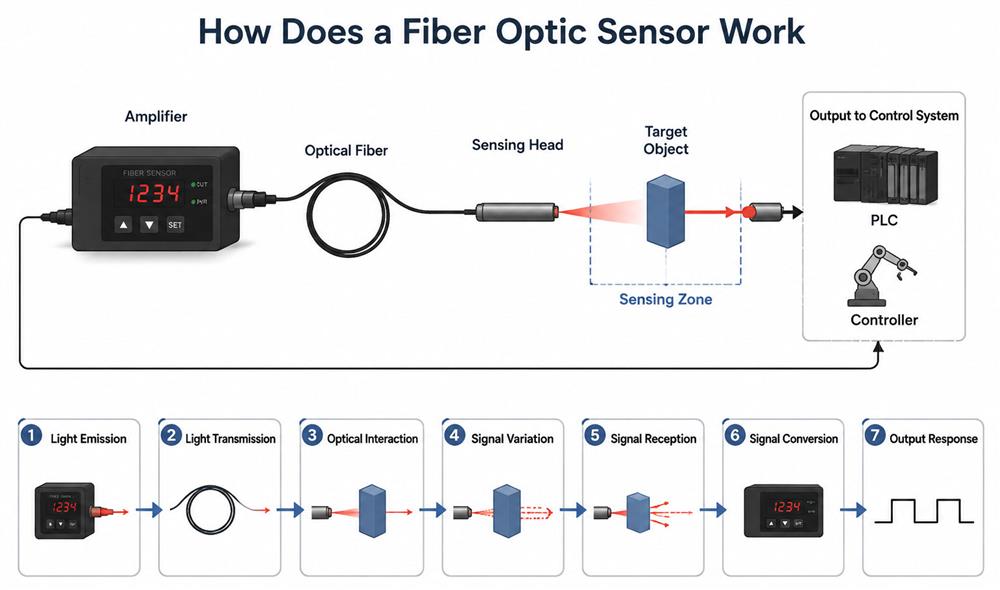
A fiber optic sensor works by transmitting light from an amplifier through optical fibers to a sensing head, where the light interacts with a target object. The sensor detects changes in the transmitted or reflected light caused by the presence, position, or movement of the object. When a target enters the sensing zone, it may block, reflect, or scatter the light signal. These changes alter the light intensity received by the optical receiver. The amplifier then converts these optical variations into electrical output signals that can be processed by industrial control systems such as PLCs, controllers, or automation equipment.
Working Process
- Light Emission: The amplifier generates and emits a stable light signal into the optical fiber.
- Light Transmission: The light travels through the fiber to the sensing head with minimal loss.
- Optical Interaction: The light reaches the detection zone and interacts with the target object.
- Signal Variation: The presence of the object causes the light to be blocked, reflected, or scattered.
- Signal Reception: The receiver detects changes in light intensity or pattern.
- Signal Conversion: The amplifier converts optical changes into electrical output signals.
- Output Response: The system triggers an output for industrial control or automation tasks.
This design enables highly accurate detection in confined or hard-to-reach spaces, as the optical fiber is extremely thin, flexible, and immune to electromagnetic interference, allowing stable operation in harsh industrial environments.
Types of Fiber Optic Sensors
Fiber optic sensors can be classified based on their optical detection principle and light propagation structure. The three main types are through-beam, reflective, and diffuse reflective fiber optic sensors. Each type is designed for different detection distances, installation conditions, and industrial applications.
Through-Beam Fiber Optic Sensor
A through-beam fiber optic sensor consists of a separate transmitter and receiver installed opposite each other. Detection occurs when an object interrupts the light beam between the two ends.
Features:
- Long detection distance with high stability
- Strong resistance to electromagnetic interference (EMI)
- High precision for fast-moving object detection
- Excellent for small object detection in high-speed environments
Applications:
- Conveyor belt systems
- Packaging production lines
- High-speed counting systems
- Industrial sorting equipment
Reflective Fiber Optic Sensor
In reflective fiber optic sensors, the transmitter and receiver are integrated into a single unit. Detection is based on light reflected from the target surface.
Features:
- Compact and integrated structure
- Easy installation with reduced wiring complexity
- Medium detection range
- Suitable for space-limited applications
Applications:
- Object presence detection
- Positioning systems
- Automated assembly lines
- Industrial equipment monitoring
Diffuse Reflective Fiber Optic Sensor
Diffuse reflective sensors detect objects by receiving light reflected directly from the target surface, without requiring a separate reflector.
Features:
- No external reflector required
- Simple and flexible installation
- Suitable for irregular or moving surfaces
- Well-suited for compact automation systems
Applications:
- Product detection in automation lines
- Material handling systems
- Online inspection processes
- Presence/absence detection in confined spaces
After understanding the three main types of fiber optic sensors, the following table provides a clear comparison to help quickly evaluate their key differences and typical applications.
| Type | Detection Method | Structure | Detection Range | Typical Applications |
| Through-Beam | Light beam interruption | Separate transmitter & receiver | Long distance | Conveyors, high-speed counting |
| Reflective | Target surface reflection | Integrated unit | Medium range | Positioning, assembly lines |
| Diffuse Reflective | Direct surface reflection | Integrated, no reflector needed | Short range | Product detection, presence sensing |
Advantages of Fiber Optic Sensors
Fiber optic sensors offer a range of unique advantages derived from their optical signal transmission principle, making them especially effective in environments requiring high precision, strong electromagnetic interference resistance, and compact installation.
- Ultra-Compact Sensing Head: Extremely small sensing head allows installation in tight or confined spaces, suitable for compact machinery and precision equipment.
- Flexible and Easy Installation: Optical fiber can be bent and routed through complex structures without performance loss, enabling flexible system design.
- High Precision for Small Object Detection: High detection accuracy for small or delicate objects, widely used in stable and precise object recognition applications.
- Fast Response for High-Speed Automation: Very short response time enables accurate detection of fast-moving objects in high-speed production lines.
- Excellent Performance in Harsh Environments: Reliable operation in high temperature, dust, vibration, and moisture conditions, suitable for demanding industrial applications.
- Strong Resistance to Electromagnetic Interference (EMI): Uses optical signals instead of electrical signals, ensuring immunity to EMI and stable operation in noisy industrial environments.
Limitations of Fiber Optic Sensors
Despite its excellent performance in industrial applications, fiber optic sensors also have certain inherent limitations related to their optical structure and system configuration that should be considered in practical use.
- Higher system cost: Compared to standard photoelectric sensors, fiber optic sensor systems generally have higher overall cost due to additional components such as amplifiers and fiber cables.
- Mechanical sensitivity of fiber cables: Fiber cables can be damaged or degraded if exposed to excessive bending, pulling, or mechanical stress during installation or operation.
- Limited detection range in some configurations: In certain reflective or diffuse sensing setups, the effective detection range may be shorter compared to other sensor types.
- Sensitivity adjustment requirement: Proper calibration and sensitivity adjustment are required to achieve stable and accurate detection performance in different environments.
Fiber Optic Sensor vs Photoelectric Sensor
Fiber optic sensors and photoelectric sensors are both widely used in industrial automation for object detection, but they differ significantly in terms of detection capability, installation requirements, environmental adaptability, and cost structure. Fiber optic sensors are designed for high-precision detection of very small objects and perform especially well in confined installation spaces or environments with strong electromagnetic interference. Their optical signal transmission allows flexible installation and stable operation in harsh industrial conditions. In contrast, photoelectric sensors are more suitable for general-purpose detection tasks where cost efficiency and medium-level accuracy are the primary requirements. They typically offer a longer detection range for standard-sized objects but are less flexible in tight or interference-heavy environments.
| Feature | Fiber Optic Sensor | Photoelectric Sensor |
| Detectable object size | Micro to small objects | Small to medium objects |
| Installation space requirement | Ideal for tight or confined spaces | Requires more installation space |
| Electromagnetic interference (EMI) resistance | Very strong (immune to EMI) | Moderate |
| Detection accuracy | High precision | Medium precision |
| Cost | Higher | Lower |
| Installation flexibility | High (flexible fiber routing) | Moderate |
Summary
Overall, fiber optic sensors are the preferred choice for applications that require high precision, compact installation, and stable performance in harsh or electromagnetically noisy environments. Photoelectric sensors, on the other hand, are more cost-effective and better suited for general industrial detection applications where extreme precision or space constraints are not critical.
How to Choose the Right Fiber Optic Sensor
Based on ATO fiber optic sensor product series, different sensor types are designed for specific industrial environments and detection requirements. Selecting the right model depends on detection method, installation space, environmental conditions, and target object characteristics.
| Application Requirement | Recommended Fiber Sensor Type | Example ATO Model | Key Feature |
| Long-distance detection & high-speed counting | Through-beam fiber optic sensor | ATO-FIBER-TBS | Long detection range up to 800mm, stable signal for fast moving objects |
| Standard object presence detection | Diffuse reflective fiber optic sensor | ATO-FIBER-RC | Simple installation, cost-effective general detection |
| Small object counting (micro parts) | Slotted (U-shape) fiber sensor | ATO-FIBER-1220 | Detects very small objects, ideal for counting systems |
| High-temperature industrial environment | High-temperature fiber optic sensor | ATO-FIBER-HRSG | Works in -55°C to 350°C harsh conditions |
| High-speed production line automation | Laser / fast-response fiber sensor | ATO-FIBER-LFM | High-speed response for dynamic detection |
| Precision inspection & positioning | Rectangular top induction sensor | ATO-FIBER-RT | Stable detection for accurate positioning tasks |
| Confined or angled installation space | Right-angle / compact reflective sensor | ATO-FIBER-RAS | Ultra-compact design, suitable for tight mechanical structures |
Practical Selection Logic
ATO fiber optic sensors are designed to cover different industrial scenarios through modular sensor heads and amplifier systems. The selection should follow these principles:
- Detection distance priority: Use through-beam sensors for long-range and high-speed applications
- Space limitation priority: Choose right-angle or compact reflective types
- Environmental resistance priority: Use high-temperature or rugged industrial models
- Precision priority: Choose slotted or laser-based fiber sensors for micro-object detection
Summary
ATO fiber optic sensor series provides a full range of solutions from standard industrial detection to high-precision and harsh-environment applications. By matching the correct sensor type with specific industrial requirements, users can significantly improve detection accuracy, system stability, and automation efficiency.
Conclusion
Fiber optic sensors play a critical role in modern industrial automation systems due to their high precision, compact structure, and strong resistance to electromagnetic interference. By understanding the working principle of fiber optic sensors, as well as their types, components, and industrial applications, users can better choose the right fiber optic sensing solution for specific automation tasks. This helps improve detection accuracy, system stability, and overall production efficiency in demanding industrial environments. For more high-quality industrial automation products, visit ATO to explore sensors, controllers, and complete automation solutions.
FAQ
Q1: Why are fiber optic sensors resistant to electromagnetic interference?
Fiber optic sensors use light signals instead of electrical signals for detection, making them immune to electromagnetic interference and ensuring stable operation in noisy industrial environments.
Q2: How small of an object can a fiber optic sensor detect?
Fiber optic sensors can detect extremely small objects, such as electronic components, IC chips, or precision parts. Detection capability depends on the sensor head type and system configuration.
Q3: Are fiber optic sensors difficult to install?
Installation is flexible but requires proper fiber routing and sensitivity adjustment. While optical fibers can be bent, excessive bending or mechanical stress should be avoided.
Q4: What is the typical lifespan of a fiber optic sensor?
Fiber optic sensors generally have a long service life in standard industrial environments. However, proper handling of the fiber—avoiding excessive bending, pulling, or mechanical impacts—is necessary to maintain stable performance.
