
How to Choose an LED Dimming Technology?
Intelligent LED dimming technology is reshaping the future of lighting control, offering unprecedented flexibility, significant energy savings, and the ability to create a more comfortable ambient lighting environment. However, it is important to recognize that not all dimming technologies are the same—they differ fundamentally in their principles and performance.
In this article, we will systematically analyze the mainstream LED dimming methods available in the market today and delve into their specific impacts on lighting performance, fixture longevity, and light quality. Our goal is to help you make a well-informed choice among the wide array of technological options.
Top 8 LED Dimming Tech
- Analog Dimming
- 0-10V Dimming
- PWM Dimming
- Triac Dimming
- DALI Dimming
- DMX512 Dimming
- ZigBee Dimming
- Bluetooth Dimming
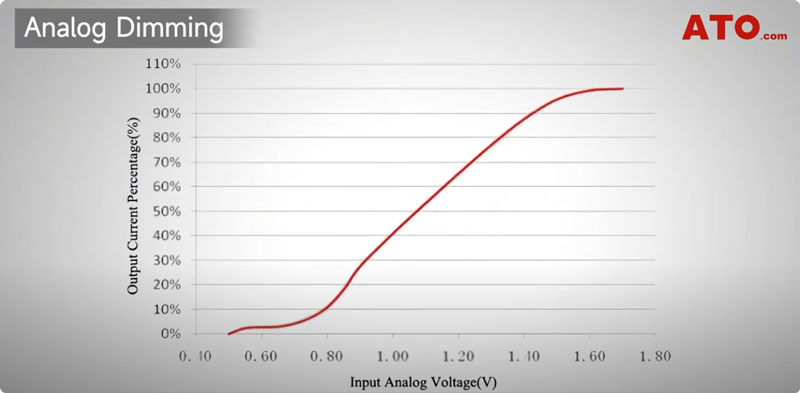
1. Analog Dimming
Principle: This technique is a traditional method that adjusts LED brightness by altering the voltage or current supplied to the LED—much like turning a faucet to control water flow. This reliable approach offers consistent, flicker-free performance—though it is less precise than digital alternatives—and is widely adopted in commercial lighting systems.
Pros and Cons: Simple and cost-effective, analog dimming delivers smooth, flicker-free light reduction, ensuring a consistent lighting experience for applications such as video recording and photography where stable illumination is critical. However, prolonged use may shorten the LED’s lifespan and can cause color shifts due to limited dimming accuracy. One drawback is that it requires additional control wiring and dedicated controllers.
Application: A common use case of analog dimming is in office buildings or retail spaces where lighting needs to be adjusted throughout the day to match natural light levels. It is also applied in photography studios and classrooms, where consistent, flicker-free illumination is necessary to avoid eye strain and maintain visual comfort.
2. 0-10V Dimming
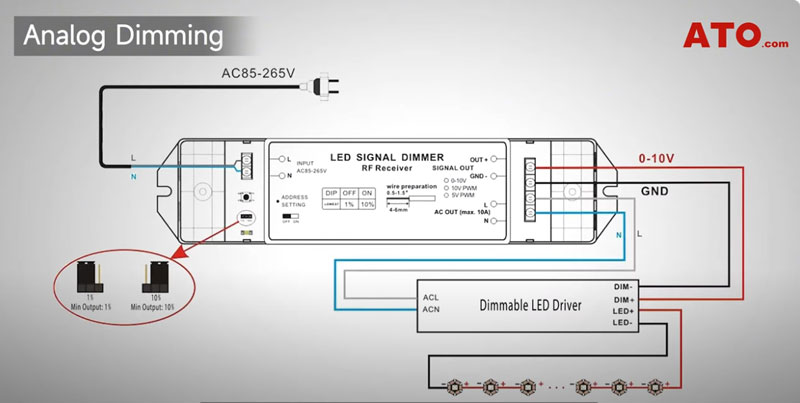
Principle: A classic industry example of analog dimming is the 0-10V dimming system. In this system, a dimmer sends a low-voltage DC signal ranging from 0 to 10 volts to the lighting fixture, which then adjusts its output accordingly. By modulating the voltage within this range, linear brightness control is achieved. The 0-10V dimmer consists of two separate circuits: a standard voltage circuit and a low-voltage control circuit that provides reference voltage and feedback signals to determine specific dimming levels.
Pros and Cons: 0-10V dimming offers simple implementation and strong compatibility with existing systems, making it widely adopted in commercial spaces. However, it requires additional control wiring and is dependent on dedicated controllers for operation.
Application: Many commercial projects rely on compatible LED drivers to implement 0-10V dimming. ATO LED Drivers, for example, support direct 0-10V input, providing stable, flicker-free performance that integrates seamlessly with existing control systems—making them a practical solution for large-scale office, retail, or industrial lighting installations.
3. PWM Dimming
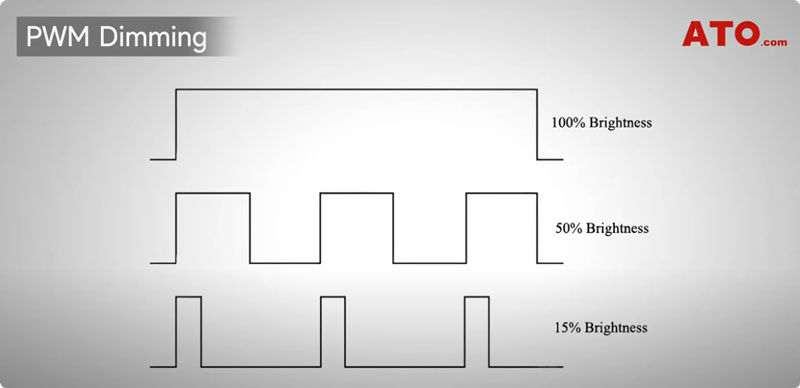
Principle: In contrast, pulse width modulation (PWM) dimming operates by rapidly switching LEDs on and off at full current, adjusting brightness through variations in pulse duration. This method involves continuously cycling the current between zero and a fixed maximum level—analogous to controlling water flow by repeatedly turning a faucet on and off.
Pros and Cons: PWM dimming provides high precision in brightness control without causing color shifts, thereby maintaining consistent color performance and preserving LED lifespan due to the stability of the operating current. However, it may generate low-frequency noise during operation. Furthermore, the use of low PWM frequencies can lead to visible flickering, while higher frequencies might create perceptible steps in brightness. Thus, selecting an appropriate PWM frequency requires careful consideration and balance.
Application: PWM dimming is widely used in environments that demand precise and stable color control, such as stage lighting, architectural illumination, and LED displays. It is also common in residential smart lighting systems, where users expect smooth transitions between brightness levels without noticeable flicker.
4. Triac Dimming
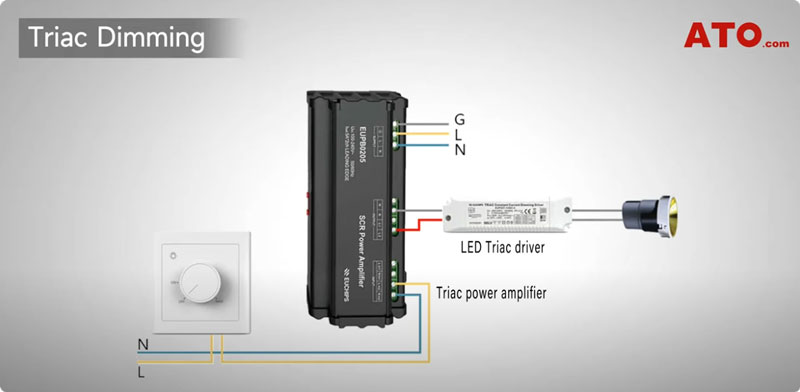
Principle: This technique utilizes thyristor components to adjust the conduction angle of each AC half-wave, modifying the sinusoidal waveform to regulate the effective current value for dimming purposes. TRIAC dimming includes both "Leading Edge" and "Trailing Edge" phase-cut variants.
Pros and Cons: It offers stable performance, lower cost, and simple installation. However, as an outdated technology, it is limited to basic brightness adjustment. Compatible with traditional phase-cut dimmers, TRIAC dimming is primarily suited for retrofitting LED bulbs into existing electrical installations.
Application: In practical use, Triac dimming often requires reliable phase-control hardware. ATO SCR Power Regulator Module provides robust support for this application, ensuring smooth current adjustment and stable brightness control—making it an effective solution for retrofitting projects where cost-efficiency and compatibility are priorities.
5. DALI Dimming
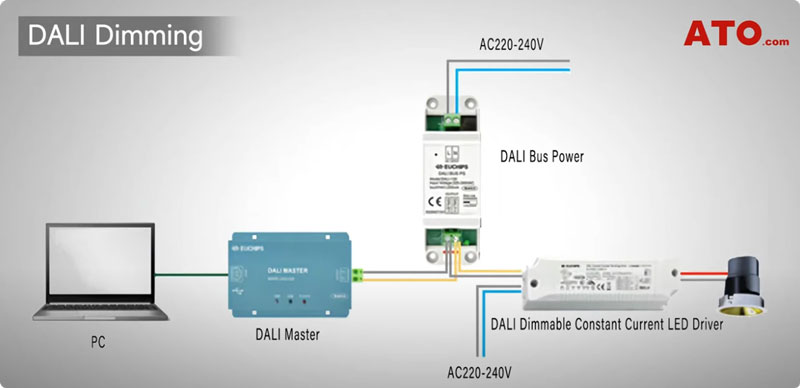
Principle: DALI is a digital communication protocol that enables two-way communication and allows individual or grouped control of lighting fixtures. Each luminaire in the circuit is assigned a unique address, facilitating precise independent control.
Pros and Cons: This method provides flexible and accurate dimming, strong anti-interference performance, and simplified maintenance. It also supports fault feedback functionality, enhancing the reliability of LED control systems, and enables smooth dimming transitions as well as remote management in both commercial and residential applications. Additionally, DALI supports scene configuration, making it well-suited for smart buildings requiring scalable and programmable lighting solutions. A notable drawback is that these advanced capabilities result in higher system costs.
Application: DALI dimming is commonly adopted in modern office buildings, shopping malls, and airports where centralized and programmable lighting control is essential. For example, facility managers can set different lighting scenes for daytime, evening, or emergency conditions, while also monitoring system health through built-in fault reporting—making it ideal for large-scale smart building projects.
6. DMX512 Dimming
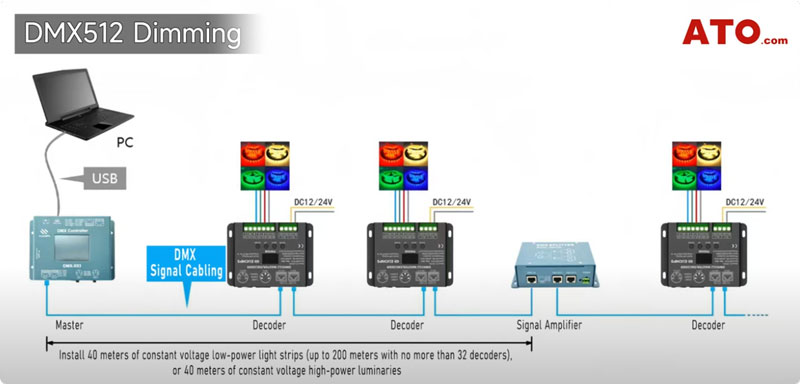
Principle: DMX512 is a digital dimming protocol designed for precise multi-channel control to achieve dynamic lighting effects. It employs a multi-drop bus topology that prevents signal path congestion, making it ideal for master-slave control systems while offering simple wiring and high reliability. The system supports installations of up to 40 meters of constant-voltage low-power light strips (extendable to 200 meters with no more than 32 decoders) or 40 meters of constant-voltage high-power luminaires.
Pros and Cons: DMX512 enables pixel-level precision in dynamic lighting control and is widely used in stage/theatrical lighting systems and RGB applications.
Application: DMX512 dimming is the standard choice in theaters, concert halls, and television studios, where synchronized lighting effects must be coordinated with music and stage performances. It is also applied in large architectural lighting projects, such as building facades or bridges, to create visually striking color-changing displays and dynamic animations.
7. ZigBee Dimming
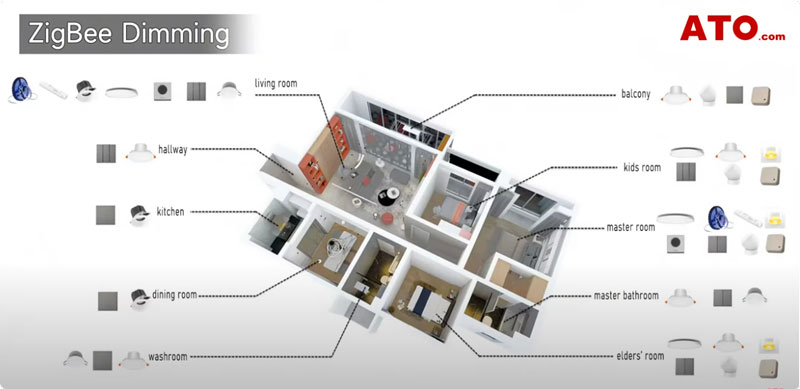
Principle: ZigBee dimming utilizes wireless communication technology to enable seamless control of LED brightness, providing flexible and convenient lighting management across various spaces. Its mesh network architecture ensures strong interference resistance and secure data transmission.
Pros and Cons: This technology is well-suited for scalable smart lighting systems with high scalability. It should be noted, however, that data transfer rates may be relatively lower during short-distance communication.
Application: ZigBee dimming is frequently used in smart homes, office complexes, and hotel environments where centralized wireless control is desirable. For example, homeowners can manage multiple rooms’ lighting through a single app, while facility managers in commercial buildings can expand lighting networks floor by floor without the need for extensive rewiring.
8. Bluetooth Dimming
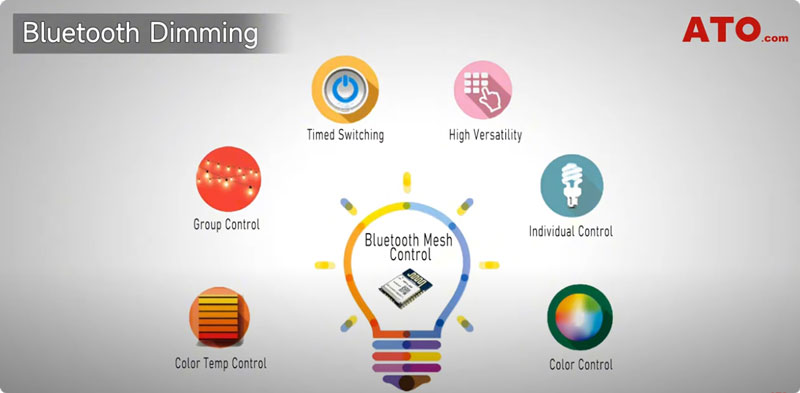
Principle: Bluetooth dimming technology enables wireless control of LED lighting via mobile devices, providing intuitive dimming functionalities and smart lighting solutions for modern environments. This short-range wireless system requires no additional wiring and offers convenient connectivity, precise dimming adjustment, low latency, and low power consumption.
Pros and Cons: However, it exhibits relatively lower stability compared to other solutions. Bluetooth dimming supports direct smartphone control, making it highly user-friendly for residential and small-scale commercial applications. While convenient for compact spaces, its limited operational range makes it unsuitable for large-scale installations.
Application: Bluetooth dimming is commonly found in residential lighting setups, such as living rooms, bedrooms, and small offices, where users can easily adjust brightness through their smartphones. It is also popular in retail stores or cafés that require localized, flexible lighting adjustments without the need for complex infrastructure.
Conclusion
Each dimming method possesses distinct strengths and limitations, influencing critical factors such as color accuracy, dimming precision, and LED longevity. Selecting the appropriate dimming technology significantly affects overall performance, energy efficiency, and user experience.
When evaluating dimming technologies, key considerations include compatibility, range, scalability, control granularity, and ease of use, all of which should align with practical requirements and budget constraints. The optimal choice varies by application:
- Smart homes typically favor ZigBee or Bluetooth
- Retrofit projects commonly utilize Triac
- Commercial spaces benefit from DALI or 0-10V systems
- Creative and dynamic lighting applications demand DMX
For scenarios without specific requirements or those needing customized solutions, consulting with lighting professionals is recommended to ensure an optimal selection. For any specialized inquiries, feel free to reach out to ATO.com technical professionals, who can provide guidance based on your specific application needs.
