
Sliding Vane Pump Price List
A 380V sliding vane pump in the 2–10 HP range costs $4,205–$7,942. Each HP tier adds approximately $900–$1,100, driven by motor frame size, body material, and flow capacity.
This pump series, provided by ATO Industrial Automation, is commonly used in fuel transfer, chemical processing, and industrial fluid handling systems.
| Price range | $4,205 – $7,942 |
| Power range | 2 HP (1.5 kW) – 10 HP (7.5 kW) |
| Voltage | 380V three-phase |
| Working pressure | 0.4 MPa (all models) |
| Self-priming height | Up to 6.5 m (all models) |
| Max flow rate | Up to 40 m³/h (10 HP model) |
| Operating temperature | −10 °C to +80 °C |
| Viscosity limit | Up to ~500 cSt |
| Pump type | Rotary positive displacement (also: rotary vane pump) |
Key Takeaways
- Price range: $4,205 (2 HP) to $7,942 (10 HP), 380V three-phase
- Best fluid range: up to 500 cSt — diesel, kerosene, light oils, solvents
- Self-priming: up to 6.5 m vertical lift — no flooded suction required
- Road-mobile applications: specify ATO-SVP-075 — the only ductile iron model in the series
- Maximum throughput: ATO-SVP-10 delivers up to 40 m³/h at 960 r/min
- Do not use for: fluids above 2,000 cSt, abrasive solids, or Zone 1/2 hazardous areas without explosion-proof motor certification
- Sizing rule: select the smallest HP that covers required flow rate plus 15–20% margin
Contents:
- What Is a Sliding Vane Pump?
- Price List by Model
- How to Choose the Right Sliding Vane Pump?
- Application Guide by Use Case
- Sliding Vane Pump vs. Gear Pump
- Frequently Asked Questions
What Is a Sliding Vane Pump?
A sliding vane pump is a positive displacement pump that delivers constant, metered flow regardless of discharge pressure variation, using spring-loaded vanes to form sealed chambers inside an eccentric rotor-casing assembly.
How it works:
- Spring-loaded vanes slide radially in and out of a slotted rotor mounted eccentrically inside a cylindrical casing
- As the rotor turns, vanes maintain contact with the casing wall, forming chambers that expand at the inlet (drawing in fluid) and compress at the outlet (discharging)
- Flow output is proportional to rotor speed — not affected by downstream pressure changes
Comparison: Sliding vane pumps provide more consistent flow than centrifugal pumps under variable back-pressure, and self-prime from below-grade tanks where centrifugal designs require flooded suction.
| Feature | Sliding vane pump | Centrifugal pump |
| Flow under back-pressure change | Constant | Drops as pressure increases |
| Self-priming | Up to 6.5 m | Requires flooded suction |
| Viscosity handling | Up to ~500 cSt | Best for thin, low-viscosity fluids |
| Typical use | Fuel transfer, chemical dosing, marine bunkering | High-volume water, HVAC, general process |
When to use — and when not to:
| Condition | Suitable? |
| Fluid viscosity < 500 cSt | ✓ Yes — full rated performance |
| Fluid viscosity 500–2,000 cSt | ⚠ Conditional — consult ATO derating data |
| Fluid viscosity > 2,000 cSt | ✗ No — use a gear pump |
| Suction lift ≥ 3 m from below-grade tank | ✓ Yes — self-primes to 6.5 m |
| Abrasive or particle-laden fluid | ✗ No — accelerates vane and stator wear |
| Hazardous area Zone 1 / Zone 2 | ⚠ Only with explosion-proof motor certification |
Pro Tip: "Sliding vane pump" and "rotary vane pump" refer to the same device. "Sliding vane pump" is standard in North American catalogs; "rotary vane pump" is more common in European and marine documentation.
Price List by Model
All five models share: 380V three-phase · 0.4 MPa working pressure · mechanical seal · self-priming to 6.5 m.
| Model | Power | Body material | Price (USD) | SKU |
| 2 HP Sliding Vane Pump | 2 HP / 1.5 kW | Cast iron | $4,205.56 | ATO-SVP-02 |
| 4 HP Sliding Vane Pump | 4 HP / 3 kW | Cast iron | $5,310.32 | ATO-SVP-04 |
| 5.5 HP Sliding Vane Pump | 5.5 HP / 4 kW | Cast iron | $6,159.13 | ATO-SVP-055 |
| 7.5 HP Sliding Vane Pump | 7.5 HP / 5.5 kW | Ductile iron | $6,899.60 | ATO-SVP-075 |
| 10 HP Sliding Vane Pump | 10 HP / 7.5 kW | Cast iron | $7,942.86 | ATO-SVP-10 |
ATO-SVP-02 · 2 HP · $4,205.56
Cast iron body, mechanical seal, fixed installation only — not rated for road-mobile or high-vibration mounting.
Specify when: low flow demand, fixed indoor installation, unit cost is the primary constraint.
ATO-SVP-04 · 4 HP · $5,310.32
Self-priming to 6.5 m covers the majority of below-grade fuel tank configurations without auxiliary priming equipment. High-efficiency vane geometry reduces energy consumption at this power level.
Specify when: suction lift 3–5 m, moderate throughput, fixed installation at fuel retail or depot sites.
ATO-SVP-055 · 5.5 HP · $6,159.13
Operates at 960 r/min — below typical pump speeds — reducing vane tip contact velocity and extending service intervals in continuous-duty environments. Suited to variable-viscosity batch transfer where consistent output pressure matters more than peak flow.
Specify when: continuous 24/7 process transfer, variable-viscosity batches, low unplanned maintenance frequency required.
ATO-SVP-075 · 7.5 HP · $6,899.60
The only ductile iron model in this series. Ductile iron tensile strength is approximately 414 MPa versus 180 MPa for gray cast iron. Road-mobile tank trucks subject pump bodies to simultaneous road vibration and repeated pressure cycling — a combined load that causes fatigue cracking in cast iron bodies within 18–24 months of field use. Ductile iron eliminates this failure mode.
Specify when: road-mobile installation, oil tank truck, or any application with mechanical shock or sustained pressure cycling.
ATO-SVP-10 · 10 HP · $7,942.86
Highest flow in the series: up to 40 m³/h at 960 r/min. For marine bunkering and port fuel operations, transfer throughput per hour directly determines vessel turnaround time per berth. Specify over the 7.5 HP when throughput — not viscosity or lift — is the binding operational constraint.
Specify when: marine bunkering, high-volume port or depot operations, refinery pipeline circulation.
How to Choose the Right Sliding Vane Pump?
Step 1 — Calculate required flow rate
Required flow rate (m3/h) = total volume ÷ available hours × 1.15–1.20 (margin factor).
- Add 15–20% margin for suction line losses and efficiency variance
- Select the smallest HP model whose rated flow exceeds this figure
- Over-specifying HP adds $900–$1,100 per tier with no operational benefit if peak flow is already covered
Step 2 — Assess suction conditions
All models self-prime to 6.5 m vertical lift. Effective lift is reduced by:
- Suction pipe ID smaller than pump inlet port — never reduce pipe diameter at any point
- Each 3 m of horizontal suction run adds approximately 0.3–0.5 m of effective lift loss
- Each foot valve or elbow fitting adds resistance — minimise the number of fittings
Step 3 — Check fluid viscosity
- Up to ~500 cSt: all models perform within specification
- 500–2,000 cSt: flow rate will decrease; consult ATO for derating curves
- Above 2,000 cSt: sliding vane pump not recommended — use a gear pump
Step 4 — Confirm installation type
| Installation | Recommended | Reason |
| Fixed (indoor/depot) | ATO-SVP-02 to ATO-SVP-055 | Cast iron adequate for static mounting |
| Road-mobile (tank truck) | ATO-SVP-075 (ductile iron) | Ductile iron resists road vibration and fatigue cracking |
| Marine / port | ATO-SVP-10 | Highest throughput in the series |
| Hazardous area | Contact ATO | Explosion-proof motor certification required |
Application Guide by Use Case
The following guide shows typical model selection based on different application scenarios and operating conditions.
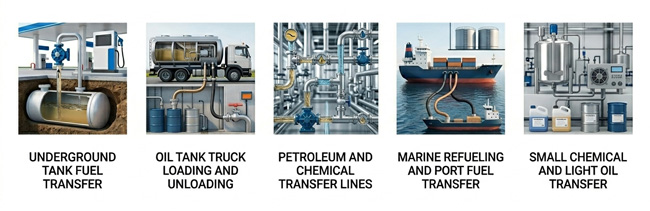
Underground Fuel Tank Unloading · ATO-SVP-04 ($5,310)
Underground storage tanks at retail fuel sites typically sit 3–5 m below grade. The 4 HP self-prime height covers this range without auxiliary priming equipment.
- Suction line must run continuously uphill — no air-trapping high points
- Fit a foot valve at the tank pickup to hold prime between operations
- Suitable for: underground diesel storage, fuel retail stations, small fuel distribution depots
Oil Tank Truck Loading and Unloading · ATO-SVP-075 ($6,899)
Road-mobile pumps face three concurrent stresses absent in fixed installations: highway vibration, pressure spikes at each delivery stop, and temperature cycling between ambient and warmed fluid. Cast iron develops fatigue micro-cracks under this combination within 18–24 months. Ductile iron (414 MPa tensile strength) does not.
- Verify seal elastomer before ordering — NBR is not suitable for E10 or higher ethanol-blended fuels
- Specify PTFE or FKM (Viton) for E10–E85 grades
- Suitable for: oil tank trucks, mobile diesel transfer units, fuel delivery fleets
Typical applications:
- Oil tank trucks
- Mobile diesel transfer units
- Fuel delivery fleets
- Road-based fuel transportation systems
Petroleum and Chemical Process Transfer · ATO-SVP-055 ($6,159)
Process lines transferring multiple products on a batch schedule require consistent displacement output across varying viscosities. At 960 r/min, the 5.5 HP model reduces internal wear rate in 24/7 environments compared to higher-speed alternatives, lowering unplanned maintenance frequency.
- Stable output pressure across viscosity variation within a batch cycle
- Lower vane tip contact velocity extends service intervals
- Suitable for: petroleum refinery transfer lines, chemical batch processing, solvent handling systems
Typical applications:
- Petroleum processing systems
- Chemical transfer pipelines
- Solvent handling systems
- Continuous circulation processes
Marine Bunkering and Port Fuel Transfer · ATO-SVP-10 ($7,942)
At up to 40 m³/h, this is the standard specification for shore-to-ship and ship-to-ship fuel transfer at commercial ports. Transfer throughput per hour directly determines vessel turnaround time per berth.
- Verify seal compatibility with marine fuel grades before installation — IFO 180, MGO, and VLSFO viscosity ranges widely with temperature
- Specify over the 7.5 HP when throughput, not viscosity or lift, is the binding constraint
- Suitable for: ship-to-shore transfer, marine bunkering terminals, large petroleum storage facilities
Typical applications:
- Ship-to-shore fuel transfer
- Marine bunkering systems
- Port fuel distribution stations
- Large petroleum storage facilities
Light Chemical and Small-Scale Fuel Transfer · ATO-SVP-02 ($4,205)
For low-flow applications where cast iron body is adequate and minimising unit cost is the priority.
- Suitable for: chemical dosing lines, small above-ground diesel storage, low-capacity industrial transfer
- Not rated for road-mobile or high-vibration environments
Sliding Vane Pump vs. Gear Pump
Rule: Use a sliding vane pump for low-to-medium viscosity fuels and chemicals requiring self-priming or temperature-stable transfer. Use a gear pump for fluids above 500 cSt or when upfront cost dominates at small scale.
| Scenario | Better choice | Reason |
| Low-viscosity fuel < 10 cSt (diesel, kerosene) | Sliding vane pump | Lower heat generation; flow stable under back-pressure variation |
| High-viscosity fluid > 500 cSt (heavy oil, asphalt) | Gear pump | Maintains rated flow; vane performance degrades above 500 cSt |
| Below-grade tank, suction lift ≥ 3 m | Sliding vane pump | Self-primes to 6.5 m; gear pump requires flooded suction |
| Volatile / low-flash-point chemicals | Sliding vane pump | Lower internal friction = more stable fluid temperature |
| Precise metering, low flow rate | Either | Both deliver smooth positive displacement output |
| Small scale < 2 HP, budget priority | Gear pump | Comparable gear pumps often available at lower upfront cost |
| Road-mobile / tank truck | Sliding vane pump | Ductile iron body option (SVP-075) — rare in gear pump range |
Frequently Asked Questions
Find quick answers to the most common questions about sliding vane pump pricing, operation, and applications.
Q1: What affects sliding vane pump price?
A: Sliding vane pump price is mainly affected by motor power (HP), flow rate, material construction, sealing method, and application requirements. Higher-power models generally provide greater transfer capacity and may include heavier-duty construction for fuel, chemical, or marine applications.
Q2: Can a sliding vane pump run dry?
A: Sliding vane pumps are generally not designed for dry running because the pumped liquid helps lubricate and cool internal components. Running dry for extended periods may increase wear on vanes and internal surfaces, potentially reducing service life.
Q3: What liquids are suitable for a sliding vane pump?
A: Sliding vane pumps are commonly used for diesel, gasoline, kerosene, solvents, light oils, lubricants, and some industrial chemicals. They are generally more suitable for low to medium viscosity liquids rather than highly viscous fluids.
Q4: What is the difference between a sliding vane pump and a centrifugal pump?
A: A sliding vane pump is a positive displacement pump, meaning flow output remains relatively stable under changing pressure conditions. A centrifugal pump relies on velocity and is often better suited for high-flow, low-viscosity liquid transfer where precise flow consistency is less critical.
