
What is a Soil Moisture Sensor?
Instruments that measure soil dryness and moisture are often called soil moisture meters or soil hygrometers. Soil temperature and humidity meters, on the other hand, are more comprehensive instruments that measure not only soil moisture but also soil temperature.
Soil moisture is a crucial component of soil fertility and a major factor influencing plant growth and development. It is also a crucial parameter for studying agricultural drought and crop drought conditions and a key indicator in water-saving agriculture. Only by accurately understanding soil moisture content can we provide the most suitable environment for crop growth.
- How does a soil moisture sensor work?
- How to choose the right soil sensor?
- Where are the application scenarios of soil moisture sensors?
- Future Development of Soil Moisture Sensors
How does a Soil Moisture Sensor Work?
A soil moisture sensor monitors soil moisture. Its hardware control circuit is embedded within the root zone of the crop. The sensor system's detection circuit transmits "excessively high" and "excessively low" humidity signals via an encoder to the main intelligent controller, which then determines the control state. If "excessively high humidity" occurs, irrigation is stopped; if "excessively low humidity" occurs, optoelectronic isolation and relays are used to control a solenoid valve connected to the water source. The system also provides fault alarms. The main intelligent controller communicates with a host computer via a communication interface, enabling real-time monitoring of system operation and data analysis. Soil moisture sensors employ various measurement principles.
A common one is based on frequency domain reflectometry (FDR), which measures the propagation characteristics of electromagnetic waves in the soil to infer soil moisture content. Other soil moisture sensors use resistance measurement, measuring soil moisture by measuring changes in electrical conductivity as soil moisture changes.
- Resistive sensors: These detect soil moisture by measuring the resistance or conductivity between two electrodes. These sensors are inexpensive and suitable for DIY or home gardening, but may not be accurate enough for scientific research requiring precision.
- Capacitive soil moisture sensors: These use the soil as a capacitor, calibrating moisture content by measuring the soil's charge storage capacity. These sensors offer continuous readings, low power consumption, and low cost, with an accuracy of 2% to 3%.
- Time-Domain detector (TDR) sensors: These measure soil moisture by measuring the time it takes for a reflected electrical wave to travel along a transmission line. These sensors are insensitive to salinity and offer high accuracy, but they are relatively expensive and consume relatively high power.
- Frequency-Domain detector (FDR) sensors: These use the soil as a capacitor to measure the maximum resonant frequency in a circuit, which is related to moisture content. Compared to TDR sensors, FDRs are less expensive and require less time to measure.

How to Choose the Right Soil Sensor?
Consider the specific application and environment.
- Personal gardening (balcony gardening, small vegetable garden): Accuracy requirements are low, and cost and ease of use are more important. Basic capacitive or resistive sensors may be sufficient, but be aware of the long-term durability issues of resistive sensors.
- Agricultural greenhouses and field irrigation: High accuracy and stability are required, requiring long-term, reliable operation. FDR sensors are a common choice. If integrated water and fertilizer management is required, a multi-parameter sensor that can also measure electrical conductivity (EC) may be necessary.
- Scientific research experiments and high-precision monitoring: Extremely high accuracy is required, and the environment may be complex. TDR sensors or laboratory-grade high-precision FDR sensors are more suitable.
- Environmental monitoring and landslide warning: The sensor must operate stably and long-term in harsh outdoor environments, requiring a high level of protection and durability.
Consider the sensor price range
Soil moisture sensors span a wide price range, making it crucial to balance the initial investment with long-term benefits. Lower-priced sensors may offer upfront savings, but they may lack accuracy, durability, or stability, potentially increasing long-term maintenance or replacement costs. On the other hand, more expensive sensors often offer greater reliability, improved accuracy, and a longer lifespan, reducing operating costs and improving results in the long run. When selecting a sensor, consider not only its purchase price but also its overall value in terms of performance, lifespan, and suitability for your specific needs.
- Low-cost options: Resistive sensors are the cheapest, but they sacrifice accuracy and durability, making them suitable for short-term or low-demand experiments.
- Cost-effective options: FDR sensors are moderately priced and offer a good balance between accuracy, stability, and cost, making them a popular choice for agricultural applications.
- High-investment options: TDR and multi-parameter sensors are expensive, but they provide extremely high accuracy and a wide range of data, making them suitable for specialized applications and those requiring stringent data accuracy.
Consider the following key parameters
- Measurement accuracy and range: Accuracy is typically expressed as a percentage (e.g., ±3%). Choose a sensor based on your data accuracy requirements. Also, ensure the sensor's range covers the soil moisture range you need to measure.
- Protection rating and durability: Especially for outdoor use, choose a sensor with an IP68 rating, which is waterproof, dustproof, and corrosion-resistant, making it suitable for harsh environments. Probe material (e.g., stainless steel) and packaging quality are also important.
- Soil property calibration: Different soil types (sand, clay, loam) have different dielectric properties. High-quality sensors typically offer calibration models for a variety of soil types, and some even support custom calibration, which is crucial for obtaining accurate readings.
- Salt impact: If the soil is high in salt (e.g., saline-alkali soil or frequent fertilization), it's important to choose a sensor with strong salt resistance (such as a TDR or specially designed FDR). Otherwise, the readings may be severely distorted
Where are the Application Scenarios of Soil Moisture Sensors?

Scenario 1: Landscaping
Soil moisture sensors are the "brains" of smart irrigation systems in green belt management in parks, golf courses, commercial complexes, and residential communities.
Large-scale landscaping irrigation consumes significant water. Soil moisture sensors monitor soil moisture in different areas (such as lawns, flower beds, and bushes) in real time, activating irrigation only when needed. This avoids wasted timers that continue watering even during rainy days, significantly reducing water and utility costs.
Soil moisture sensors can also enable differentiated irrigation based on the varying water requirements of different plants (for example, shallow-rooted grass requires frequent watering, while deep-rooted trees require deep watering). Sensors can be arranged in zones, with different moisture trigger thresholds set for different plants, enabling personalized irrigation to maintain plant health. Automated irrigation reduces the workload of manual inspections and watering, lowering labor costs. Furthermore, by avoiding over- or under-watering, plant mortality and replacement costs are reduced, maintaining optimal landscape appearance.

Scenario 2: Orchards & Vineyards
Cash crops require extremely precise irrigation, as it directly impacts fruit yield and quality. Fruit trees and grapes have varying water requirements during different growth stages. During flowering and fruit setting, crops require adequate water. During fruit expansion, water requirements are highest, requiring a consistent water supply. During ripening, moderate water control is necessary to promote sugar accumulation and enhance fruit sweetness and flavor. Sensors can provide precise data, helping growers make optimal decisions at each stage.
Fruit trees have deep root systems, so sensors need to be installed at different depths (e.g., 20 cm, 40 cm, and 60 cm) to monitor water infiltration through the soil profile and actual root uptake, ensuring that irrigation water reaches the effective root zone.
Scenario 3: Agricultural Farming
In large-scale cultivation of crops such as wheat, corn, cotton, and soybeans, moisture meters are a core component of precision agriculture and smart farming. Uniform irrigation across vast farmlands is neither scientific nor economical. By deploying sensors in a grid, soil moisture distribution across the entire field can be mapped, guiding variable-rate irrigation techniques. More water is applied in dry areas, while less water is applied or even stopped in moist areas, significantly improving the efficiency of water, electricity, and fuel.
Soil moisture sensors can prevent water stress during critical growing seasons, ensuring high yield potential. Over-irrigation can also lead to root hypoxia and nutrient loss, which soil moisture sensors can effectively prevent, creating an optimal growth environment for the roots.
Furthermore, sensor data can be directly integrated into large-scale automated irrigation systems (such as pivot sprinklers and drip irrigation systems) for fully automated start-stop control. This reduces labor costs and allows for irrigation at night, when evaporation is lower, for even greater efficiency. Long-term collected soil moisture data, combined with meteorological data, can be used to establish prediction models, optimize future irrigation strategies, and achieve more scientific farm management.
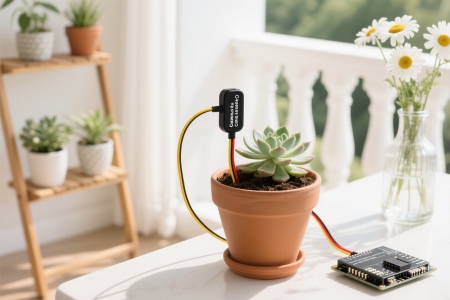
Scenario 4: Home Gardening
For flower and vegetable gardeners on balconies, terraces, and backyards, soil moisture sensors make gardening simple and smart.
Using a soil moisture sensor can solve the problem of forgetting to water or overwatering. It's the perfect tool for busy office workers or gardening novices. It can send instant alerts via a mobile app when the soil is drying out, or even directly control a small irrigation system to automatically refill water, preventing your beloved plants from withering due to neglect. Furthermore, soil moisture sensors are compatible with a variety of plant types. Users can set different alarm thresholds for moisture-loving ferns and dry-loving succulents, allowing them to manage all their potted plants from a single device.
Modern sensors typically feature a simple, specifically home sensors, plug-and-play design, connecting to a mobile app via Bluetooth or Wi-Fi. The data is intuitive and easy to understand, significantly lowering the technical barrier to entry.
Future Development of Soil Moisture Sensors
The future development of soil moisture sensors will focus on deepening innovation in the areas of intelligence, multi-parameter integration, environmental sustainability, and low-power long-distance transmission, bringing more efficient solutions to agriculture, environmental monitoring and other fields.
Environmental Sustainability
Future soil moisture sensors will prioritize environmental friendliness. Researchers are exploring the use of biodegradable polymer materials in sensor manufacturing to reduce the environmental impact of electronic waste. This is crucial for achieving sustainable agricultural and environmental monitoring.
Intelligence and Algorithm Empowerment
Soil moisture sensors are evolving from simple data collection to intelligent decision-making. By integrating artificial intelligence (AI) and machine learning algorithms, these sensors can not only monitor current data in real time but also analyze historical trends, predict future soil moisture changes, and even provide early warning of pest and disease risks.
Multi-parameter Integration and High-Precision Sensing
Single humidity measurement is no longer sufficient to meet the needs of complex applications. Future sensors will integrate multiple sensing functions, simultaneously measuring temperature, salinity, pH, and even meteorological factors, providing a more comprehensive environmental picture.
Low Power and Long-Range Transmission (LPWAN)
To accommodate large-scale field deployments, low-power wide-area network (LPWAN) technology will become standard. Technologies such as LoRa (which can transmit up to 10 kilometers in open areas) and NB-IoT5 enable sensors to operate in remote areas without public network coverage, allowing them to operate continuously for years on battery or solar power alone, greatly improving the device's adaptability and durability.
Edge Computing and Self-Calibration
To improve response speed and reduce the burden on the cloud, edge computing capabilities will be built into the sensor. Some high-end products support 5G transmission, achieving millisecond-level data response. Furthermore, a self-calibration function designed into the software algorithm automatically corrects measurement errors, reduces maintenance requirements, and ensures long-term data accuracy and reliability.
In short, soil moisture sensors are evolving towards becoming smarter, more integrated, more environmentally friendly, and more self-reliant, deeply empowering smart agriculture and sustainable development.
