
How Monitoring Relay Works?
The monitoring relay is an advanced automation control and protection component, distinct from a regular switching relay. Its core function is to continuously monitor a specific physical parameter (such as voltage, current, frequency, phase, etc.) in the circuit and compare it with a user-defined reference value (setpoint). Once the measured parameter deviates from the preset normal range, it automatically controls the switching of its output contacts, thereby triggering an alarm or disconnecting the circuit to protect the equipment and ensure personnel safety.
This article will analyze the working principles of three types of monitoring relays, examining their internal mechanisms and operational logic to explain how they effectively guard against electrical faults. Through a comprehensive understanding of the technical characteristics of these relays, engineers and technicians can further optimize their application across various industrial and commercial scenarios, enhancing system reliability and minimizing downtime caused by electrical issues.
- The Working Principle of the Phase Monitoring Relay
- The Working Principle of the Voltage Monitoring Relay
- The Working Principle of the Current Monitoring Relay
The Working Principle of the Phase Monitoring Relay
The phase monitoring relay is a protective device used in three-phase power systems. Its primary function is to detect the phase sequence (order of phases) and phase loss status of the power supply. The core purpose of the phase monitoring relay is to prevent three-phase equipment such as motors and compressors from reversing rotation, overheating, or being damaged due to incorrect phase sequence or missing phase connections.
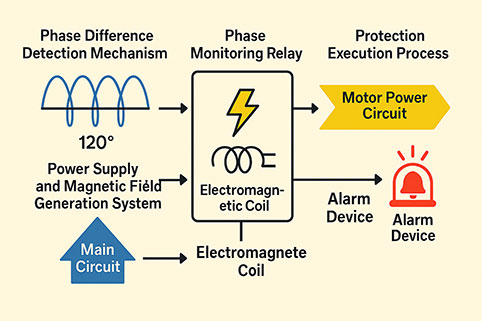
- Phase Difference Detection Mechanism: The phase monitoring relay continuously monitors the phase relationship between three-phase voltages through its internal measurement circuit. Under normal operating conditions, the three-phase voltages should maintain a stable 120-degree phase difference. When a deviation from the rated phase difference is detected, the system is determined to have an abnormal phase sequence.
- Power Supply and Magnetic Field Generation System: The phase monitoring relay obtains its operating power from the main circuit. Its electromagnetic coil forms a loop with components such as thermal relays and AC contactors. After energization, the coil generates a stable magnetic field, keeping the relay in an engaged state. At this time, the normally open contacts remain closed, ensuring normal equipment operation.
- Fault Detection and Response Mechanism: When a phase error occurs, abnormal changes in voltage and current cause variations in the magnetic field strength of the electromagnetic coil. Once the change in magnetic field exceeds the preset safety threshold, the relay immediately activates the protection program.
- Protection Execution Process: The phase monitoring relay achieves rapid demagnetization through its internal mechanical device, causing the normally open contacts to open and cutting off the motor's power circuit. This design effectively prevents the motor from operating under incorrect phase sequence conditions, avoiding equipment damage caused by reverse rotation or overload.
The Working Principle of the Voltage Monitoring Relay
Voltage monitoring relays operate on different principles for the single-phase and the three-phase systems, with specific working mechanisms as follows.
The single-phase voltage monitoring relay
The single-phase voltage monitoring relay is a key protective device used to protect single-phase electrical equipment. Its primary function is to continuously monitor voltage fluctuations and ensure that the equipment operates within the normal voltage range. If the voltage exceeds the preset overvoltage or undervoltage limits, the relay automatically activates the protection mechanism, disconnecting the power supply to prevent damage to the equipment due to voltage abnormalities.
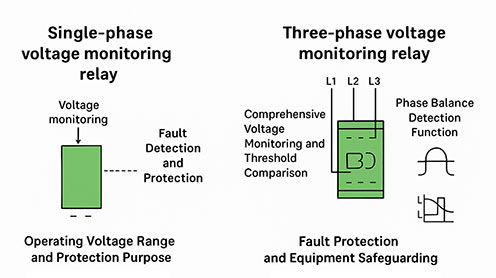
- Operating Voltage Range and Protection Purpose: This sigle-phase voltage monitoring relay is designed for single-phase AC or DC voltage systems, with the primary function of protecting motors and connected equipment from overvoltage or undervoltage damage. Some models also ensure that the voltage stays within a preset safe bandwidth while monitoring both upper and lower voltage limits.
- Voltage Monitoring and Action Logic: The sigle-phase voltage monitoring relay continuously monitors the line voltage and compares it with preset thresholds: when the voltage drops below the maximum set value, the normally closed contacts remain closed, maintaining power supply. When the voltage exceeds the set limit, it immediately activates, causing the contacts to open and disconnect the power. When the voltage falls back to the preset value minus the hysteresis amount, the relay automatically resets and restores power. Different manufacturers may implement this functionality using open or closed circuits, among other methods.
- Time Delay Protection Mechanism: The sigle-phase monitoring relay is equipped with a fixed or programmable time delay function (trip delay), ensuring that protection is only triggered when the voltage anomaly persists beyond the set time. This design effectively avoids false trips caused by transient voltage fluctuations and supports automatic delayed reset when the fault is cleared.
- Impact of Abnormal Voltage and the Necessity of Protection: Undervoltage can lead to increased motor current, excessive heat generation, and difficulty in starting. Overvoltage can cause core saturation, reduced efficiency, and insulation aging. Both situations can result in motor overheating and unexpected shutdowns, but the voltage monitoring relay can promptly disconnect the power, effectively preventing equipment damage and potential safety incidents.
The three-phase voltage monitoring relay
The three-phase voltage monitoring relay is a key protective device used to safeguard three-phase electrical equipment. Its primary function is to monitor voltage fluctuations in the three-phase system and ensure that the equipment operates under stable voltage conditions. It can detect various abnormalities in real time, including overvoltage, undervoltage, phase sequence errors, and phase imbalance. When the voltage deviates from the preset range, the relay automatically disconnects the power supply to prevent damage to the equipment caused by voltage issues.
- Comprehensive Voltage Monitoring and Threshold Comparison: The three-phase voltage monitoring relay synchronously monitors the voltage magnitudes of the three-phase system, calculates the average three-phase voltage, and compares it with the preset overvoltage/undervoltage thresholds. When the three-phase voltage simultaneously rises or falls beyond the allowable range, the protection mechanism is immediately triggered.
- Phase Balance Detection Function: The three-phase voltage monitoring relay analyzes in real-time the deviation of each phase voltage from the average three-phase voltage. When any phase voltage drops below a set percentage of the average value, it is determined to be a phase imbalance. The relay also continuously monitors the integrity of the three-phase voltage, and if any phase experiences a complete loss of voltage, it will directly trigger a trip protection.
- Phase Sequence Logic Judgment Mechanism: Using hardware circuits or digital algorithms, the three-phase voltage monitoring relay analyzes the phase relationship of the three-phase voltage to monitor the phase sequence. When any two phase sequences are detected to have swapped (e.g., L1-L2-L3 changes to L1-L3-L2), the relay immediately determines a phase sequence error and executes the protection action.
- Fault Protection and Equipment Safeguarding: Phase imbalance can lead to uneven current distribution in motor windings, causing localized overheating; operation with a missing phase will overload the motor, resulting in insulation damage. Phase sequence errors can cause the equipment to run in reverse, leading to mechanical accidents. The relay quickly disconnects the power supply, effectively preventing these faults from causing damage to motors and other three-phase equipment.
The Working Principle of the Current Monitoring Relay
The current monitoring relay is a protective device used to monitor the current of electrical equipment, primarily to detect whether the operating current is within a safe range. When the current exceeds the preset upper or lower limits, the relay immediately triggers the protection mechanism, disconnecting the power supply or issuing an alarm to prevent damage to the equipment caused by overcurrent or undercurrent.
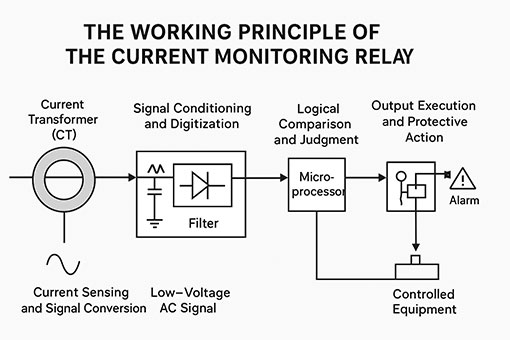
- Current Sensing and Signal Conversion: When the monitored conductor passes through the built-in current transformer (CT) of the current monitoring relay, the alternating current flowing through the conductor induces an accurately proportionally reduced AC current signal in the secondary coil of the transformer. This signal then flows through a precision sampling resistor and is converted into a low-voltage AC voltage signal proportional to the current.
- Signal Conditioning and Digitization: The generated low-voltage AC signal passes through rectification and filtering circuits, where it is converted into a smooth and stable DC voltage signal. In modern digital relays, this analog DC signal is then fed into an analog-to-digital converter (ADC), where it is transformed into a digital signal that can be recognized and processed by a microprocessor.
- Logical Comparison and Judgment: The microprocessor continuously reads the digital signal and calculates the effective value of the measured current. It rapidly compares this real-time measurement with user-preset safety thresholds (overcurrent and undercurrent values) to determine whether the current remains within the permitted normal range.
- Output Execution and Protective Action: Once the microprocessor detects that the current exceeds the safe range (too high or too low), it immediately issues a command to the output drive circuit. The drive circuit then controls an independent output relay, changing its contact state (normally open contacts close, normally closed contacts open). This action either cuts off the control circuit of the protected equipment or triggers an audible and visual alarm device, ultimately achieving the protection objective.
Conclusion
In modern electrical systems, relays serve as critical protective components playing a vital role. Whether it is phase monitoring relays, voltage monitoring relays, or current monitoring relays, they all operate by continuously monitoring changes in electrical parameters, promptly detecting abnormalities, and taking effective protective measures to ensure equipment safety. By understanding the working principles of these relays, we can better select and configure suitable protection devices in practical applications—just like the ATO online store, which not only come in complete varieties and reliable performance but also provide highly competitive prices and professional technical support.
