
Air Quality Sensor Installation Guidelines
With the deepening of smart environmental protection construction, the role of air quality sensors has become increasingly important. Based on actual application needs, this guide scientifically analyzes outdoor environmental factors, accurately determines monitoring height ranges, and standardizes installation and operation procedures to help users establish appropriate air quality monitoring points and ensure that each monitoring data accurately reflects the environmental quality status.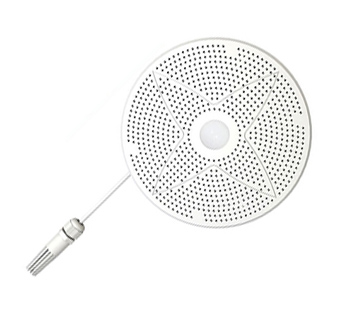
Contents
- Outdoor Installation Environment for Air Quality Sensors
- Air Quality Sensor Installation Height Recommendations
- Installation Process for Air Quality Sensors
Outdoor Installation Environment
Scientific and reasonable site selection is the first step in ensuring the accuracy of air quality monitoring data. This guide systematically summarizes the key factors that affect air quality monitoring based on natural environmental characteristics.
Understanding these site selection principles will significantly improve the spatial representativeness and environmental applicability of monitoring data.
Key Considerations for Terrain and Topography Selection
The installation location of air quality sensors should avoid enclosed valleys or low-lying areas, as such terrain can lead to air stagnation, affecting the accuracy of monitoring data. In hilly regions, it is recommended to prioritize windward slopes to ensure smooth airflow. When installing in coastal areas, the influence of sea breezes must be specially considered. It is recommended to set up control monitoring points in different wind directions to obtain more representative data.
Meteorological Conditions Compatibility Requirements
The meteorological conditions at the installation site significantly impact monitoring results. First, avoid areas with strong wind vortices and select typical regions with wind speeds between 1-5 m/s for installation. In high-temperature, high-humidity environments, specialized sensor models with moisture-proof and anti-condensation functions must be used. In rainy regions, rain covers should be installed on sensors to prevent precipitation from directly affecting monitoring results. However, care must be taken to ensure that rain covers do not obstruct airflow.
Assessment of Surrounding Vegetation Impact
The condition of surrounding vegetation significantly affects monitoring quality. Air quality sensor installation locations should maintain a safety distance of over 10 meters from tall trees to prevent plant volatiles from interfering with monitoring results. Additionally, dense shrubbery areas should be avoided to ensure free airflow. Particular attention should be paid to selecting sites near plant communities with distinct flowering periods to avoid seasonal pollen interfering with monitoring data.
Geological Conditions Considerations
Geological conditions at the installation site must not be overlooked. First, avoid areas with exposed soil prone to dust generation, as such locations can lead to distorted monitoring data. When installing near mining areas, pay special attention to dust interference issues. In geothermally active areas, the potential impact of hot spring vapor on monitoring results must also be considered, and isolation measures should be taken when necessary.
Seasonal Change Response Strategies
Environmental changes across different seasons can significantly impact monitoring effectiveness. In temperate regions, special attention must be paid to the impact of seasonal temperature differences on air quality sensor performance. When installing in monsoon regions, the patterns of dominant wind direction changes across different seasons must be assessed. In northern winters, priority should be given to preventing snow accumulation covering sensor intake ports, with options including installing snow guards or elevating installation heights.
Considerations for Water Body Environments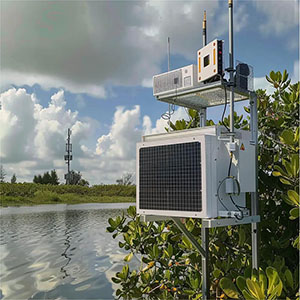
Water body environments have a unique impact on the air quality monitor sensors. Monitoring points along lake and river shores should be located at least 20 meters from the water surface.
Additionally, consider the potential impact of water evaporation on humidity-sensitive sensors. When installing in tidal areas, pay special attention to the effects of tidal fluctuations on temperature and humidity, which can cause periodic changes in monitoring data.
Special Environmental Protection Measures
Special natural environments require targeted protective measures. In foggy regions, professional sensors with anti-condensation design should be selected. In areas prone to lightning strikes, a comprehensive lightning protection grounding system must be established to ensure equipment safety. In regions frequently affected by sandstorms, sensors should be equipped with pre-filtration devices, and a more frequent equipment maintenance schedule should be established.
Recommendations for Long-Term Monitoring Assurance
To ensure the quality of long-term monitoring, it is recommended to conduct at least one full year of environmental assessment prior to site selection to fully understand the cyclical patterns of various natural factors. A comprehensive regular maintenance system should also be established, including seasonal specialized inspections, to promptly detect and respond to various impacts on air quality sensors caused by changes in the natural environment. An abnormal data warning mechanism should also be established to ensure the continuity and reliability of monitoring data.
Air Quality Sensor Installation Height Recommendations
Air quality monitoring is a critical component of environmental protection and public health management, and the installation height of sensors directly impacts the accuracy and representativeness of monitoring data. The appropriate installation height should be determined comprehensively based on monitoring objectives, pollutant characteristics, and environmental features. ATO will provide recommendations for the installation height of air quality sensors tailored to different environmental conditions.
Outdoor Environmental Monitoring Installation Standards
For outdoor environmental air quality monitoring, the recommended installation height for particulate matter (PM2.5/PM10) sensors is 2–3 meters. This height can better reflect the pollution level near the
human breathing zone while avoiding direct interference from ground dust. The sampling port should be kept at a sufficient distance from surrounding obstacles, generally recommended to be more than twice the height of the obstacle, to ensure smooth airflow. Monitoring points for gaseous pollutants (such as ozone, nitrogen dioxide, etc.) are typically set at a height of 3-5 meters. This range adequately represents human exposure levels while minimizing local interference such as ground reflection.
Key Points for Traffic Pollution Monitoring
In terms of traffic pollution monitoring, it is recommended that air quality sensors be installed within 10-20 meters of the road, at a height of 2-3 meters. This setup can accurately reflect the impact of motor vehicle emissions on the surrounding environment, while avoiding the direct impact of traffic turbulence. It is important to note that monitoring points should be located away from traffic lights, bridges, and other special locations to ensure the representativeness of the data. For monitoring on urban main roads, it is recommended to prioritize the installation of sensors on streetlight poles or dedicated monitoring poles on the sidewalk side.
Recommended Monitoring Heights for Industrial Zones
The installation height for industrial zone monitoring should be adjusted according to the characteristics of the pollution source. For downwind monitoring of fixed emission sources, the sensor height should
be similar to the height of the emission outlet; for boundary monitoring, a height of 3-5 meters is generally recommended; and for residential area impact assessments, an installation height of 2-3 meters can be used. When arranging monitoring points, the prevailing wind direction and terrain characteristics of the local area should be fully considered. For high-risk areas such as chemical industrial parks, it is recommended to adopt a multi-height monitoring scheme to obtain more comprehensive pollution dispersion data.
Indoor Environmental Monitoring Standards
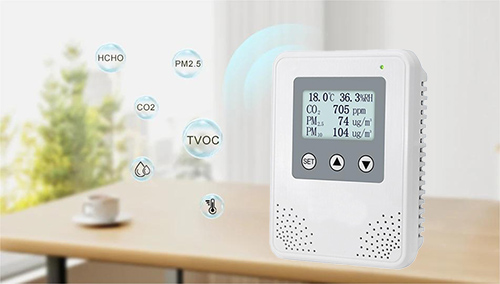
The recommended installation height for indoor air quality monitoring sensors is 1.2–1.8 meters, as this range accurately reflects human exposure levels when sitting or standing. The installation location should be away from areas with significant airflow changes, such as doors, windows, and ventilation openings, and should also avoid locations that may cause localized pollution, such as printers and kitchens. In places such as kindergartens and schools, the installation height can be appropriately lowered to 0.8–1.2 meters to reflect the exposure levels of children. For special places such as hospitals and laboratories, it is recommended to determine the installation location based on the specific usage scenario.
Low-cost Sensor Deployment Recommendations
For emerging low-cost sensor networks, in order to ensure data comparability, it is recommended to use an installation height similar to that of standard monitoring stations, typically between 1.5 and 3 meters. During installation, direct sunlight and rain should be avoided, and good air circulation around the equipment should be ensured. When interpreting data, special consideration should be given to possible interference from microenvironmental factors. It is recommended to assess sensor locations every 3–6 months and make adjustments as necessary to ensure monitoring quality.
Principles for Selecting Installation Height
In actual deployment, the purpose of monitoring air quality sensors should determine the choice of installation height. If the purpose is to assess population exposure risk, it is recommended to use breathing zone height; if the purpose is to study pollution dispersion patterns, adjustments should be made based on specific circumstances. In either case, the representativeness and comparability of monitoring data should be ensured. It is recommended to conduct a site survey before installation, taking into account factors such as the layout of surrounding buildings and vegetation distribution, to select the most representative monitoring location, thereby providing a reliable basis for environmental management and health assessment.
Installation Process for Air Quality Sensors
During the installation of air quality sensors, the following points should be noted:
Ensure Adequate Infrastructure
Before installing the air quality sensor, ensure that the equipment surface is intact. Since sensors typically require external power supply, a suitable and stable power source must be connected during installation, and the power voltage must meet the sensor's operational requirements to prevent malfunctions during measurement. If installation is conducted in a public area, prior approval from relevant authorities must be obtained, and installation must comply with applicable regulations.
Avoid Interference
The installation location of air quality sensors should be as far as possible from other electronic devices or large metal objects to avoid electromagnetic interference affecting the measurement results. Additionally, sensors should be installed at least 10 meters away from common pollution sources such as kitchens and parking lots to avoid local pollution interference.
Wiring Standards
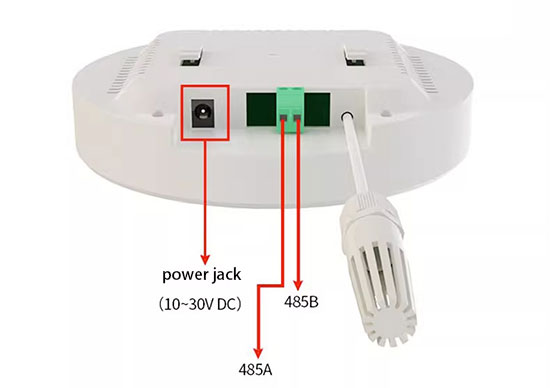
Power supply wiring is the first step. The required voltage level (commonly 12V/24V/220V) must be confirmed, and power cables compliant with specifications must be selected. When wiring, ensure the red wire is connected to the positive terminal and the black wire to the negative terminal, and perform proper insulation. For signal line connections, ensure the RS485 interface's A+/B- terminals are correctly matched; 4-20mA output must ensure correct polarity correspondence; digital signal lines must be connected accurately according to color markings.
For network connections, when using network cables, terminate the connectors according to the standard 568B wiring sequence and ensure proper waterproofing. If using wireless transmission, test the signal strength after installation to ensure it meets requirements. After all wiring is complete, thoroughly inspect each cable connection to ensure it is secure and reliable.
Commissioning and Testing
Before powering on, a comprehensive safety inspection must be conducted to confirm that all wiring is correct, insulation is intact, and the supply voltage is stable. After powering on, observe the status of the device indicator lights, test each interface function one by one, and verify that data transmission is normal. During calibration, perform zero-point calibration according to the manual, set an appropriate data upload interval, and test whether the alarm function triggers normally.
Precautions
Before installation, carefully read the product manual to understand any special requirements. All wiring operations must be performed with the power disconnected to ensure safety. Outdoor installations must include proper lightning protection and grounding measures. During regular use, periodically inspect the wiring terminals for loosening and keep the area around the air quality sensor clean. It is important to note that different brands and models of equipment may vary; actual operations should follow the specific product manual. It is recommended that installation and commissioning be performed by professional technicians.
In summary, the correct installation location of air quality sensors is critical to ensuring monitoring accuracy. This installation guide provided by ATO Industrial Automation will help you adhere to location standards and precautions, thereby enhancing data accuracy and safeguarding urban air quality and public health.
