
How to Choose Signal Isolator
If you are confused by terms like ground loop, common mode interference, or different signal types such as 4-20 mA and 0-10 V, you are not alone.
This guide is designed for:
- Engineers working with PLC or DCS systems
- Automation technicians in industrial control panels
- Buyers selecting signal conditioning or isolation modules
In real applications, signal isolators are mainly chosen based on a few key considerations. Below is a quick table of contents — click to go straight to the topic you care about:
- When Do You Need a Signal Isolator?
- Signal Isolator or Signal Conditioner
- Signal Type Matching
- Power Supply Selection
- Channel and Space Requirements
- Environment and Safety
- Performance Comparison
For example, in a factory with variable frequency drives (VFDs), electrical noise can easily distort sensor signals and cause unstable readings. In chemical plants or oil facilities, improper grounding can even damage PLC input modules due to ground loops.
That’s where signal isolators become essential—they stabilize signals, protect equipment, and ensure accurate data transmission.
This article also provides a 30-second selection reference table for purchasers looking for a reliable 4-20mA signal isolator or universal conditioning module. You can match the right product to your application by checking the key specs side by side.
When Do You Need a Signal Isolator?
You need to condition your signal when a sensor signal cannot be directly and reliably used by the controller (PLC, DCS, or display system). The core job of a signal isolator is to provide electrical isolation, which helps block interference, eliminate ground loops, and protect your equipment.
Some signal isolators also convert or split signals. In that case, you're actually looking at an isolated signal conditioner. — It can also convert, split, and protect signals. That means you might actually be talking about a signal conditioning device that includes isolation.
Here are a few simple signs that your signal has a problem:
- The signal types do not match, such as 4-20 mA vs 0-10 V.
- The signal is weak or unstable over long cable distances.
- Electrical noise from devices like VFDs or motors causes signal fluctuation.
- Multiple devices share the same grounding and create ground loop issues.
In short, if the signal is not clean, compatible, or stable for your controller, a signal isolator with conversion is needed.
Signal Isolator or Signal Conditioner – Which One Should You Pick?
Some problems only need a signal conditioner (like an amplifier or converter), not necessarily an isolator.
Signal Isolator Application Guide
| Your Problem | Possible Risk | Key Thing to Check |
| Signal type mismatch (4-20 mA vs 0-10 V) | Won't work at all | Signal type |
| The signal gets weak after a long distance | Signal loss | Signal type |
| The thermocouple signal is too small | Can't read it | Special signal type |
| Multiple sensors interfering with each other (ground loop) | Ground loop damage | Grounding/Environment |
| The signal gets unstable when a VFD starts up | Data fluctuation | Electromagnetic environment |
| Mixing different types of signals | The system becomes unstable | System integration |
Quick answer for "Thermocouple signal is too small":
A thermocouple outputs a mV-level signal, which a PLC can't read directly. You need a thermocouple transmitter (often built into a signal isolator). It amplifies the signal, handles linearization and cold junction compensation, and converts it to 4-20 mA or 0-10 V. See product examples under "Matching Signal Types" below.
Match Your Signal Type for Your Signal Isolator (Most Important!)
My sensor is a K-type thermocouple. Does your signal isolator support that?
My PLC only takes 4-20 mA. Can you convert it?
This means the sensor outputs a millivolt-level (mV) signal—not a standard analog signal. The PLC’s analog input module can only read 4-20 mA current signals. When selecting a 4-20mA signal isolator, the most critical factor is to ensure it can convert your specific sensor type (like mV or thermocouple) into a standard 4-20 mA output that your PLC can understand.
This is the first step in choosing the right model. If the signal types don’t match, then all the other specs, like accuracy and isolation voltage, are useless.
If you connect a K-type thermocouple (mV) to a basic signal isolator:
The signal isolator doesn't understand mV signals—its input range is usually 4-20 mA or 0-10 V. So the output is still mV, and your PLC still can't read it.
Ask yourself these questions to know if you need signal type conversion:
- What signal does my sensor output? (4-20 mA, 0-10 V, thermocouple, etc.)
- What signal does my controller accept?
Sensor not 4-20 mA? A K-type thermocouple outputs only ~0-50 mV — most PLCs can’t read that. The universal signal isolator ATO-TS-TR/TS-TC lists “K/B/S/E thermocouple, Pt100” as input types. That spec tells you it amplifies mV signals to 4-20 mA. If your sensor type is on that list, the mismatch is solved.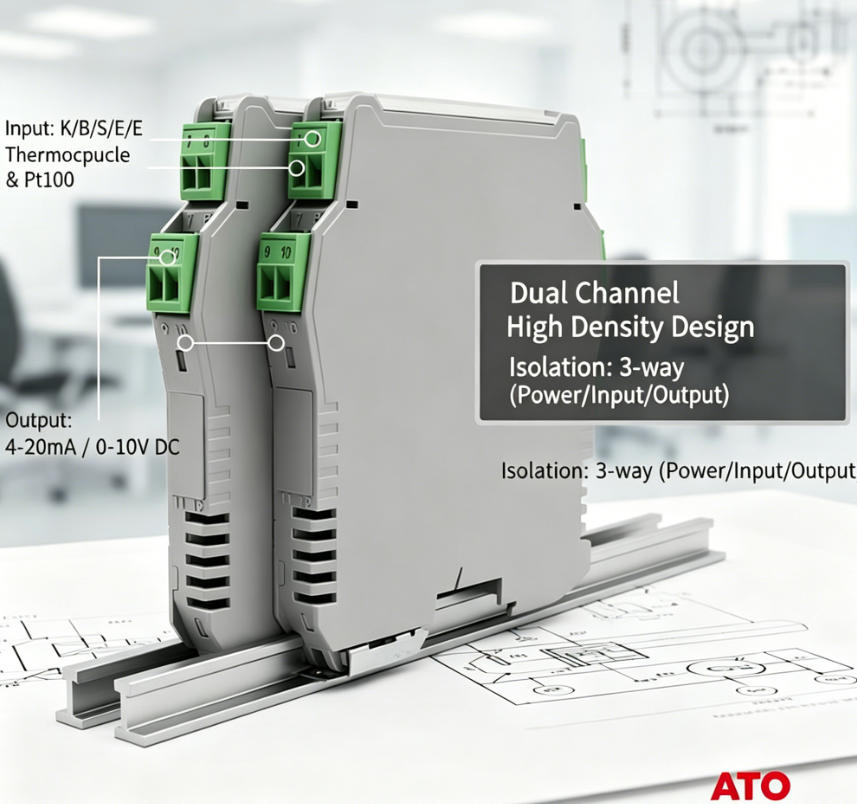
Follow this simple guide for signal isolator and conditioner selection:
- If they don’t match, you need a conditioning function (from a signal conditioner OR a signal isolator that also converts signals).
- If they match but you have interference or ground loops, it means you need a basic signal isolator (it isolates without changing the signal).
- If they don’t match AND you have interference, it means you need a signal isolator with conversion built in.
What to do if your signal gets weak over a long distance?
If you're using 0-10 V or thermocouple mV signals, the signal can weaken or pick up noise when the cable runs longer than 100 feet (30 meters).
Recommended conversion & isolation approach:
0-10 V voltage signals are usually reliable only up to 100 feet. But 4-20 mA current signals can travel thousands of feet (over 1,000 meters). So the fix is to convert your voltage or mV signal to 4-20 mA at the sensor side.
What you need is a 4-20mA signal isolator with conversion capability—one that turns voltage/mV into 4-20 mA and also provides electrical isolation. This type of isolator is essential when converting voltage signals for long-distance transmission to a PLC.
Choose the Power Supply Type for a Signal Isolator
You need to think about whether there is an extra 24 V power cable on site. If there isn’t, and you want something easy, choose loop-powered.
If you want stable performance and strong load capacity, choose a separate power supply.
| Type | Pros | Cons | Best For |
| Loop-powered | No extra power needed | Limited output | Simple systems |
| External power (24 V) | Stable, strong output | Extra wiring | Industrial systems |
Tip:
- Want simplicity? Choose loop-powered.
- Want stability? Choose external power.
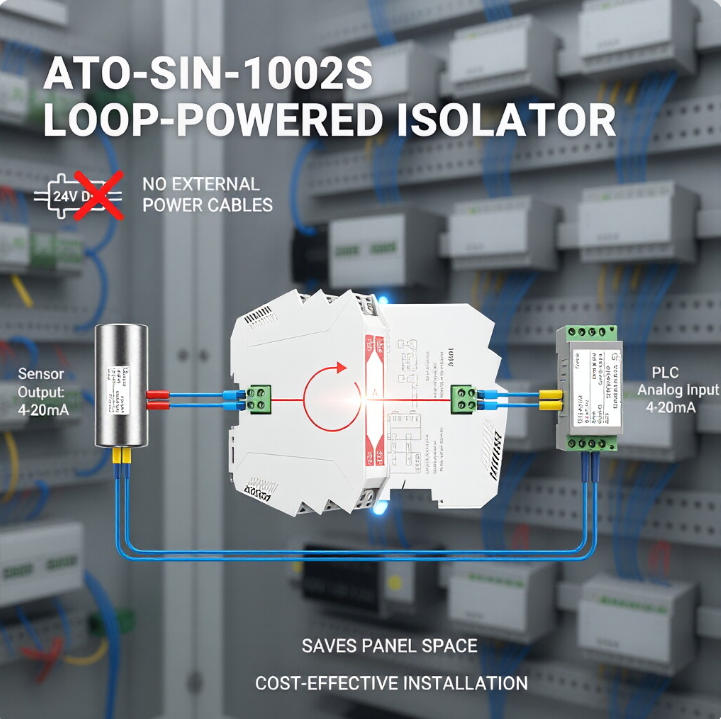
What does "loop-powered" solve? No extra 24 V cable.
The 4-20 mA signal isolator ATO-SIN-1002S draws all power from the 4-20 mA loop (0 W external), converting it to a 0-10 V output. That number means you can install it without pulling new wires — saves cost and space in crowded panels.
Check Space & Channel Requirements for Signal Isolators
Control panels use DIN rails (35 mm), so size matters.
- Narrow modules (12.5 mm) save space
- Wider modules (17.5 mm) may offer more features
Common configurations:
- 1 input for 1 output
- 1 input for 2 outputs (for PLC + display)
- 2 inputs for 2 outputs (space-saving option)
If you are an engineer working with a DCS (Distributed Control System) for large factories, you have to pay attention to channel density (for example, two inputs and two outputs). Because the system is very big, saving space inside the control cabinet means saving money.
Tip:
If you have many signals, multi-channel signal isolators save space and cost.
Channel numbers tell you what fits. The explosion proof signal isolator ATO-FK-SFX110/112/114 series: 110 = 1-in-1-out, 112 = 1-in-2-out, 114 = 2-in-2-out. The extra spec [Ex ia Ga] ⅡC solves hazardous area compliance — without that number, your plant won’t pass safety inspection.
![Specifications table of ATO-FK-SFX110/112/114 explosion-proof signal isolator series. 110 = 1-in-1-out, 112 = 1-in-2-out, 114 = 2-in-2-out. The [Ex ia Ga] ⅡC hazardous area compliance spec ensures your plant safety. Without that number, your plant won't pass safety inspection](/Content/Images/uploaded/blog/explosion-proof-signal-isolator-data.jpg)
Consider Environment & Safety
This one step decides whether your equipment will be shut down by safety inspectors or get burned up in extreme environments.
Isolation Voltage
If you run into problems like 'two sensors interfering with each other' or 'the signal goes crazy as soon as the inverter starts up', that means you have ground loop current or electromagnetic interference. The spec you need to pay attention to is isolation voltage.
This shows how much electrical stress the isolator can handle.
- Standard industrial use: ≥ 1500 V recommended
- High interference (motors, VFDs): higher is better
Higher isolation is better protection
How high is enough?
In normal environments, 1500 V isolation is enough. But if you have a VFD (variable frequency drive), going with 2000 V is a safer bet.
So, which product fits this VFD scenario? You don’t necessarily need a specified 2000 V rating — a well-designed loop-powered isolator with strong isolation and proven noise immunity can do the job.
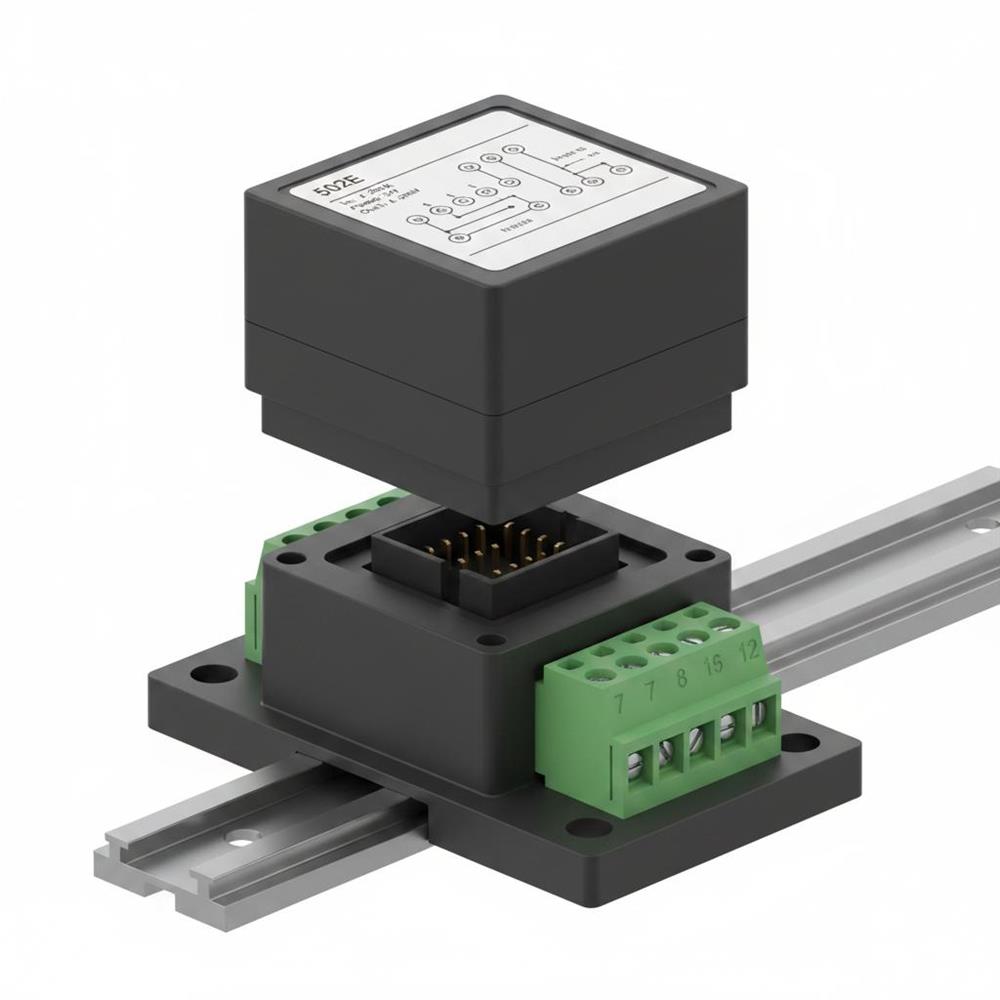
This loop-powered signal isolator ATO-SINIR-502E offers signal conversion and electrical isolation for 4-20 mA/0-20 mA/0-5 V/0-10 V signals. It features strong input/output/power supply isolation to help eliminate ground loops and is suitable for industrial fields with severe signal interference.
What Is 3-Way Isolation?
If your system has both 4‑20 mA and 0‑10 V signals, or if there is a lot of noise from the power supply, what you need is triple isolation (input, output, and power supply are all isolated from each other).
It means full isolation between the following:
- Input
- Output
- Power supply
Choose this if:
- You mix different signal types
- Your system has electrical noise
Do You Need Explosion-Proof Certification?
If you work in:
- Oil & gas
- Chemical plants
- Fuel stations
For dangerous industries (like oil and chemicals), you MUST choose isolators with Ex certification.
Compare Performance
Accuracy
Example: ±0.1% (lower is better)
Temperature Drift (Very Important!)
Shows how much accuracy changes with temperature
Why it matters:
- A cheap signal isolator may work fine at 77 °F (25 °C).
- But at 122 °F (50 °C), readings may drift significantly.
If your control cabinet gets hot, always check temperature drift.
Response Time
| Application | Speed Requirement |
| Temperature/pressure | Not critical |
| Speed/vibration | Fast (≤ 2 ms) |
Tip:
Most applications don't need ultra-fast response.
For experienced engineers: view the full isolated signal conditioning product catalog and datasheets for all technical specifications.
Final Checklist for Choosing a Signal Isolator
| Step | What to Check | Action |
| 1 | Signal type | Must match input & output |
| 2 | Power supply | Loop or external |
| 3 | Channels & size | Fit your panel |
| 4 | Environment | Isolation voltage / safety |
| 5 | Accuracy & drift | Stable under temperature |
| 6 | Response time | Only if high-speed signals |
3 Key Rules for Isolated Signal Conditioning
- Always match signal types first.
- Choose a higher isolation voltage in noisy environments.
- In hot environments, temperature stability matters more than accuracy.
Conclusion
Choosing the right signal isolator doesn’t have to be complicated.
If you focus on:
- Signal compatibility
- Electrical protection
- Environmental conditions
You can quickly find the right solution for your system.
If you need help, provide these details when contacting a supplier:
- Sensor type
- Output signal (e.g., 4-20 mA, 0-10 V)
- Controller/PLC input type
30-Second Selection Reference Table for 4-20mA Signal Isolators
| Type | Model | Best For | Key Feature | Price |
| Universal | ATO-SIN-1002S | Loop-powered, 4-20 mA input to 0-10 V output | No external power needed; best value | $96.88 |
| Industrial | ATO-SINIR-502E | Harsh industrial environments | Switch between loop or external 24 V power, high isolation & anti-interference | $122.13 |
| Multi-function | ATO-TS-TR/TS-TC (ATO-SIGNI-402E) | Special signals like thermocouple (K/B/S/E) or RTD (Pt100) | Universal converter; input to 0-10 V or 4-20 mA output | $101.07 |
| Explosion-proof | ATO-FK-SFX110/112/114 | Chemical plants, oil & gas, hazardous areas | Certified [Ex ia Ga] ⅡC — safe for dangerous locations | $112.84 |
About signal isolator ATO-FK-SFX110/112/114:
- If you need basic 1-to-1 isolation, then choose model 110.
- If you need to split one signal to two receivers, then choose model 112.
- If you need to handle two independent signals in a single module, choose model 114.
This will help you get the best recommendation faster.
If you have special requirements such as an LCD real-time display or USB parameter adjustment, please feel free to contact us, ATO Automation, for customization.
