
Low-Pressure Switch vs. Electric-Contact Pressure Gauge in Fire Protection
Pressure monitoring and control are essential to the reliable operation of firefighting water systems. Two components used for this purpose are the low-pressure switch and the electric-contact pressure gauge. Both respond to changes in system pressure and can be used to trigger control actions at preset pressure thresholds. In some applications, they may serve similar functions, but they differ in how they detect pressure changes, indicate pressure readings, and interact with control circuits.
Understanding these differences helps determine which device better suits a particular fire protection application. This article compares construction, configuration, and installation of low-pressure switches and electric-contact pressure gauges, highlighting the factors to consider when selecting between them.
I. Key Differences at a Glance
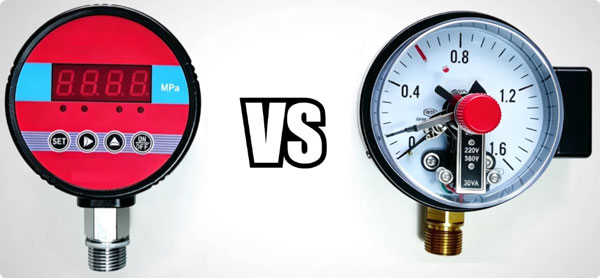
| Low-Pressure Switch | Electric-Contact Pressure Gauge | |
| Construction | Electronic | Mechanical |
| Configuration | Digital menu | Mechanical dial |
| Installation | Discharge pipe | Regulator pipe |
| Output Type | On/Off signal | Analog display + contacts |
| Function | Detects low pressure only | Triggers at high/low setpoints |
| Readout | No visual display | Real-time analog display |
| Adjustability | Fixed set point | Manually adjustable contacts |
| Use Case | Alarm & emergency triggers | Visual + control in one |
II. Construction
The low-pressure switch uses electronic circuitry to detect preset pressure thresholds and trigger a control response, with its single output signal wire identified on the back label. In contrast, the electric-contact pressure gauge uses a mechanical sensing mechanism to display pressure on a dial and activate electrical contacts at preset limits. Its terminal box contains three connections: common, lower limit, and upper limit.
The key difference is that the low-pressure switch provides a pressure-triggered switching signal, while the electric-contact pressure gauge combines visual pressure indication with electrical switching.
III. Configuration
The configuration methods differ according to each device's operating mechanism.
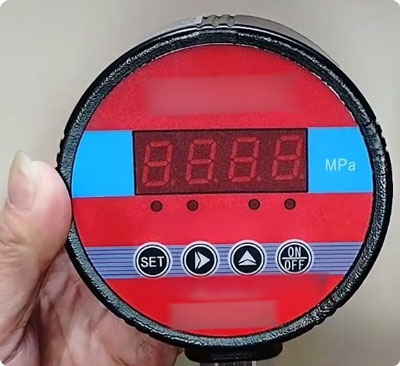
- Low-pressure switch: The pressure threshold is typically set through a keypad and digital menu. The exact setting procedure and available parameters depend on the model. In a firefighting application configured for low-pressure starting, the switch can initiate the specified control response when the pressure falls below the setpoint. Other water systems may use different thresholds and control sequences.
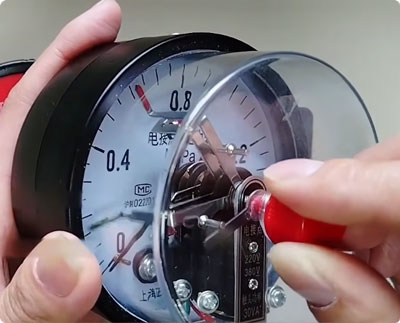
- Electric-contact pressure gauge: The switching limits are adjusted using the gauge's contact-setting mechanism. On some models, a green pointer marks the lower limit, a red pointer marks the upper limit, and a black pointer indicates the current pressure. When the measured pressure reaches a configured limit, the corresponding electrical contact changes state.
IV. Installation
Installation depends on the intended control function and the approved system design.
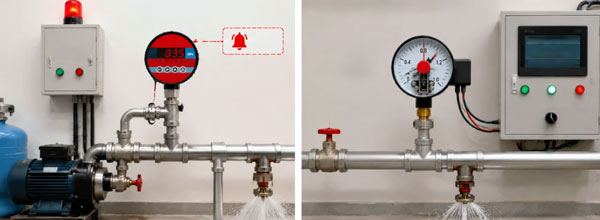
- Low-pressure switch: The switch is installed on the main outlet pipe in the fire pump room. It monitors system pressure and initiates the configured low-pressure response. Whether this response starts a fire pump or activates another control function depends on the approved control sequence and applicable fire protection requirements.
- Electric-contact pressure gauge: The gauge is installed on the regulator line in the water tank room. Its dial allows personnel to observe pressure, while its electrical contacts can support pressure-based control functions.
The installation locations above apply to the specific arrangement being discussed, not every fire protection system. Verify the pressure connection, mounting position, wiring, and control logic against the manufacturer's instructions and approved system drawings. Fire pump start and stop functions must comply with applicable codes; automatic stopping should not be assumed to be permissible in every system.
V. How to Choose
A low-pressure switch is suitable when the primary requirement is to initiate a defined response at a pressure threshold. An electric-contact pressure gauge is useful when operators need to read pressure locally and the system also requires electrical switching at preset limits. When both functions are needed, the two devices can be used together according to the approved system design.
| Application Requirement | Recommended Device | Main Reason |
| Pressure-triggered alarm or control signal | Low-Pressure Switch | Changes output state at a configured pressure threshold |
| Real-time visual pressure monitoring | Electric-Contact Pressure Gauge | Displays the current pressure on a dial |
VI. Conclusion
The low-pressure switch and electric-contact pressure gauge serve different but complementary roles in fire protection systems. The low-pressure switch focuses on pressure-triggered control, while the electric-contact pressure gauge combines visual pressure monitoring with adjustable electrical contacts. When comparing these components, readers can also explore relevant industrial control products and application information on ATO.com. Ultimately, the right choice depends on the required control functions, system configuration, and applicable fire protection requirements. Always verify device specifications, wiring, and control sequences against the approved system design before installation.
