
Hour Meter Basics
In modern industrial and mechanical systems, accurate equipment management is essential for ensuring efficiency, safety, and long-term reliability. As a simple yet highly practical device, hour meter provides precise operating time records that support preventive maintenance, cost control. In this article, we will explore the basics of hour meter.
I. What is a Hour Meter?
Hour meter is an instrument used to track and record the total cumulative operating time of mechanical equipment. Unlike a regular clock, it only keeps time while the equipment is running, accurately recording the cumulative working time in hours or minutes. This quantitative tool provides strong support for the entire lifecycle management of equipment, triggering preventative maintenance based on actual operating time, ensuring scientifically accurate maintenance cycles, thereby extending equipment lifespan and controlling maintenance costs. In short, an hour meter is a fundamental tool for improving operational efficiency and preventing unexpected downtime.
II. Working Principle
The working logic of an hour meter is simple. The core principle of an hour meter is to activate its internal timing system by detecting the device’s operating signals and continuously accumulate the device's actual operating time.
- When the device is started, receives power, or senses a working signal, the internal detection circuitry of the hour meter identifies the "operating status." Once the device is confirmed to be working, the internal timing module begins counting.
- It continuously counts and accumulates time using an internal high-precision clock reference (usually a crystal oscillator) to achieve statistical analysis of the running time.
- When the device stops, loses power, or the signal disappears, the timing pauses. The accumulated running time is periodically stored in non-volatile memory (such as EEPROM or Flash), ensuring long-term preservation even in the event of a power outage.
Different types of hour meters differ slightly in their triggering methods:
- Wired hour meters: Driven by AC/DC power
- Inductive hour meters: Triggered by electromagnetic signals
- Some electronic hour meters: Can be powered by their own batteries and do not require an external power source
III. Features
Hour meters are valued for their reliability and simplicity. It’s features typically include:
- Accurate Time Accumulation
Stable internal clock ensures reliable measurement. - Automatic Operation
Starts and stops counting based on equipment status. No manual operation required, reducing errors and ensuring data authenticity and continuity. - Simple Structure
Most hour meters feature a relatively simple design with no complex computational systems, resulting in low failure rates and extended service life. - Low Power Consumption
Minimal impact on the machine’s electrical system.
IV. Common Types
Hour meters can be categorized into several types based on structure and signal detection method.
- Mechanical Hour Meter
Use a small synchronous motor and gear system to drive number wheels. Durable, resistant to interference, low cost and high reliability, suitable for harsh industrial environments, but subject to mechanical wear over time. - Electronic Hour Meter
Use internal circuits and microcontrollers to count time electronically. More accurate, compact, and widely used today. - AC Hour Meter
Activated when AC voltage is applied, commonly used in industrial equipment. - DC Hour Meter
Triggered by DC power, suitable for vehicles, generators, and battery-powered systems. - Inductive Hour Meter
Operates by sensing the engine's ignition signal, requiring no wiring for power supply. Installation is simple, making it ideal for motorcycles, lawn mowers, and small general-purpose engines.
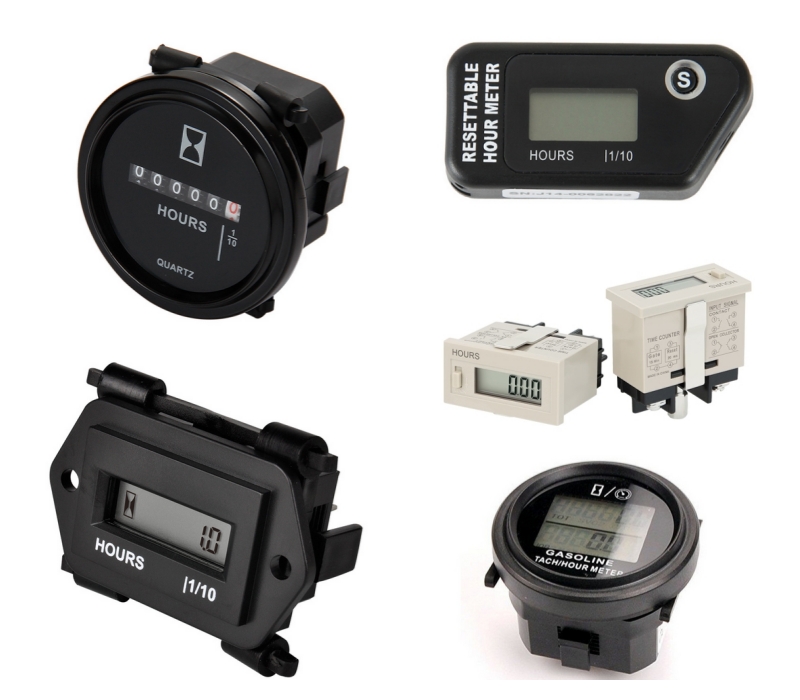
Some advanced models also provide reminders or resettable partial timers.
V. Applications
The Hour Meter is suitable for a wide range of applications. Some are listed below:
- Transportation and Heavy Equipment
Agricultural vehicles, heavy-duty trucks, and material handling equipment rely on hour meters to schedule oil changes, filter replacements, and lubrication intervals based on actual operating stress rather than calendar dates. - Power Generation and HVAC
Generators, compressors, blowers, and HVAC systems utilize hour meters to monitor runtime, verify warranty status, and predict component end-of-life. - Manufacturing and Process Control
Production machinery, assembly lines, and industrial processing equipment employ hour meters for overall equipment effectiveness (OEE) calculations, utilization analysis, and preventive maintenance triggers. - Rental and Fleet Management
Hour meters provide indisputable usage records for fair billing and asset rotation. Equipment resale value improves significantly when documented hour meter readings verify proper maintenance history.
Any equipment that requires scheduled servicing based on running hours can benefit from an hour meter.
VI. Conclusion
Hour meter is a simple yet essential device that records the actual operating time of machinery. By detecting equipment activity and accumulating working hours, it supports preventive maintenance, reduces downtime, and improves management efficiency. Whether in construction, agriculture, industry, or power systems, the hour meter remains a reliable tool. ATO online store offer a wide range of hour meters to meet your needs. Welcome to browse ATO hour meter catalog and feel free to contact us for expert recommendations. Shop now to find the perfect hour meter fit for your equipment.
