
What is a Vacuum Gauge?
A vacuum gauge is a precision tool designed to measure pressure below atmospheric pressure. By using local air pressure as a baseline (0), it tracks exactly how much gas or air has been removed from a sealed system—displaying results in units like Pa, mBar, mmHg, or Micron.
In the professional world, these instruments serve three critical functions:
- Verifying target vacuum depths.
- Detecting system leaks.
- Monitoring equipment performance.
Whether you are evacuating an HVAC unit, diagnosing a car engine, or controlling a chemical reactor, choosing the right gauge is vital. This comprehensive guide breaks down how vacuum gauges work, compares them to pressure gauges, and provides a clear roadmap to help you pick the perfect model.
Contents:
- How Does a Vacuum Gauge Work?
- Vacuum Gauge vs Pressure Gauge: What Is the Difference?
- What Are the Main Types of Vacuum Gauges?
- How to Choose the Right Vacuum Gauge?
- Where Are Vacuum Gauges Used?
- Vacuum Gauges FAQs
- Conclusion
How Does a Vacuum Gauge Work?
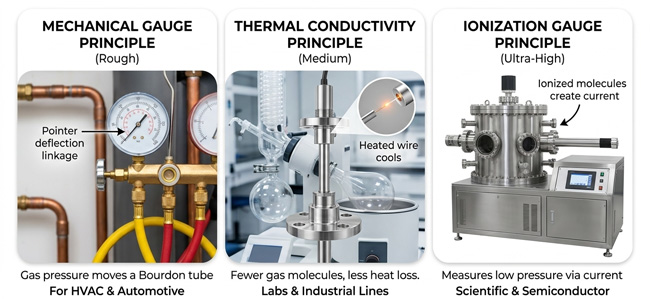
Vacuum gauges use mechanical movement, thermal conductivity, or ionization to measure pressure—the method used depends on how deep the vacuum needs to be measured.
Mechanical Vacuum Gauges (Low / Rough Vacuum, 0 to ~1 kPa)
Mechanical vacuum gauges are used for low vacuum or near-atmospheric pressure measurement. Vacuum gauges use gas pressure to move a Bourdon tube or flexible diaphragm, and this movement is linked to a pointer or converted into an electrical signal—producing a simple, reliable pressure reading. These gauges are durable, require no power source, and are well-suited for HVAC servicing, automotive diagnostics, and general field maintenance.
Pirani Vacuum Gauges (Medium / High Vacuum, 10-1to 105 Pa)
A Pirani gauge measures vacuum by tracking heat loss from a heated wire: when pressure drops, fewer gas molecules are present to carry heat away, causing the wire to cool more slowly. This change in cooling rate is used to calculate the vacuum level with high accuracy. Pirani gauges are the standard choice for industrial automation, factory vacuum lines, and laboratory equipment requiring medium to high vacuum measurement.
Ionization Vacuum Gauges (Ultra-High Vacuum, below 10-3 Pa)
An ionization gauge measures extremely low pressure—typically below 10-3 Pa—by ionizing gas molecules and measuring the resulting electric current. This method is used in high-precision scientific and semiconductor systems, and is rarely needed for standard HVAC or industrial field applications.
Vacuum Gauge vs Pressure Gauge: What Is the Difference?
A vacuum gauge measures negative pressure (below atmospheric), while a pressure gauge measures positive pressure (above atmospheric). Both use atmospheric pressure as the zero reference point, but their scales run in opposite directions.
| Feature | Vacuum Gauge | Pressure Gauge |
| Pressure Type | Below atmospheric (Negative) | Above atmospheric (Positive) |
| Reference Point | Atmospheric pressure (0) | Atmospheric pressure (0) |
| Scale Direction | Negative direction | Positive direction |
| Common Units | Pa, mBar, mmHg, Micron | PSI, kPa, MPa |
| Typical Use | HVAC vacuum, leak detection, engine diagnostics |
Water systems, gas tanks, hydraulics |
- Important: A vacuum gauge reading of 0 means system pressure equals atmospheric pressure—not a perfect vacuum.
- Note: A compound pressure gauge covers both negative and positive pressure ranges in a single instrument. It is the standard choice in HVAC when both vacuum pull-down and refrigerant pressure need to be read on the same gauge.
What Are the Main Types of Vacuum Gauges?
Vacuum gauges are generally classified into four main types based on measurement method and application.
1. Portable Digital Vacuum Gauge
- Best for: HVAC systems, refrigeration service, automotive repair, and field maintenance.
A portable digital vacuum pressure meter provides real-time readings on a digital display, with easy unit switching between Pa, mBar, mmHg, and Micron. Typical range covers atmospheric pressure down to around 75,000 Microns. Selected models include a high-resolution LCD screen and built-in alarms that trigger when pressure moves outside a set threshold—making them practical for carrying on a tool belt and using anywhere on-site.
2. Pirani Vacuum Sensor
- Best for: Industrial vacuum systems, automation control, and safety monitoring.
A Pirani vacuum sensor measures vacuum using thermal conductivity across a wide range from 1×10⁵ Pa down to 1×10⁻¹ Pa. These sensors deliver industrial-grade accuracy with analog output (0–10V / 4–20mA) for direct PLC and automation integration. Standard KF16 / KF25 flange connections are available, and most models automatically detect when the system is open to atmospheric pressure.
3. Compound Vacuum Sensor (Pirani + MEMS)
- Best for: Semiconductor equipment, aerospace systems, laboratories, and precision manufacturing.
A compound vacuum sensor combines MEMS pressure sensing with Pirani technology, allowing continuous full-range measurement from atmospheric pressure down to deep vacuum in a single instrument—without needing to swap sensors at different vacuum stages. High stability and repeatability are maintained across the entire range, with support for both analog and digital output.
4. Wireless Pirani Vacuum Gauge
- Best for: Complex systems, hazardous environments, remote installations, and multi-point monitoring.
A wireless vacuum gauge integrates sensing, display, and wireless data transmission in one unit, allowing operators to monitor vacuum levels remotely without standing next to the equipment. Selected models feature dual LCD screens for two-channel simultaneous display and support Pa, mBar, and Torr unit switching. Analog output is also available for control system integration.
How to Choose the Right Vacuum Gauge?
The right vacuum gauge depends on three factors: vacuum range, output method, and installation type. Work through each step below.
Step 1: Match the Gauge to Your Vacuum Range
Start here—this determines which gauge technology you need:
- If your vacuum is low (atmospheric pressure to 1 kPa)—such as HVAC servicing or automotive repair—a portable digital vacuum gauge is sufficient.
- If your vacuum is medium to high (1 kPa down to 10-1 Pa)—such as industrial automation or laboratory work—a Pirani vacuum sensor is required.
- If you need full-range coverage (atmospheric pressure to deep vacuum)—a compound sensor (MEMS + Pirani) lets you monitor the entire process without changing instruments.
Step 2: Match the Output to Your Workflow
- If you are reading data on-site by eye—choose a gauge with a built-in digital display.
- If you are connecting to a PLC or factory control system—look for 0–10V or 4–20mA analog output.
- If you need remote or multi-point monitoring—choose a model with wireless data vacuum gauge.
Step 3: Check the Fitting Type
The gauge must physically connect to your system. Check the fitting before ordering:
- Fixed industrial systems: KF16 / KF25 flange connection (bolt-on, standard in industrial vacuum pipelines)
- Portable handheld tools: SAE or NPT threaded connectors (screw-in, standard for HVAC service ports)
Where Are Vacuum Gauges Used?
Vacuum gauges are used in any industry that requires controlled pressure below atmospheric level.
- HVAC and Refrigeration Systems
Before charging a system with refrigerant, technicians must remove all air and moisture from the lines. The system must reach below 500 Microns and hold steady to confirm there are no leaks—a portable digital vacuum gauge or Pirani-based instrument is used to verify this. - Automotive Diagnostics
Vacuum gauges are connected to the engine intake manifold to check engine health. A normal reading falls between approximately 45 and 70 kPa; values outside this range typically indicate intake leaks, valve problems, or timing issues. They are also used to test brake booster performance. - Chemical and Process Industries
Vacuum gauges monitor reactors, distillation columns, and process pipelines to ensure chemical reactions occur within the correct pressure range for safe and efficient operation. - Laboratory and Research Equipment
Vacuum ovens, rotary evaporators, and scientific testing systems require precise, stable pressure control. Pirani sensors are the preferred choice in these environments due to their wide range and high measurement accuracy. - Industrial Automation
Sensors with analog output or wireless transmission feed live vacuum data directly into PLC or DCS control systems, enabling automated process control and continuous monitoring without manual intervention.

Vacuum Gauges FAQs
Explore these frequently asked questions to better understand the distinct features, unit conversions, and hidden operational mechanisms of different vacuum gauge types.
Q: Can a vacuum gauge measure positive pressure?
A: No—a standard vacuum gauge only measures pressure below atmospheric pressure. For systems that require both positive and negative pressure measurement, a compound pressure gauge is required.
Q: How do you convert between Pa, mBar, mmHg, and Micron?
A: 1 atm = 101,325 Pa = 1,013.25 mBar = 760 mmHg = 760,000 Microns. Micron is commonly used in HVAC, Pa in laboratories, and mBar in European industrial settings. A digital gauge with unit switching eliminates the need for manual conversion.
Q: What is the difference between a Pirani gauge and a standard digital vacuum gauge?
A: A Pirani gauge measures deeper vacuum (down to 10-1 Pa) using thermal conductivity, while a standard digital gauge is limited to rough vacuum (0 to ~100 kPa) using mechanical or electronic sensors. For HVAC and automotive work, a standard digital gauge is sufficient. For industrial automation and laboratory applications, a Pirani gauge is required.
Q: What does analog output mean on a vacuum sensor?
A: Analog output converts a vacuum reading into a continuous electrical signal (typically 0–10V or 4–20mA) that connects directly to a PLC or control system, enabling automated pressure monitoring without manual intervention.
Q: When should I use a wireless vacuum gauge?
A: Use a wireless vacuum gauge when equipment is in a confined, hazardous, or hard-to-reach location, or when monitoring multiple vacuum points simultaneously. Wireless models transmit live readings remotely, removing the need to stand next to the machine and improving both workflow efficiency and operator safety.
Conclusion
The right vacuum gauge is determined by two factors: the vacuum range of your application and the output method your system requires.
- HVAC and general field service: a portable digital vacuum gauge is sufficient.
- Industrial automation and deep vacuum measurement: a Pirani vacuum sensor is recommended.
- Full-range monitoring from atmospheric to deep vacuum: a compound sensor (MEMS + Pirani) is the best choice.
Looking for a reliable vacuum gauge?
Browse ATO's full range of professional vacuum gauges and sensors at the ATO online store—multiple ranges, output types, and fittings available to match your exact application.
