
What is a Hydraulic Electric Pump?
If you want to fully understand hydraulic electric pumps in the shortest time possible, this guide is all you need.
A hydraulic electric pump is a motor-driven hydraulic unit that converts electrical energy into hydraulic pressure to power cylinders and hydraulic motors. To ensure you make the right choice and avoid operational pitfalls, this guide covers its selection techniques, configurations, and troubleshooting solutions.
- Quick Answer: In simple terms, it is an electrically powered machine used to generate massive force for heavy-duty industrial tasks like lifting, pushing, or clamping objects.
Contents:
- Working Principle of a Hydraulic Electric Pump
- Types of Hydraulic Electric Pumps
- How to Choose a Hydraulic Electric Pump?
- Hydraulic Electric Pump Troubleshooting
- Typical Applications
- Hydraulic Electric Pump FAQ
- Conclusion
Working Principle of a Hydraulic Electric Pump
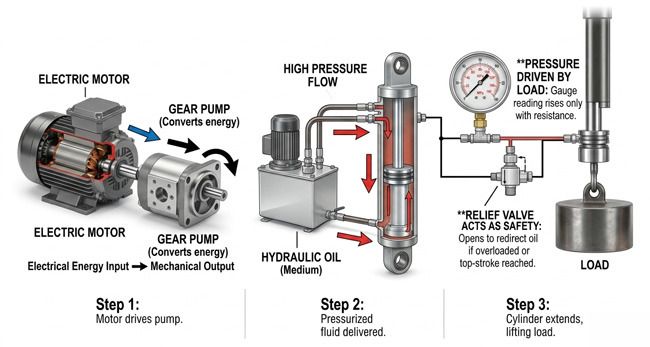
A hydraulic electric pump lifts heavy loads because the hydraulic oil multiplies and transmits pressure to the cylinder.
The basic operating process is simple: The electric motor drives the oil pump, which converts electrical energy into hydraulic energy. The system then relies on a heavy-duty hydraulic electric pump to deliver high-pressure fluid to hydraulic cylinders or motors to extend the piston.
- Pressure is driven by the load: The oil pump itself does not generate pressure. It only delivers oil. Pressure spikes within the system only when the oil flows into the cylinder and encounters an immovable object. The heavier the load, the higher the pressure gauge reading.
- Flow rate determines the operating speed: A larger pump flow rate outputs more oil per minute. Consequently, the hydraulic cylinder extends or retracts much faster.
- The relief valve acts as a safety valve: The cylinder may reach the end of its stroke. Alternatively, the load may be completely overloaded. In either case, the relief valve automatically opens to redirect oil back to the reservoir, preventing the hydraulic hose from bursting.
Types of Hydraulic Electric Pumps
When purchasing, skip the complex internal mechanics and focus directly on the pump core type to make a quick decision:
Gear Pumps: Ideal for low-cost, low-pressure systems. Best choice for tight budgets and harsh, dirty environments (e.g., simple lift tables, forklifts).
Vane Pumps: Ideal for quiet and smooth operation. Best choice for indoor environments with strict noise limits (e.g., precision machine tools, indoor assembly lines).
Piston Pumps: Ideal for high-pressure and ultra-high-pressure heavy-duty systems. A must-have for heavy-duty applications requiring over 10,000 PSI (e.g., bridge lifting, heavy press machines).
| Pump Type | Common Pressure Range | Volumetric Efficiency (Internal Leakage) | Noise Level | Selection Advice |
| Gear Pump | 2.5 - 16 MPa(360 - 2300 PSI) | 70% - 90% | High | Best for low budgets, dirty environments, and low-pressure setups. |
| Vane Pump | 6 - 21 MPa(870 - 3000 PSI) | 80% - 95% | Low | Best for indoor factories, precision machinery, and noise-sensitive areas. |
| Piston Pump | 10 - 100 MPa(1450 - 14500 PSI) | 85% - 98% | Medium-High | A must-have for ultra-high pressure and lifting hundreds of tons. |
Pro tip: Higher volumetric efficiency means less internal leakage, lower energy loss, and better power savings.
Core Circuit Configuration: Single-Acting vs. Double-Acting
Single-Acting (One Hose): Power-extends the cylinder, then relies on gravity or an internal spring to retract it. A typical industrial setup often pairs a single-acting hydraulic jack with a 750W single-acting hydraulic electric pump.
Double-Acting (Two Hoses): Both extension and retraction are forcefully driven by the motor and high-pressure oil. This design is highly suitable for complex machinery, such as 1.5 kW heavy-duty double-acting hydraulic electric pumps used in dump trailers or material handling platforms.
How to Choose a Hydraulic Electric Pump?
Core Selection Principle: Meet the maximum working condition requirements while leaving a 10% to 15% safety margin.
Step 1: Determine Required Pressure (PSI or MPa)
Pressure determines the weight capacity the equipment can lift.
- Selection Example: To lift a 10-ton load using a 100 mm diameter cylinder, the calculation yields a requirement of 1.25 MPa. Accounting for a safety margin, you should purchase a pump with a rated pressure of at least 1.5 MPa (217 PSI). (Note: For standard Western ultra-high pressure heavy-duty tools, the market standard is universally set to 70 MPa / 10,000 PSI, eliminating the need for calculations).
Step 2: Determine Required Flow Rate (GPM or L/min)
Flow rate determines the operating speed of the equipment.
A simple rule for estimating flow rate is:
Q = V × 1.1
Where:
Q = Required flow rate (L/min)
V = Cylinder hydraulic demand per minute (L/min)
1.1 = Safety margin factor (10%)
- Selection Example: If a cylinder requires 1 liter of oil for a single stroke and needs to cycle 5 times a minute, you should purchase a pump with a flow rate of at least 5.5 L/min (approx. 1.45 GPM).
Step 3: Match the On-Site Power Supply
Always check the motor voltage before ordering, as this is the most common mistake in online purchasing:
- North American Standard: Look for 110V - 120V AC / 60Hz.
- European/UK/Chinese Standard: Look for 220V - 240V AC / 50Hz.
- Mobile/Vehicle Applications: Look for 12V DC or 24V DC powered by vehicle batteries.
- Industrial Facilities: Choose three-phase power (380V - 480V AC), which is widely compatible with heavy-duty units like the 1.5 kW hydraulic electric pump.
Step 4: Check the Oil Reservoir Capacity
- Selection Conclusion: For continuous operation spanning several hours, you must buy a large reservoir of 10L (2.6 Gallons) or more.
- The Reason: Low fluid levels in a small tank cause the hydraulic oil to overheat rapidly, which directly degrades and destroys the internal rubber seals.
Hydraulic Electric Pump Troubleshooting
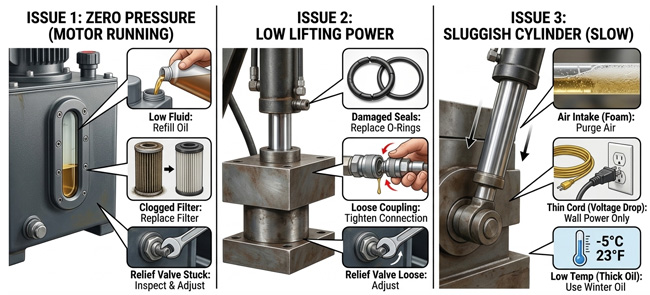
If you are a hands-on user, you can use the table below to quickly diagnose and fix common issues yourself:
| Issue | Common Cause | DIY Solution |
| Motor runs, but the system develops zero pressure |
|
|
| Equipment functions, but lacks lifting power |
|
|
| Cylinder moves extremely slowly, like a snail |
|
|
SAFETY WARNING: High-pressure hydraulic fluid can slice through skin like a blade! Before performing any maintenance or disconnecting hoses, you must unplug the power supply and repeatedly cycle the control handle to relieve pressure. Verify the pressure gauge reads exactly zero before working!
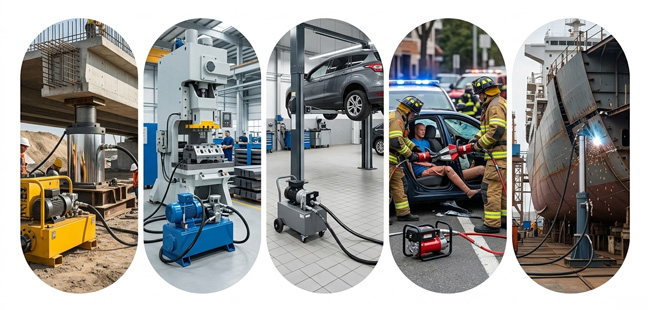
Typical Applications
Thanks to their high power output and flexible control options, hydraulic electric pumps are widely utilized across various heavy-duty industries:
- Construction Engineering: Synchronized bridge lifting, house foundation leveling, static pile driving, and concrete component demolding.
- Industrial Manufacturing: Factory mold clamping, component press-fitting, metal sheet shearing, bending, and stamping.
- Automotive Repair: Vehicle post lifts, tire removal, frame realignment, and engine replacements.
- Emergency Rescue: Vehicle extrication at accident scenes, earthquake search and rescue shoring, and firefighting operations.
- Shipbuilding & Marine Engineering: Hull welding alignment, heavy equipment installation, and steering gear calibration.
- Scientific Research Testing: Material mechanics testing rigs, foundation pile load testing, and pressure vessel hydrostatic testing.
Hydraulic Electric Pump FAQ
To help you avoid common operational mistakes and keep your system running smoothly, we have compiled the most frequently asked questions by hydraulic technicians:
Q1: How do you maximize the lifespan of a hydraulic electric pump?
A: Regular maintenance is required to extend the lifespan of a hydraulic electric pump. Check the oil level before each use, ensure the pressure gauge returns to zero weekly, clean the suction filter every 2 months, and replace hydraulic oil every 6 months. High-pressure hoses should also be inspected regularly for damage.
Q2: How do you choose the correct hydraulic oil for a hydraulic electric pump?
A: The hydraulic oil used in a hydraulic electric pump must match the operating temperature. ISO VG 32 or 46 is suitable for moderate climates (10°C–40°C), ISO VG 22 is recommended for cold environments below 10°C, and ISO VG 68 is used in high-temperature conditions above 40°C.
Q3: How do you adjust the pressure of a hydraulic electric pump?
A: To adjust the pressure of a hydraulic electric pump, a pressure gauge must be connected. Loosen the locknut, turn the relief valve screw clockwise to increase pressure or counter-clockwise to decrease it, then monitor the gauge and avoid exceeding the rated pressure. Finally, tighten the locknut to secure the setting.
Q4: Is a higher working pressure better for a hydraulic electric pump?
A: No. A hydraulic electric pump operating at excessive pressure may suffer from overheating, higher energy consumption, and seal damage. The pressure should match the actual load with a 10% safety margin, and the system should be shut down once the cylinder reaches its end position.
Conclusion
The hydraulic electric pump serves as an indispensable power unit in modern industry. Correctly understanding its working mechanics, mastering precise selection criteria, and sticking to routine maintenance will optimize its performance, extend operational lifespan, and lower overall operational costs.
During selection, clearly define your system's pressure and flow rate needs, verify the facility's electrical compatibility, and choose the correct pump core mechanism. ATO provides various hydraulic electric pump configurations, including gear, vane, and piston models for different industrial applications to match various heavy-duty industrial and precision setups perfectly.
