
10 Industrial Communication Protocols
Industrial communication protocols are the foundation of every modern automation system. PLCs rarely operate alone—they continuously communicate with HMIs, sensors, servo drives, robots, industrial PCs, and other field devices. Communication protocols define how these devices exchange data accurately, efficiently, and reliably.
From traditional serial communication to Industrial Ethernet and Industrial IoT (IIoT), different protocols are designed for different requirements, including communication speed, real-time performance, interoperability, and scalability. If you're new to PLC programming or industrial automation, understanding the most common communication protocols is an essential first step. In this guide, we'll introduce 10 industrial communication protocols every beginner should know, explain their key features, and highlight where each protocol is commonly used.
- Why PLC Communication Protocols Matter
- 10 Essential PLC Communication Protocols
- Comparison of PLC Communication Protocols
- Conclusion
I. Why PLC Communication Protocols Matter
No single communication protocol is suitable for every application. Some prioritize simplicity and compatibility, while others focus on deterministic real-time communication for motion control or seamless data exchange across different software platforms. Generally speaking:
- Serial communication: Modbus and Profibus are widely used in traditional industrial control systems.
- Industrial Ethernet: EtherNet/IP, EtherCAT, Profinet, and CC-Link IE deliver higher speed and better real-time performance.
- CAN-based communication: CAN/CANopen and DeviceNet are designed for reliable embedded control.
- Software interoperability: OPC UA enables secure communication between devices, software, and cloud platforms regardless of manufacturer.
II. 10 Essential PLC Communication Protocols
1. Modbus
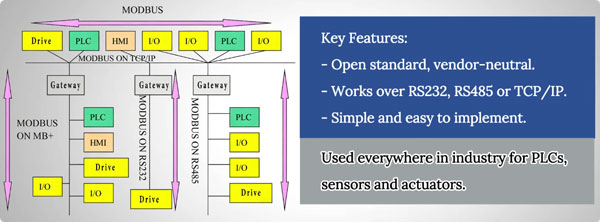
Modbus is one of the oldest and most widely used industrial communication protocols. It is a serial-based protocol that supports multiple communication media, including RS232, RS485, and TCP/IP. The three common versions are Modbus RTU, Modbus ASCII, and Modbus TCP.
Because Modbus is open, vendor-independent, reliable, flexible, and easy to implement, it remains the preferred choice for connecting PLCs, sensors, actuators, variable frequency drives, and other industrial devices in small and medium-sized automation systems.
2. Profibus
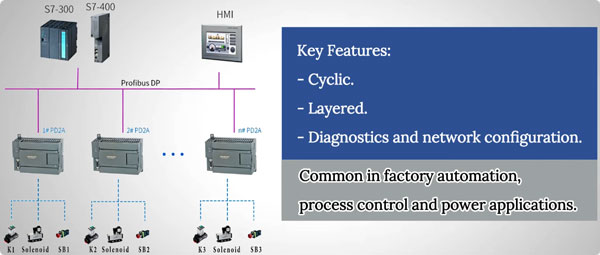
Profibus is an open communication protocol developed for industrial data transmission. It supports several transmission media, including serial communication, fiber optics, and Ethernet-based networks.
Using cyclic communication, a layered communication model, and built-in diagnostic and network configuration functions, Profibus has become a mature solution for factory automation, process control, and power applications, particularly in large distributed systems.
3. EtherNet/IP
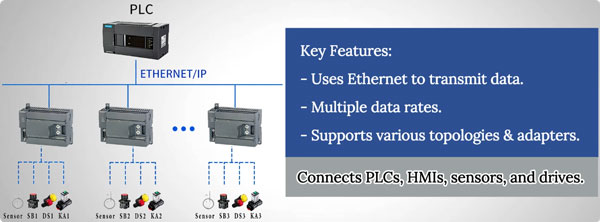
EtherNet/IP combines standard Ethernet technology with industrial automation communication. It supports multiple transmission speeds, high-speed data transfer, real-time control, flexible network topology, and protocol adapters.
Its compatibility with standard Ethernet infrastructure makes EtherNet/IP one of the most popular Industrial Ethernet protocols for connecting PLCs, HMIs, sensors, actuators, and industrial controllers in large manufacturing systems.
4. EtherCAT
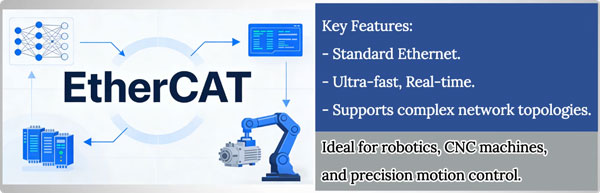
EtherCAT is an ultra-fast real-time Industrial Ethernet fieldbus designed for applications requiring extremely precise synchronization. Instead of communicating with each device separately, EtherCAT sends a single Ethernet frame through every node, allowing each device to process data while the frame is passing.
This unique communication method minimizes latency and makes EtherCAT an ideal solution for multi-axis motion control, robotics, servo systems, CNC machines, and other high-speed automation equipment.
5. Profinet
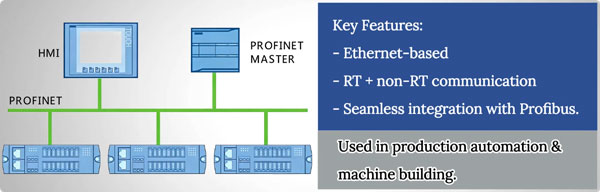
Profinet is the Ethernet-based evolution of Profibus. It supports both real-time and standard Ethernet communication while connecting PLCs, distributed I/O modules, servo drives, and other automation devices.
Its high performance, flexible architecture, and easy integration with enterprise networks have made Profinet a leading protocol in production automation, process automation, and machine building.
6. CAN / CANopen
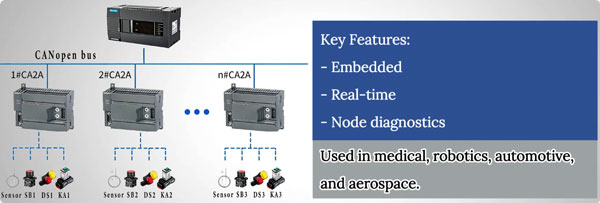
CAN (Controller Area Network) was originally developed for embedded control systems and is known for its reliability and real-time performance. CANopen extends the CAN protocol by standardizing communication between devices while supporting automatic node detection and diagnostic functions.
Today, CAN and CANopen are widely used in industrial control, robotics, medical equipment, transportation, automotive systems, and aerospace applications where dependable real-time communication is essential.
7. DeviceNet
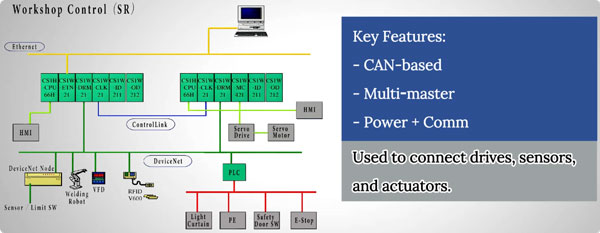
DeviceNet is another industrial protocol built on CAN technology. It supports multi-master network structures and allows communication and power to share the same cable, simplifying wiring and reducing installation costs.
By standardizing cyclic I/O data exchange between industrial devices, DeviceNet is commonly used for connecting sensors, actuators, motor drives, and other field equipment.
8. CC-Link
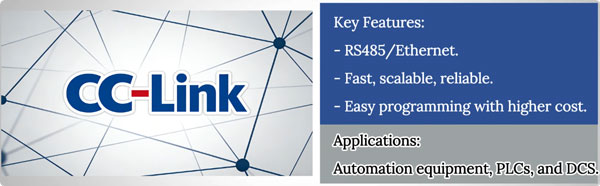
CC-Link is an open industrial fieldbus widely adopted in Asia, particularly in Mitsubishi-based automation systems. Supporting both RS485 and Ethernet communication, CC-Link offers high-speed communication, scalability, and excellent reliability.
Although complete CC-Link systems generally require a higher investment, they are easy to configure and are commonly found in PLC systems, machine tools, industrial robots, automation equipment, and distributed control systems.
9. CC-Link IE
CC-Link IE is the Industrial Ethernet version of CC-Link. It provides deterministic Gigabit Ethernet communication with transmission speeds of up to 1 Gbps and supports as many as 121 nodes on a single network.
Its outstanding bandwidth and scalability make CC-Link IE an excellent choice for large distributed control systems and factory-wide automation networks.
10. OPC UA
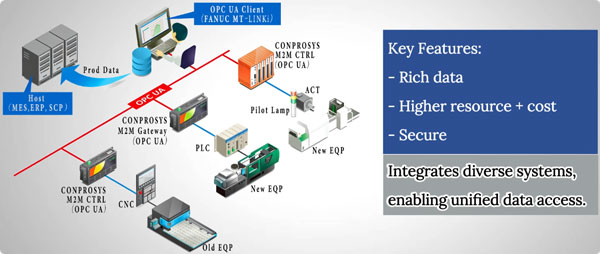
Unlike the previous protocols, OPC UA is not a fieldbus but a platform-independent communication standard. It enables secure data exchange between devices, software, and systems from different manufacturers through a standardized interface.
OPC UA supports complex data structures, unified information models, and advanced security features. Although it requires more hardware and software resources than simpler protocols, it has become the preferred solution for SCADA systems, MES platforms, Industrial IoT, and smart factory applications.
III. Comparison of PLC Communication Protocols
| Protocol | Communication Type | Typical Applications |
| Modbus | Serial / Ethernet | General PLC communication |
| Profibus | Serial Fieldbus | Factory and process automation |
| EtherNet/IP | Industrial Ethernet | Large manufacturing systems |
| EtherCAT | Real-time Ethernet | Motion control and robotics |
| Profinet | Industrial Ethernet | Production automation |
| CAN / CANopen | CAN Bus | Embedded industrial control |
| DeviceNet | CAN Bus | Sensors, actuators, and drives |
| CC-Link | RS485 / Ethernet | Mitsubishi automation systems |
| CC-Link IE Gigabit | Gigabit Industrial Ethernet | Large distributed control systems |
| OPC UA | Software communication standard | SCADA, MES, IIoT, and cloud integration |
IV. Conclusion
Industrial communication protocols form the backbone of every automation network, but each protocol is designed with different priorities in mind. Traditional serial protocols like Modbus and Profibus remain popular for reliable device communication. EtherNet/IP, EtherCAT, Profinet, and CC-Link IE provide the speed and real-time performance required by modern Industrial Ethernet applications. CAN/CANopen and DeviceNet continue to deliver dependable communication for embedded and field-level devices, while OPC UA enables secure, standardized data exchange across different manufacturers, software platforms, and Industrial IoT systems. By understanding these 10 essential PLC communication protocols, you'll be better prepared to select the right network for your automation projects, troubleshoot communication issues, and build more efficient industrial control systems. If you have any technical questions or need assistance with product selection, you can contact the ATO.com for support.
