
Difference Between Signal Isolator And Signal Conditioner
A signal isolator electrically separates input and output circuits to block ground loops and interference — the signal type and range remain unchanged at the output.
A signal conditioner converts raw sensor signals (thermocouple, RTD, 0–5V) into standard formats a PLC or DCS can read directly, with amplification, filtering, and linearization built in.
They are not interchangeable. Use the wrong one and you either fail to fix the noise problem or fail to convert the signal.
- Quick Answer
A signal isolator electrically separates input and output circuits to eliminate ground loops and interference, without changing the signal type.
A signal conditioner converts or processes raw sensor signals — including amplification, filtering, type conversion, and linearization — so a PLC or DCS can read them directly.
When both functions are required, an isolated signal conditioner is used. - Core Difference
A signal isolator protects a signal from its electrical environment.
A signal conditioner changes the signal itself into a format the control system can read.
In practice, the most common mistake we see is engineers deploying an isolator when the real problem is signal format mismatch — or vice versa. This guide is built to help you identify the root cause before selecting a device.
Contents:
- What Is a Signal Isolator and Signal Conditioner?
- Signal Isolator vs Signal Conditioner: Key Differences
- How to Choose Between Signal Isolator and Signal Conditioner
- Typical Applications of Signal Isolators and Signal Conditioners
- Common Mistakes in Signal Isolator and Conditioner Selection
- FAQ: Signal Isolator vs Signal Conditioner
- Conclusion
What Is a Signal Isolator and Signal Conditioner?
To properly design an error-free control loop, it is essential to first understand the distinct roles these two components play in signal integrity and processing.
What is a signal isolator?
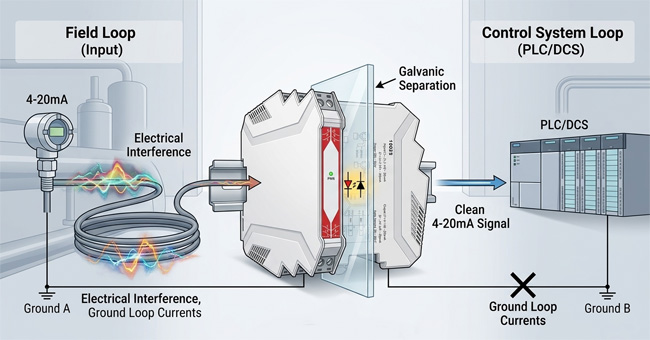
A signal isolator electrically separates input and output circuits while transmitting the signal unchanged. It uses optical, magnetic, or capacitive coupling to block ground loops, common-mode interference, and cable noise — without altering the signal type or range.
This matters in practice because the root cause of most unstable 4–20mA readings is not the transmitter — it's a conducted interference path that an isolator can break at the source.
It eliminates:
- Ground loop currents
- Common-mode voltage interference
- Electrical noise from VFDs or long cable runs
In practical applications, deploying a reliable 4-20mA signal isolator ensures that field devices and control systems remain electrically independent even when sharing the same signal loop.
What is a signal conditioner?
A signal conditioner is a device used to process raw sensor signals and convert them into standard formats that control systems can directly read.
Industrial sensors often output signals that are weak, non-linear, or non-standard, such as thermocouples or 0–5V analog signals. These signals cannot be directly accepted by PLC or DCS input modules.
A signal conditioner bridges this gap by performing functions such as:
- Signal amplification
- Filtering
- Linearization
- Range conversion
- Sensor excitation (power supply)
Electrical isolation may be included in some models, but it is not a mandatory function and must be verified in the datasheet.
Signal Isolator vs Signal Conditioner: Key Differences
Signal isolators and signal conditioners solve different problems in industrial signal transmission systems. The table below covers the parameters that matter most when you are comparing the two in a real specification.
| Parameter | Signal isolator | Signal conditioner |
| Primary function | Electrical isolation between circuits | Signal conversion and processing |
| Changes signal type? | No — same type in and out | Yes — converts type and range |
| Isolation included? | Always | Optional — verify in datasheet |
| Amplification / filtering | Not included | Common features |
| Sensor power supply | Some models | Commonly supported |
| Linearization | No | Available on some models |
| Typical isolation voltage | 500V–3000V RMS | 0V (non-isolated) or 500V–1500V |
| Signal accuracy impact | Minimal — transparent pass-through | Depends on processing circuit quality |
| Typical use case | 4–20mA loop with grounding issues | Thermocouple or RTD to PLC conversion |
Pro Tip: Signal isolator preserves the signal. Signal conditioner modifies it.
How to Choose Between Signal Isolator and Signal Conditioner
Selection comes down to identifying the root cause of the problem.
If the signal type is already correct but the reading is unstable, the problem is electrical — an isolator solves it.
If the signal type or range does not match what the control system expects, the problem is format — a conditioner solves it. If both problems exist simultaneously, an isolated signal conditioner resolves both in a single device.
- Ground loops, common-mode interference, or electrical safety separation required — and signal type does not need to change?
→ Use a standalone signal isolator - Signal conversion, range adjustment, filtering, linearization, or sensor power required — with no electrical isolation requirement?
→ Use a non-isolated signal conditioner - Both electrical isolation and signal processing are required?
→ Use an isolated signal conditioner (integrated)
Before finalizing selection, also confirm:
- Input and output signal types are both supported
- The isolation voltage rating meets your system's actual voltage levels
- The power supply method (loop-powered vs. external) matches your installation.
In hazardous areas, verify whether intrinsic safety certification is required — a standard isolator does not qualify.
Choose a Signal Isolator When
You should select a high-quality signal isolator when your field environment matches any of the following conditions:
- VFDs or large motors create electrical noise near signal cables
- High-voltage and low-voltage systems require separation
- Long cable runs cause ground potential differences
- Signal type is correct, only interference exists
Choose a Signal Conditioner When
A signal conditioner becomes essential when dealing with any of the following application challenges:
- Thermocouple or RTD needs conversion to 4–20mA
- Sensor output does not match PLC input range
- Signal requires amplification or linearization
- Two-wire sensors require loop power
- Analog signals are weak or non-linear
Typical Applications of Signal Isolators and Signal Conditioners
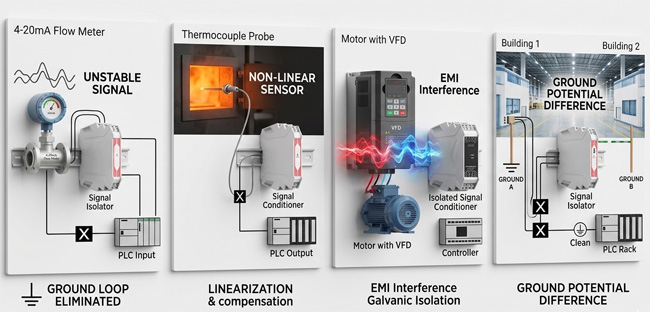
The following scenarios represent the most common use cases in process control, power, and manufacturing environments. Each follows the same logic: identify the problem type first, then select the device that matches it.
- Unstable 4–20mA loop signal → Signal isolator
Ground loop current from cabinets at different ground potentials adds noise to the reading. An isolator breaks the loop path without changing the 4–20mA signal itself. - Thermocouple input to PLC system → Signal conditioner
Utilizing a dedicated thermocouple/RTD signal conditioner allows you to convert millivolt-level thermocouple output into standard industrial signals with built-in linearization and cold-junction compensation. - Sensors installed near VFDs or motors → Isolated signal conditioner
VFD environments combine strong electromagnetic interference with potential signal format mismatches. An isolated signal conditioner handles both in one device. - 0–5V to 4–20mA conversion → Signal conditioner
Signal type mismatch between sensor output and PLC input card. A non-isolated conditioner handles the conversion if grounding is not a concern. - Long-distance signal transmission between buildings → Signal isolator
Cables running between buildings accumulate ground potential differences over distance. An isolator at the receiving end eliminates the resulting interference without signal conversion. - Hazardous area instrumentation → Safety barrier
Explosive environments require a device that limits energy entering the hazardous zone. A certified safety barrier with IS certification is required — a standard signal isolator does not qualify.
Common Mistakes in Signal Isolator and Conditioner Selection
Most selection errors fall into a few common patterns. These mistakes are avoidable if you check the datasheet and clearly identify the problem you need to solve.
Mistake 1: Confusing isolators with conditioners
- A signal isolator only provides electrical isolation. It does not amplify, filter, or convert signals.
- A signal conditioner processes signals but may not include isolation.
- Using the wrong device won’t solve the problem and may create new issues.
Mistake 2: Assuming all conditioners include isolation
- Many signal conditioners are non-isolated.
- If your sensor and control system have ground potential differences, a non-isolated conditioner won’t remove interference.
- Always check the datasheet for the isolation voltage. No value listed = non-isolated.
Mistake 3: Using a standard isolator in hazardous areas
- Explosive or hazardous areas require certified safety barriers (Zener or galvanic type) with intrinsic safety (IS) certification.
- Standard isolators do not limit energy and cannot replace safety barriers.
Mistake 4: Expecting isolators to fix signal format issues
- A signal isolator cannot convert a thermocouple’s millivolt signal to a PLC-compatible range.
- The root issue is signal format, not interference.
- Use a signal conditioner with thermocouple input for proper conversion.
FAQ: Signal Isolator vs Signal Conditioner
To help you make the right choice for your control system, we have answered some of the most frequently asked questions regarding signal isolators and conditioners below:
Q1: Can a signal isolator replace a signal conditioner?
A: No. A signal isolator does not convert, amplify, or process signals; it only provides electrical isolation.
Q2: Do I always need a signal isolator for 4–20mA signals?
A: Not always. It depends on grounding and the electrical environment. In noisy industrial settings, isolators are commonly used.
Q3: Does a thermocouple require a signal conditioner?
A: Yes. Thermocouples output millivolt signals that need amplification, linearization, and conversion before they can be read by a PLC.
Q4: How do I know if my system has a ground loop problem?
A: Common signs include unstable readings that shift when nearby equipment switches on, or a consistent offset between the expected and actual 4–20mA value.
Conclusion
Signal isolators and signal conditioners are both essential components in industrial automation, but they serve different purposes.
- Signal isolators focus on electrical isolation and noise immunity
- Signal conditioners focus on signal conversion and system compatibility
In many real-world systems, both functions are required simultaneously, which is why integrated isolated signal conditioners are widely used.
Correct selection depends on identifying the root cause: electrical interference or signal format mismatch.
If you are selecting a signal isolator or signal conditioner for an industrial automation project and are unsure about signal compatibility — 4–20mA, 0–10V, thermocouple, RTD, or others — contact ATO technical support for selection guidance.
