
How to Choose a Weighing Indicator?
Learn how to select the right weighing indicator for industrial applications in the USA, Europe, and Southeast Asia. This 2026 buying guide covers accuracy, connectivity, display type, and environmental considerations to ensure reliable and cost-effective operations.
This guide provides a practical framework to help you evaluate and select a weighing indicator that meets your application requirements. A variety of digital weighing indicators are available at the ATO.com Online Store, offering options for different industrial needs, from compact panel displays to multifunctional controllers.
- What Is a Weighing Indicator
- How to Choose the Right Weighing Indicator
- ATO Weighing Indicators Price List
- Why Choose ATO Weighing Indicators
What Is a Weighing Indicator
A weighing indicator is the central control unit of a scale system that receives signals from load cells and converts them into precise, readable weight values. Designed for industrial users, these digital weighing indicators support advanced functions such as data transmission, printing, automation control, and remote monitoring, making them ideal for applications in manufacturing, logistics, agriculture, and infrastructure, where accurate, real-time weight data and system connectivity are critical.
How to Choose the Right Weighing Indicator
Choosing the right weighing indicator is essential for achieving accurate measurements, operational efficiency, and seamless integration in industrial applications. A well-selected digital weighing indicator ensures reliable performance in manufacturing, logistics, agriculture, and infrastructure projects. To make an informed decision, consider the following key factors:
1. Compatibility with Load Cells
Ensure the weighing indicator is compatible with your load cells, whether they output analog (mV/V) or digital signals (RS485, Modbus, or Ethernet). Indicators supporting multiple load cells are ideal for large platforms, truck scales, or weighbridge systems. Proper compatibility avoids measurement drift and ensures long-term reliability.
2. Accuracy and Resolution
High-precision weighing indicators provide finer resolution and stable calibration, which is critical for applications requiring precise measurements, such as laboratory scales, industrial production lines, or quality control processes. Look for features like advanced A/D conversion and high-resolution signal processing to maintain consistent accuracy over time.
3. Display and Power Options
Choose an indicator with a display suited to your environment. LED displays offer high visibility in bright industrial settings, while backlit LCDs are better for indoor or low-light environments. Consider the power source—AC, DC, or battery-powered models—to match mobility requirements and ensure uninterrupted operation.
4. Communication and Integration
Modern industrial systems often require data collection and automation. Select a weighing indicator with the right communication interfaces, such as RS232, RS485, USB, Ethernet, WiFi, or Bluetooth, for easy integration with PLCs, SCADA systems, printers, or computers. These features enable remote monitoring, automated logging, and real-time data analysis.
5. Environmental Suitability
Industrial environments vary greatly, from dusty warehouses to outdoor storage yards. Verify the operating temperature range, IP rating (e.g., IP65 or IP67), and robust construction of the indicator. Indicators designed for harsh conditions provide long-term durability and stable performance in challenging settings.
7. Additional Features
Advanced weighing indicators may offer extra functionalities such as data transmission, printing, automation control, and remote monitoring, effectively turning the indicator into an intelligent data hub that enhances industrial connectivity and workflow efficiency.
ATO Weighing Indicators Price List
| SKU | Product | Details | Price |
| ATO-WI-A12E | 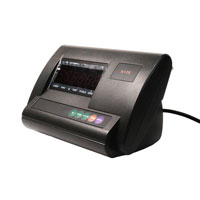 |
Power Supply: Built-in 6V/4AH rechargeable battery Display: LED red digital display Communication: 5-pin Vibration-resistant & Long-battery |
$222.79 |
| ATO-WI-E360 | 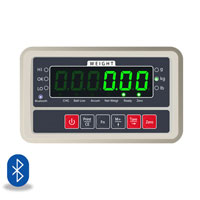 |
Power Supply: 5V 1000 mA Display: 6-digit LED Digital Tube Interface: USB-B Wireless-connectivity & Portable |
$143.97-160.15 |
| ATO-WI-GSI404 | 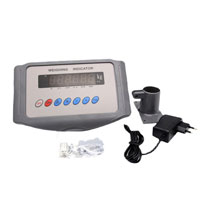 |
Power Supply: AC 100–240V Display: 0.8-inch red LED Interface: Print/ RS485/ 4-20mA/ WiFi Multi-interface & Industrial-grade |
$133.38-324.56 |
| ATO-WI-E218W | 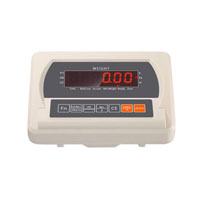 |
Power Supply: 220V, 50Hz AC Display: 6-digit LED Digital Tube Interface: Wired (1–8 sensors) Platform-scale & Basic-display |
$118.82 |
| ATO-WI-XK3109 | 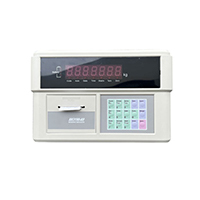 |
Power Supply: DC 5V Display: 7 bits LED Input Signal Range: -16 mV to 18 mV Print-enabled & High-precision |
$333.68 |
| ATO-WI-280P | 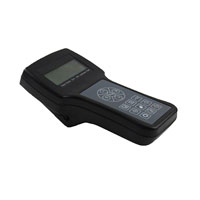 |
Power Supply: Battery ≥50 h Display: LCD screen Interface: RS232 Remote-transmission & Multi-unit |
$289.26 |
Why Choose ATO Weighing Indicators
Choosing a reliable weighing indicator is critical for consistent, high-quality weighing results. ATO industrial weighing indicators are designed for global applications and offer features that support accuracy, connectivity, and durability.
1. High Accuracy and Measurement Stability
ATO digital weighing indicators feature advanced A/D conversion technology and high-resolution signal processing to ensure precise measurement. Calibration remains stable over time, even under heavy loads or continuous operation. These high-precision weighing indicators are ideal for truck scales, platform scales, and weighbridge systems in industrial environments across the USA, Europe, and Southeast Asia.
2. Smart Connectivity for Automation
Our indicators support multiple communication interfaces, including RS232, RS485, USB, WiFi, and Bluetooth, enabling seamless integration with PLCs, SCADA systems, printers, and computers. These features make ATO indicators perfect for factory automation, industrial data collection, and remote monitoring.
3. Built for Tough Industrial Environments
Designed for harsh industrial conditions, weighing indicators provide robust construction, clear LED/LCD displays, wide operating temperature ranges, and multiple power supply options. They ensure reliable performance indoors and outdoors and are widely used in logistics, manufacturing, agriculture, and infrastructure projects worldwide.
Selecting the right weighing indicator is more than just matching specifications — it’s about ensuring long‑term accuracy, connectivity, and reliability in your weighing system. The ideal indicator not only delivers precise measurements under diverse conditions but also integrates seamlessly with your existing setup, whether it’s a factory automation line, logistics scale, or industrial platform system. By understanding your performance requirements, prioritizing essential functions like communication interfaces and environmental resilience, and evaluating real‑world applications, you can confidently choose a model that meets both technical demands and operational expectations. With ATO’s range of digital weighing indicators designed for global industrial use, you gain a solution engineered for stability, flexibility and efficiency — giving you peace of mind today and value for years to come.
