
What is a Differential Pressure Sensor?
A Differential Pressure Sensor (DP sensor) measures the pressure difference (ΔP) between two points and converts it into a standard 4–20mA or digital signal for PLC and DCS systems.
In real plant work, engineers often search for issues like “why is my DP sensor reading drifting,” “DP reading fluctuation causes,” or “impulse line blockage troubleshooting.” In most cases, the problem is not the transmitter itself, but installation conditions, impulse lines, or process instability.
This guide combines real industrial experience with core technical principles to help you understand, diagnose, and select DP sensors more effectively.
Contents:
- How a Differential Pressure Sensor Works
- Differential Pressure Sensor vs. Pressure Sensor
- Application of a Differential Pressure Sensor
- Main Types of a Differential Pressure Sensor
- How to Select a Differential Pressure Sensor
- Differential Pressure Sensor Troubleshooting
- Differential Pressure Sensor FAQs
- Conclusion
How a Differential Pressure Sensor Works
A Differential Pressure Sensor converts pressure differences into standard electrical signals used in PLC and DCS control systems.
It has two ports:
- High Pressure (H)
- Low Pressure (L)
Pressure applied on both sides acts on a sensing diaphragm. The diaphragm deflects toward the lower-pressure side, and this movement is converted into an electrical output signal.
In real industrial environments, unstable readings are rarely caused by the sensor core. More often, engineers trace the issue back to:
- impulse line blockage
- temperature variation
- process pulsation
- improper installation
Most modern DP transmitters include temperature compensation and damping functions, but these only reduce—not eliminate—field effects.
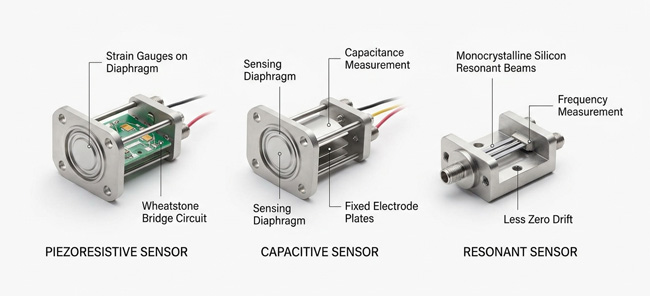
Three Main DP Sensor Technologies
- Piezoresistive Differential Pressure Sensor: Most widely used type. Cost-effective and suitable for general industrial applications. However, long-term temperature stress may cause slight zero drift in harsh environments.
- Capacitive Differential Pressure Sensor: Best for low-pressure or small differential ranges. Capacitive differential pressure transmitter is widely used in cleanrooms and pharmaceutical isolator systems due to high sensitivity and stable micro-pressure response.
- Resonant Differential Pressure Sensor: Designed for high stability and long-term zero retention. Common in custody transfer systems, gas processing skids, and high-accuracy industrial measurement.
 Pro Tip: DP sensor stability depends more on process conditions and installation quality than sensing principle alone.
Differential Pressure Sensor vs. Pressure Sensor
A regular pressure sensor measures pressure at a single point, while a DP sensor measures the difference between two points.
| Comparison Item | Regular Pressure Sensor | Differential Pressure Sensor |
| Measurement Object | Single-point gauge pressure (vs. atmosphere) or absolute pressure (vs. vacuum) | Pressure difference (ΔP) between two separate points |
| Mechanical Interface | One single pressure port | Two independent ports (High H + Low L) |
| Primary Applications | Hydraulic systems, boilers, gas cylinders, tank top pressure | Flow measurement, tank level, filter clogging, cleanroom pressurization |
Pro Tip: Many think high background static pressure damages the sensor most. In reality, what matters is the pressure difference between the two sides. As long as static pressure stays below the sensor’s rated limit, output remains stable.
Application of a Differential Pressure Sensor
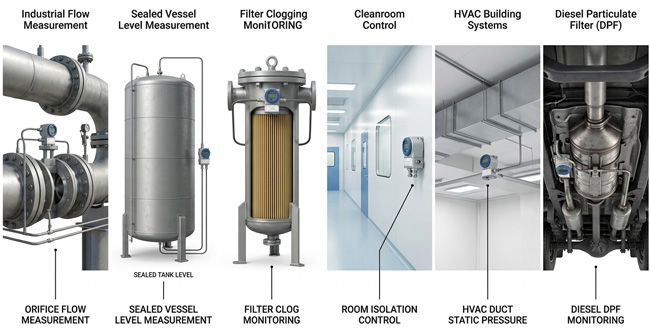
- Industrial Flow Measurement: Paired with orifice plates or Venturi tubes. It detects the pressure drop across the restriction and helps calculate real-time flow rate.
- Sealed Vessel Level Measurement: Uses dual impulse lines — one at the bottom liquid and one at the top gas space. It calculates level based on the pressure difference and medium density, even when tank pressure fluctuates.
- Filter Clogging Monitoring: Installed before and after the filter. Rising pressure difference signals clogging and triggers alerts for cleaning or replacement.
- Cleanroom Differential Pressure Control: Monitors tiny pressure differences between rooms to maintain directional airflow and prevent cross-contamination in pharma, hospitals, and semiconductor facilities.
- HVAC Building Systems: Tracks duct static pressure and filter drops to optimize fan speeds and air quality in VAV systems. A suitable differential pressure transmitter for HVAC is commonly used in these applications.
- Diesel Particulate Filters (DPF): Measures pressure drop across the soot trap to help the ECU decide when to trigger regeneration.
Main Types of a Differential Pressure Sensor
- Micro-Differential Pressure Sensor: Handles very low ranges (a few Pa to hundreds Pa). Great for cleanrooms, HVAC ducts, and lab wind tunnels due to high sensitivity.
- Industrial-Grade Differential Pressure Sensor: The most common type, engineered with wide measuring spans, robust temperature compensation, and strong electromagnetic interference (EMI) protection. As a standard Differential Pressure Sensor, it is ideal for everyday pipeline flow and tank level monitoring.
- High-Static-Pressure Differential Pressure Sensor: Built to handle very high background pressures — common in deep-sea oil, offshore pipelines, and high-pressure reactors.
- Explosion-Proof Differential Pressure Sensor: With Ex d or Ex ia certification and robust enclosures. Required in petrochemical plants, chemical facilities, and gas stations.
- Hygienic Differential Pressure Sensor: Crevice-free design for CIP/SIP cleaning. Used in food, beverage, and sterile pharma production.
How to Select a Differential Pressure Sensor
- Step 1: Define the Measuring Range — Keep normal operating pressure difference in the 30%–70% of full scale range for best performance and safety.
- Step 2: Assign the Required Accuracy Class — ±0.5% FS works for most plants; choose ±0.1% FS for critical metering or high-precision control.
- Step 3: Check Media-to-Material Compatibility — Stainless steel for normal fluids; use Hastelloy or Tantalum for corrosive media.
- Step 4: Audit Environmental and Interference Risks — Consider temperature, vibration, and EMI from VFDs or motors. Pick shielded, rugged models when needed.
- Step 5: Pick the Signal Transmission Architecture — 4–20 mA for simple long-distance transmission; RS-485 (Modbus) for smart factory networking.
- Step 6: Match Mechanical Process Connections — Choose threaded, flanged, or tri-clamp fittings to match your pipes and prevent leaks.
Differential Pressure Sensor Troubleshooting
Here is a clear and organized summary of the most common faults, causes, and solutions for differential pressure sensors:
| Fault | Description | Common Causes | Troubleshooting Steps |
| Fault 1 | Output Shift (Zero Drift or Span Error) | Temperature swings, over-tightened bolts |
|
| Fault 2 | No Output Signal | Wrong polarity, loose wires, blown fuses |
|
| Fault 3 | Output Stuck at Maximum or Minimum | Blocked impulse lines, ruptured diaphragm (one-sided overpressure) |
|
| Fault 4 | Unstable Output Signal | Air bubbles or condensate in impulse lines, process pulsation |
|
Pro Tip: Always isolate the process and vent both high and low pressure sides before performing zero trim or maintenance. This simple habit prevents many diaphragm ruptures and extends the life of your differential pressure sensor. Regular purging of impulse lines is also highly recommended in humid or condensing environments.
Differential Pressure Sensor FAQs
Got questions about running or maintaining your differential pressure sensor? Here are quick answers to the most common issues engineers run into.
Q: What is the correct 3-valve manifold sequence?
A: Open equalizing valve first → open high-pressure valve → open low-pressure valve → close equalizing valve. Reverse when shutting down.
Q: Can a Differential Pressure Sensor measure vacuum pressure?
A: Yes, bidirectional models are capable of measuring both negative and positive pressure differentials.
Q: Why is the output not zero at zero pressure?
A: This is usually caused by thermal zero drift or mechanical mounting stress. Perform a zero-point trim with both sides equalized.
Q: How often does a Differential Pressure Sensor need calibration?
A: For standard industrial use, calibrate every six months to one year. High-accuracy or custody transfer applications may require shorter intervals based on observed drift.
Conclusion
A Differential Pressure Sensor is widely used for flow measurement, tank level monitoring, filtration systems, and air pressure control in cleanrooms and HVAC. Most measurement issues are caused by incorrect range selection, material mismatch, or problems with the impulse lines.
Understanding these basics helps you choose the right sensor and keep it running smoothly with fewer headaches on the production line.
Need specific model recommendations or datasheets? Visit the ATO Automation Store to explore DP sensor solutions.
