
What is an Angle Sensor?
An angle sensor is a device designed to measure how far something has rotated from a reference position. It converts angular movement into an electrical signal that can be interpreted by control systems, allowing accurate tracking of position and motion. In practical use, angle sensors play an important role in systems that require precise movement control and feedback. They help monitor rotational positions in real time, ensuring that mechanical parts move to the correct angle and stay within required limits. This makes them essential in automation equipment, robotics, motor control systems, and various industrial applications. By providing continuous and accurate angular data, angle sensors help improve system stability, positioning accuracy, and overall control performance.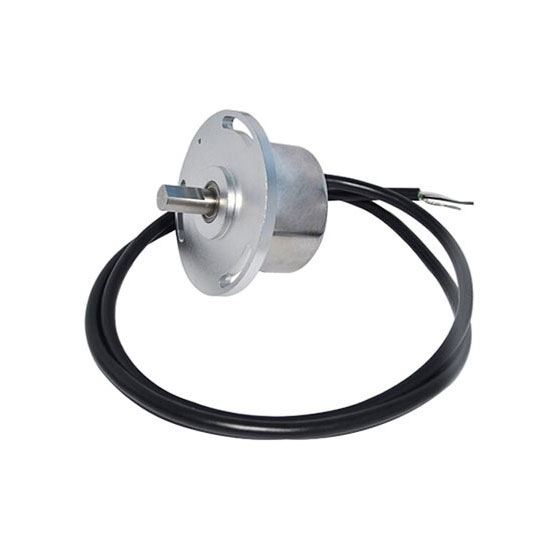
Table of Contents
- Angle Sensors Working Principle
- Types of Angle Sensors
- Angle Sensor Key Specifications
- Angle Sensors Applications
- Industrial Angle Sensor Solutions
- Angle Sensor Selection Guide
- Conclusion
- FAQ
Angle Sensors Working Principle
The core principle of an angle sensor is to convert mechanical angular movement into an electrical signal for measurement and control. Different technologies are used depending on the application:
- Magnetic Principle: Magnetic field variations are used to detect rotational position. This non-contact method offers high reliability and long service life.
- Optical Principle: An optical encoder disk and sensor detect changes in light patterns to determine angular position. This method provides high resolution and accuracy.
- Capacitive Principle: Changes in capacitance caused by rotation are measured to determine angular position. This method is suitable for high-precision and harsh environments.
- Potentiometric (Resistive) Principle: A sliding contact changes resistance as the shaft rotates, producing a voltage output proportional to the angle. This type is simple and cost-effective but subject to mechanical wear.
Types of Angle Sensors
Angle sensors come in different types depending on how they measure rotation and how they output position data. Each type is designed for specific working conditions, balancing factors such as cost, accuracy, durability, and system requirements. Understanding these differences helps in selecting the most suitable sensor for a particular application.
Contact Type Angle Sensors
Contact angle sensors measure rotation through physical contact between moving components.
Advantages: Low cost, simple structure, easy integration.
Limitations: Mechanical wear, shorter lifespan, lower long-term accuracy.
Best for: Basic position sensing and cost-sensitive applications.
Non-contact Angle Sensors
Non-contact angle sensors measure angular position using magnetic, optical, or capacitive technologies without physical contact.
Advantages: High reliability, long service life, high precision, low maintenance.
Limitations: Higher cost and possible sensitivity to environmental interference depending on technology.
Best for: Industrial automation, robotics, and high-precision motion systems.
Absolute Angle Sensors
Absolute angle sensors provide a unique position value for every angle and retain position information after power loss.
Advantages: No re-calibration required, accurate startup position, high reliability.
Limitations: Higher cost and more complex system design.
Best for: CNC machines, robotics, aerospace, and servo systems.
Incremental Angle Sensors
Incremental angle sensors generate pulse signals to indicate rotational movement and require a reference position after restart.
Advantages: Cost-effective, high resolution, fast response speed.
Limitations: Position loss after power interruption and need for homing.
Best for: Motor control, conveyors, and speed monitoring systems.
Angle Sensor Key Specifications
The performance of an angle sensor is defined by several key specifications that determine its measurement capability, response behavior, and environmental adaptability.
- Accuracy: The deviation between the measured angle and the actual physical position.
- Resolution: The smallest detectable change in angular position.
- Response Time: The time required for the sensor to output a valid signal after movement.
- Protection Rating: The level of resistance to dust, water, and harsh environmental conditions (e.g., IP ratings).
- Output Signal Type: The format of the output signal, including analog (0–5V, 4–20mA) or digital interfaces (PWM, CAN, SSI, etc.).
- Measurement Range: The maximum measurable rotation angle, such as 0–360° or multi-turn capability.
Angle Sensors Applications
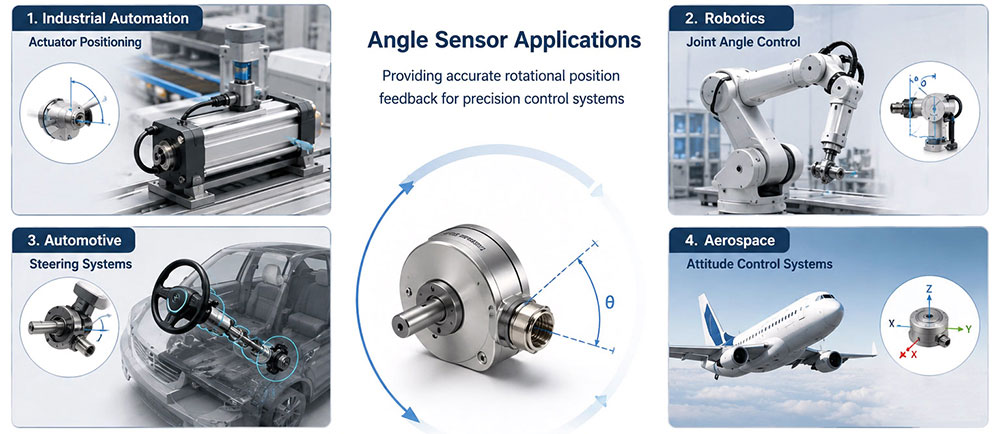
Angle sensors are widely used in industrial and precision control systems to provide rotational position feedback. Typical applications include industrial automation equipment for actuator positioning, robotics for joint angle control, automotive steering systems, aerospace attitude control systems, medical devices for position monitoring, and renewable energy systems such as wind turbine blade positioning and solar tracking systems.
Industrial Angle Sensor Solutions
In industrial projects, different types of angle sensors are selected based on accuracy, environment, and output requirements. Industrial-grade non-contact and absolute rotary sensors are widely used in automation and motion control systems. For practical applications and product selection, explore our Industrial Angle Sensor Solutions: ATO one-stop automated industrial store angle sensor series.
| Model | Measuring Range | Accuracy | Operating Temperature | Protection Grade |
| ATO-AS-105 | 0~360° | ±0.3° | -40°C~+85°C | IP66 |
| ATO-AS-CW360 | 0~360° | Standard: 0.2% | -30°C ~ +80°C | IP40 |
| ATO-AS-GTC | 0~360° | 0.15%FS | -30℃~+80℃ | IP65 |
| ATO-AS-TAH12 | 0~120° | ±2% | -40℃~+125℃ | IP67 |
| ATO-AS-TAH11 | 0~120° | ±2%FS | -40℃~125℃ | IP67 |
Angle Sensor Selection Guide
When selecting an angle sensor, several factors should be considered based on application requirements:
- First, determine the required measurement range to match system motion.
- Second, select the appropriate accuracy level depending on control precision needs.
- Third, ensure compatibility of the output signal with the control system, such as analog or digital interfaces.
Environmental conditions such as temperature, humidity, and protection rating should also be evaluated. Finally, choose between contact and non-contact technologies based on cost, durability, and lifespan requirements.
Conclusion
An angle sensor is a critical measurement and feedback device that converts rotational motion into electrical signals for precise monitoring and control of mechanical systems.
With the development of industrial automation and intelligent control systems, angle sensors are increasingly required to deliver higher accuracy, stability, and environmental adaptability. Their applications continue to expand across industrial, automotive, robotics, and renewable energy sectors.
FAQ
Q1: What is the function of an angle sensor?
An angle sensor measures rotational position and converts it into an electrical signal for control system feedback.
Q2: What is the difference between an angle sensor and an encoder?
An angle sensor provides direct angular position measurement, while an encoder generates pulse signals used to calculate position and speed.
Q3: Can angle sensors measure continuous rotation?
Some absolute multi-turn angle sensors can measure continuous rotation beyond 360 degrees.
Q4: What are the advantages of non-contact angle sensors?
Non-contact sensors have no mechanical wear, offer longer service life, and provide higher reliability.
Q5:What output signals do angle sensors use?
Common outputs include analog voltage signals, 4–20mA current signals, and digital interfaces such as CAN or SSI.
