
Residual Current Circuit Breaker Working Principle
A Residual Current Circuit Breaker (RCBO) is an advanced electrical safety device that integrates both earth leakage protection and overcurrent protection in a single unit. It is widely used in modern power distribution systems across residential, commercial, and industrial environments. Its working principle is based on real-time monitoring of the electrical current flowing through the live (L) and neutral (N) conductors. By continuously comparing the current balance between these two paths, the RCBO can quickly detect abnormal conditions such as leakage current, overload, or short circuit. When an imbalance or fault is identified, the device automatically trips and disconnects the circuit, ensuring effective protection for both electrical equipment and personnel safety.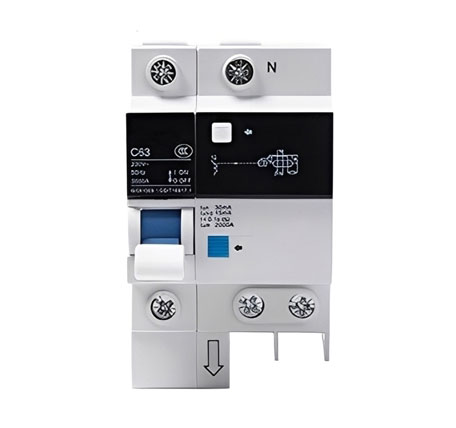
Table of Contents
- Working Principle of an RCBO
- Core Components of a Residual Current Circuit Breaker
- Key Functions of RCBO
- RCBO vs MCB vs RCD
- Types of RCBO
- Applications of RCBO
- Industry Standards for RCBO
- Common Problems RCBO Helps Prevent
- Conclusion
- FAQ
Working Principle of an RCBO
The RCBO ensures electrical safety by continuously monitoring the balance of current between the live (L) and neutral (N) conductors in an electrical distribution system. This continuous comparison allows the device to detect abnormal current conditions and react quickly to electrical faults.
Normal Operating Condition
Under normal operating conditions, the electrical system remains balanced:
- The current flowing into the circuit is equal to the current returning through the neutral conductor
- No residual (leakage) current is present in the system
- The internal magnetic balance of the RCBO remains stable
- The device stays in the ON position and allows continuous power supply
This indicates that the circuit is operating safely without any fault condition.
Leakage Fault Detection (Earth Leakage Protection)
When a leakage fault occurs, part of the electrical current flows unintentionally to earth instead of returning through the neutral path. This condition is known as residual current.
Common causes include:
- Insulation failure in cables or equipment
- Damaged or aged wiring
- Accidental human contact with live conductors
Detection process:
- A differential current transformer inside the RCBO continuously compares L and N currents
- When an imbalance is detected, a residual current is generated
- If the leakage current exceeds a preset sensitivity level (typically 30mA for human protection), the tripping mechanism is activated
- The circuit is disconnected immediately to prevent electric shock or fire hazards
This mechanism ensures fast response to earth leakage faults.
Overcurrent Protection Mechanism
In addition to leakage protection, RCBO also provides overcurrent protection using a thermal-magnetic system.
- Protection Type Cause Working Mechanism Result
- Overload Long-term excessive current Thermal bimetal heats and bends Delayed tripping
- Short Circuit Sudden high fault current Magnetic coil activates instantly Immediate tripping
This dual mechanism allows RCBO to respond to both slow-developing and sudden electrical faults.
Integrated Protection Principle
The RCBO combines two independent protection systems within a single device:
- Residual current detection for earth leakage protection
- Thermal-magnetic mechanism for overcurrent protection
These two systems operate independently but act together to ensure complete electrical protection.As a result, RCBO provides reliable protection for residential, commercial, and industrial electrical distribution systems.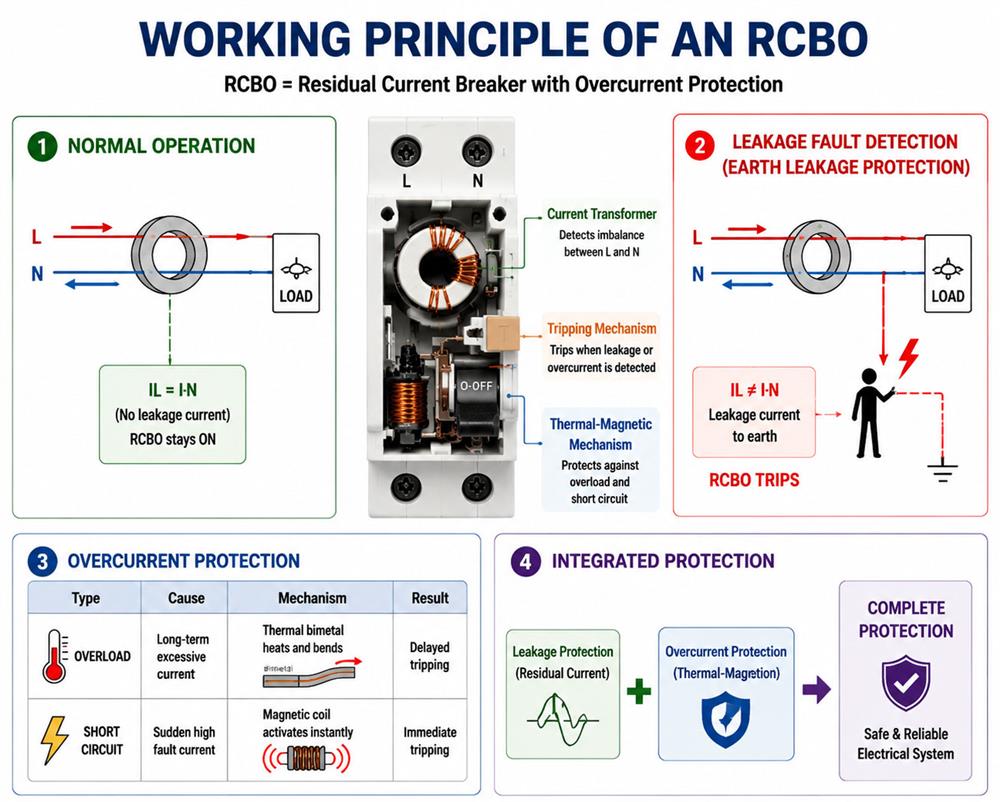
Core Components of a Residual Current Circuit Breaker
A Residual Current Circuit Breaker (RCBO) is a key electrical protection device designed to detect leakage current and automatically disconnect the circuit when a fault occurs. It integrates several functional modules that work together to ensure safe and reliable operation in both industrial and residential applications. To better understand its internal structure and working logic, the following table provides a clear overview of the core components, including their functions, structures, working principles, and roles in the protection process.
| Component | Function | Structure / Key Parts | Working Principle | Output / Role |
| Zero Sequence Current Transformer (ZSCT) | Detects leakage current by monitoring current balance between L and N | Ring-shaped magnetic core; L & N conductors pass through core forming closed magnetic circuit | No leakage = zero magnetic flux; leakage = induced voltage proportional to residual current | Sends leakage signal to control circuit |
| Electronic Control Circuit | Processes leakage signal and determines fault condition | Amplifiers, filters, comparators | Compares signal with preset threshold and evaluates leakage status | Sends trip command to mechanism |
| Leakage Trip Mechanism | Cuts off power during leakage fault | Electronic (semiconductors) or electromagnetic (coil system) | Receives control signal and triggers instant circuit disconnection | Physically disconnects power supply |
| Test and Reset Buttons | Enables testing and manual recovery | Built-in mechanical buttons on RCBO housing | Test simulates leakage; Reset restores normal operation | Ensures operational safety and maintenance |
| Auxiliary Components | Provide mechanical support and electrical insulation | Housing, terminals, operating handle, locking mechanism | Supports installation and stable switching operation | Ensures durability and safe operation |
After understanding the table above, it is clear that each component of the RCBO plays a specific and essential role in the overall protection system. From leakage detection by the ZSCT, signal processing through the electronic control circuit, to final disconnection via the trip mechanism, all parts work together to ensure fast and reliable fault response. In practical applications, regular testing using the test button is recommended to ensure that the RCBO remains in proper working condition and provides continuous protection for electrical systems.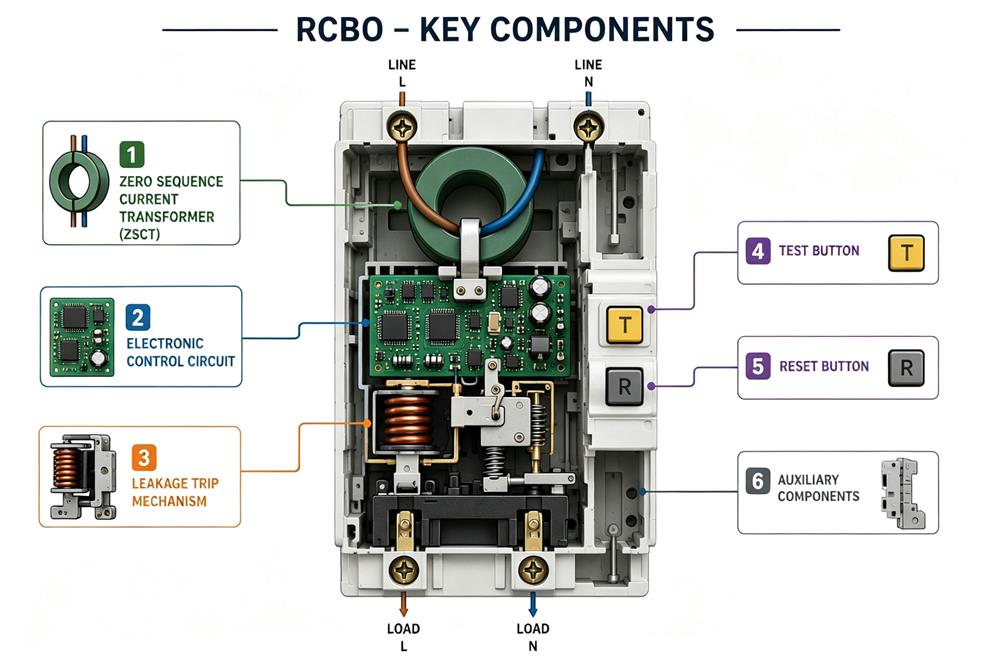
Key Functions of RCBO
The RCBO is designed to provide multiple layers of electrical protection in a single device, ensuring safe and reliable operation of electrical distribution systems.
- Earth leakage protection (shock prevention): The RCBO continuously monitors the balance between live and neutral conductors, and quickly disconnects the circuit when leakage current is detected, helping to prevent electric shock hazards.
- Overload protection: When the electrical current exceeds the rated capacity for a prolonged period, the thermal element inside the RCBO responds by triggering a delayed trip to protect cables and equipment from overheating.
- Short circuit protection: In the event of a sudden high fault current, the magnetic mechanism inside the RCBO activates instantly to isolate the faulty circuit and prevent severe damage.
- Automatic circuit disconnection during faults: The RCBO automatically cuts off power supply when abnormal conditions are detected, ensuring fast system response and reducing safety risks.
- Improved safety for end-users and equipment: By combining leakage and overcurrent protection, the RCBO enhances overall electrical safety and reduces the risk of fire, electric shock, and equipment failure.
RCBO vs MCB vs RCD
Understanding the differences between protection devices is essential for selecting the right solution for any electrical system.
| Device | Protection Function | Typical Application | Key Notes |
| MCB | Overload + short circuit | Basic circuit protection | Protects wiring and devices from excessive current but does not detect earth leakage |
| RCD | Earth leakage only | Shock protection | Protects people from electric shock but does not prevent overload or short circuits |
| RCBO | Leakage + overload + short circuit | Full circuit protection | Combines both RCD and MCB functions, providing comprehensive protection for circuits and end-users |
Explanation:
RCBOs are widely considered the most complete protection device for end-use circuits because they simultaneously detect earth leakage, overload, and short-circuit conditions. This makes them ideal for residential, commercial, and industrial applications where both personnel safety and equipment protection are required.
Types of RCBO
RCBOs (Residual Current Circuit Breakers with Overcurrent protection) are available in different types based on the residual current they can detect and the types of loads they protect. Selecting the correct RCBO type is essential to ensure safe and reliable electrical system operation.
Type AC RCBO
Type AC RCBOs are designed to detect pure AC residual currents only, which makes them suitable for conventional electrical systems where leakage currents remain purely sinusoidal.
- Suitable for basic residential electrical circuits.
- Commonly used in lighting systems and standard household appliances.
- Provides basic leakage protection where DC components are negligible.
- Recommended for simple applications with stable AC loads.
Type A RCBO
Type A RCBOs are capable of detecting both AC residual currents and pulsating DC residual currents, making them suitable for modern electrical environments with electronic loads.
- Suitable for modern household appliances and electronic devices.
- Common applications include washing machines, LED drivers, and small electronic equipment.
- Provides enhanced protection for circuits with mixed AC and DC leakage components.
- Recommended for most modern residential and light commercial installations.
Type B RCBO
Type B RCBOs are the most advanced type, designed to detect AC, pulsating DC, and smooth DC residual currents, ensuring full protection in complex electrical environments.
- Suitable for advanced industrial and technical applications.
- Commonly used in EV charging stations, photovoltaic systems, and industrial drives.
- Provides full protection against all types of leakage currents, including continuous DC.
- Essential for systems involving power electronics and variable frequency drives.
Selection Recommendation
- Type AC is suitable for simple and traditional electrical installations with purely resistive or non-electronic loads.
- Type A is recommended for most modern residential and commercial environments where electronic devices are widely used.
- Type B is required for industrial, renewable energy, and electric vehicle infrastructure where complex power electronics and DC components are present.
Applications of RCBO
RCBOs are widely used to provide comprehensive protection in a variety of electrical systems. They are essential wherever both personnel safety and equipment protection are required.
Residential electrical distribution systems: RCBOs safeguard household circuits by preventing electric shock and protecting wiring from overload or short circuit.
Industrial control panels: In industrial environments, RCBOs protect complex control circuits and automation systems from both overcurrent and residual current faults.
HVAC and pump systems: Heating, ventilation, air conditioning, and pump systems often involve high-power motors and multiple loads, making RCBO protection crucial to prevent equipment damage and downtime.
EV charging stations: With increasing adoption of electric vehicles, RCBOs are critical to prevent leakage hazards in charging infrastructure, ensuring both user safety and regulatory compliance.
CNC and automation equipment: In precision machinery and industrial automation, RCBOs protect both operators and sensitive equipment from electrical faults that could cause damage or production interruptions.
Commercial buildings and office power systems: In offices and commercial spaces, RCBOs ensure safety across multiple circuits, protecting sensitive equipment and occupants from leakage currents.
Industrial environment note:
In factories and industrial settings, where multiple high-power loads operate simultaneously and wiring systems are complex, the risk of residual current faults is higher. RCBOs provide fast, reliable detection and disconnection, minimizing downtime and enhancing overall safety.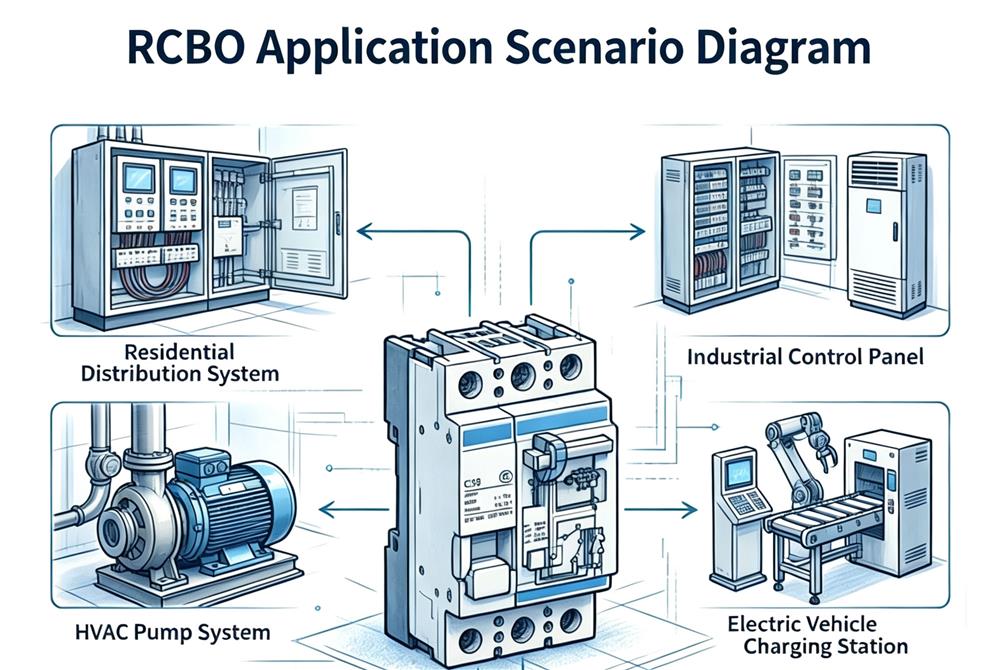
Industry Standards for RCBO
The design, performance, and safety of RCBOs are typically governed by international standards to ensure reliable protection in electrical systems. Two widely recognized standards are:
- IEC 61009: Specifies requirements for RCBOs including tripping characteristics, residual current detection sensitivity, and operational reliability. It ensures that devices provide consistent protection for both overload and earth leakage conditions in residential, commercial, and industrial applications.
- IEC 61008: Defines performance and safety requirements for residual current devices without overcurrent protection. It serves as a reference for evaluating the electrical safety of RCBOs, especially in terms of leakage sensitivity and response time.
By complying with these standards, manufacturers ensure that RCBOs deliver predictable protection, meet global safety regulations, and are suitable for a wide range of electrical distribution systems.
Common Problems RCBO Helps Prevent
RCBOs are designed to enhance electrical safety by detecting abnormal current conditions and disconnecting the circuit before serious damage or injury occurs. They help prevent several critical electrical hazards in residential, commercial, and industrial systems.
- Electric shock caused by insulation failure: When insulation breaks down, leakage current may flow through unintended paths such as metal enclosures or human contact. The RCBO detects this residual current imbalance and quickly disconnects the circuit, reducing the risk of electric shock.
- Fire hazards due to leakage currents: Small but continuous leakage currents can generate heat over time, especially in damaged or aged wiring systems. RCBOs monitor current balance and cut off the supply when leakage exceeds safe limits, helping prevent electrical fires.
- Equipment damage from overload or short circuit: Excess current caused by overload or sudden short circuits can damage sensitive electrical equipment. The thermal-magnetic protection inside the RCBO reacts to these conditions and isolates the faulted circuit immediately.
- Unstable power distribution in industrial panels: In complex industrial systems with multiple loads, electrical imbalances or faults can affect overall system stability. RCBOs improve reliability by isolating faulty circuits without affecting the entire distribution network.
Conclusion
In modern electrical systems, RCBOs play a critical role in ensuring comprehensive protection against earth leakage, overload, and short-circuit faults. By combining residual current detection with thermal-magnetic overcurrent protection, they help improve system safety, reduce equipment failure risks, and enhance overall operational reliability across residential, commercial, and industrial applications. Selecting the right RCBO type based on load conditions and installation requirements is essential for achieving stable and safe power distribution.
For more technical details and product specifications, you can explore the full range of RCBOs and electrical protection devices at ATO Industrial Automation to find the right solution for your application needs.
FAQ
Q1: What is the main function of an RCBO?
An RCBO provides protection against earth leakage, overload, and short circuit faults by automatically disconnecting the circuit when abnormal current is detected.
Q2: Why does an RCBO trip frequently?
Frequent tripping is usually caused by leakage current, faulty appliances, damaged insulation, or unstable electrical loads. When the current imbalance exceeds the rated sensitivity, the RCBO will trip.
Q3: Can an RCBO replace both an MCB and an RCD?
Yes. An RCBO combines MCB (overcurrent protection) and RCD (earth leakage protection) in one device.
Q4: Where should an RCBO be installed?
It is typically installed at the final distribution level to protect individual circuits and improve fault isolation.
